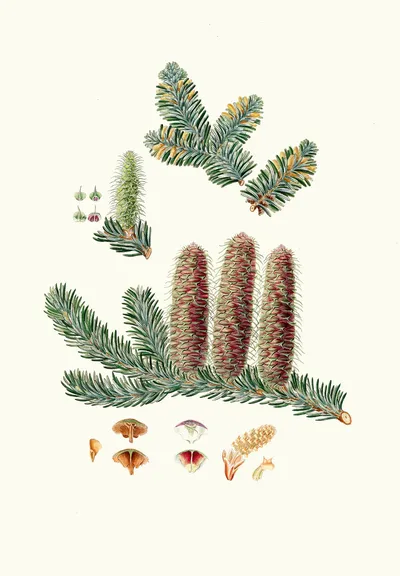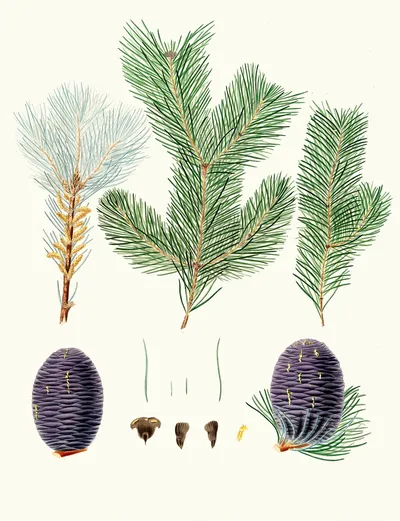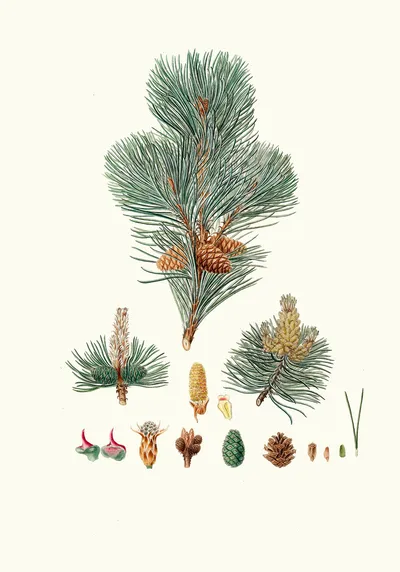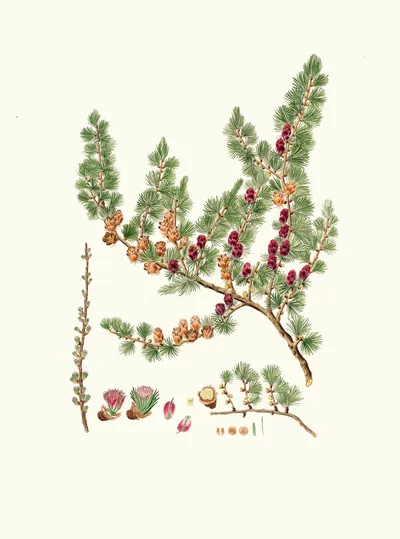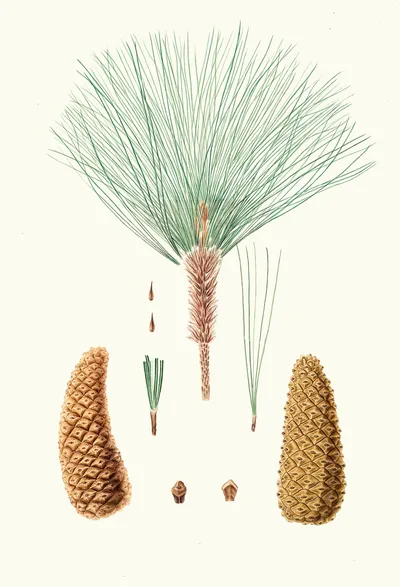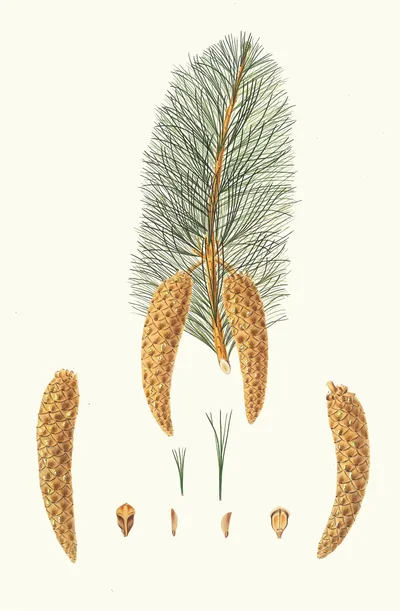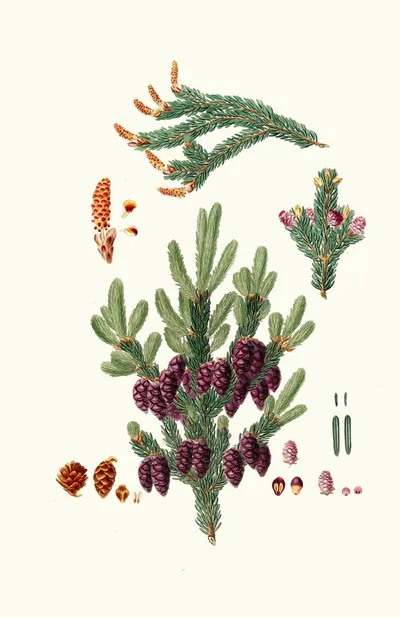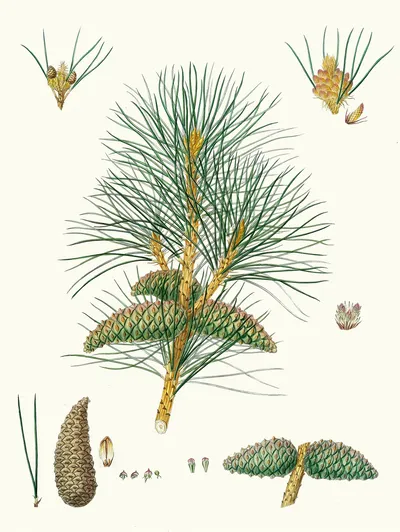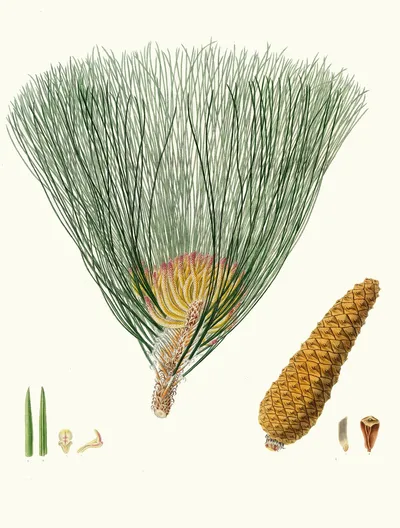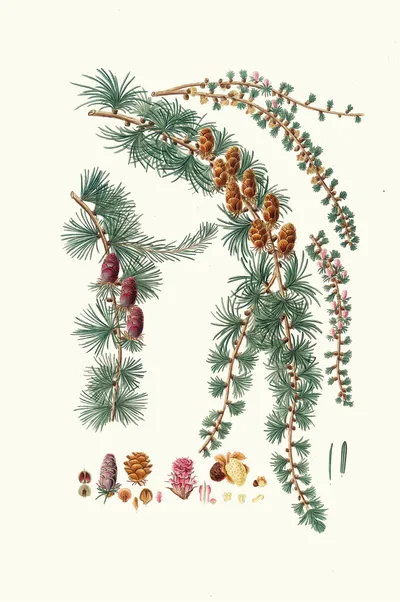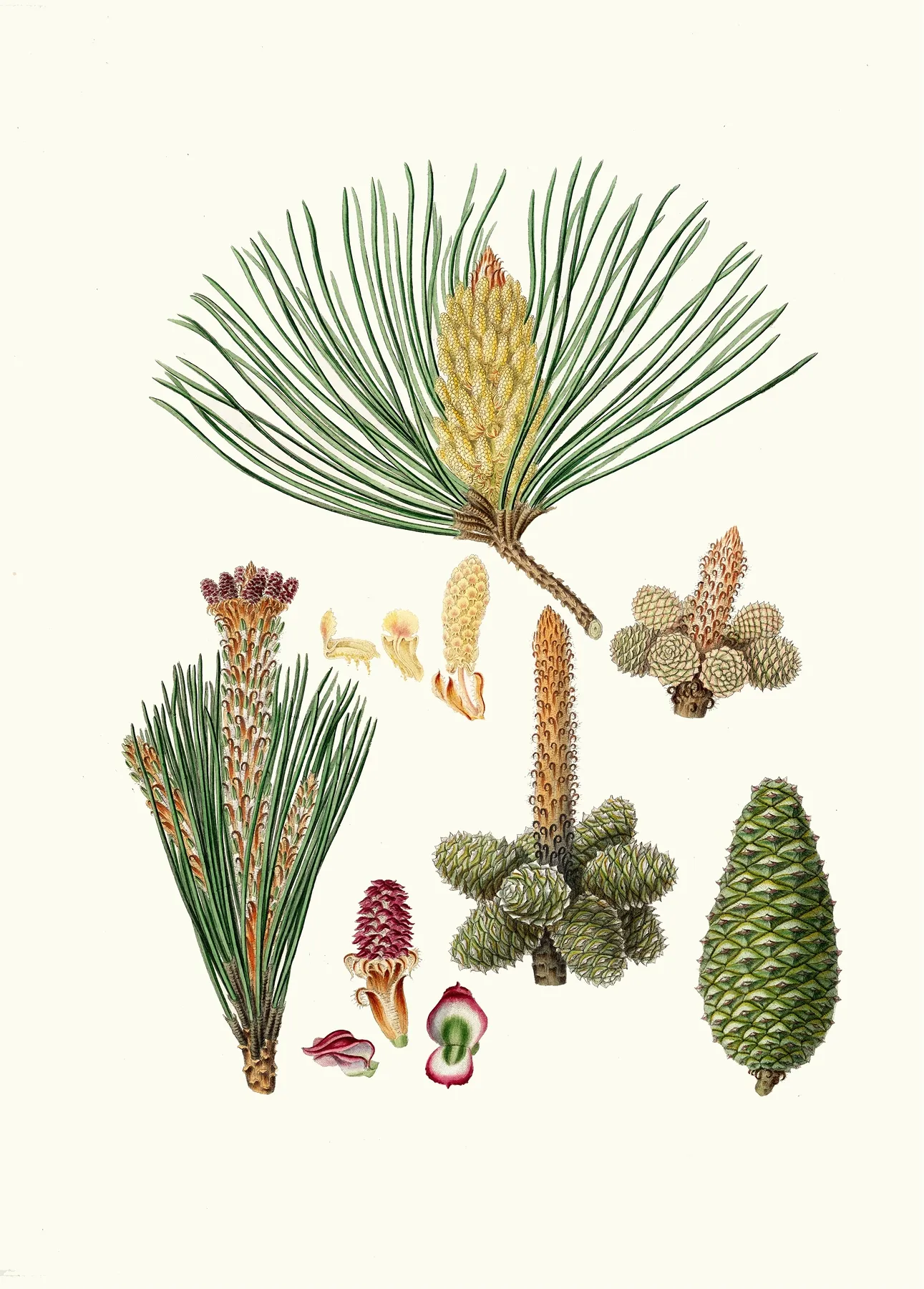
Pinus pinaster = The pinaster, or Cluster pine (1837)
Ten ways of seeing
- upright 1.39 : 1
First Look
江馆清秋,晨起看竹,烟光日影露气,皆浮动于疏枝密叶之间。
—— 清·郑板桥《题画竹》
On an autumn morning at the river lodge I looked at the bamboo: mist, sunlight, dew, all drifting among the sparse and dense leaves.
The sheet is vertical: the eye climbs and settles in the upper half. Let the plant stand before you look for detail. Then step in close: watch where colour meets line, and whether the line ever breaks. Third, find the darkest small patch: the whole tonal order is measured from there.
Name and Thing
No reliable binomial survives, so the printed title must serve. Neither name nor binomial survives: the printed title must do.
Form and Colour
Chrysanthemums are herbaceous with deeply lobed, downy leaves. Each 'flower' is a head — ray florets around the rim, disc florets in the centre, hundreds of small flowers in one.No colour group is recorded. Read the outline, then the colour layers, then the brush.
Composition
Tall and narrow, the plant rising in one movement with generous margins — the upright format of most floras. No details are appended: a plate for looking, not for keying out. Old plates set the plant slightly off centre, with unequal margins — that small imbalance is what keeps it alive.
Line and Colour
The first half of the nineteenth century moved from copper to steel to lithography; stipple could render the softest transition. There is evidence on the back too: the plate mark pressed into the paper, the slight relief of the pigment, lines worn shallow in a later printing. If you mean to copy it: take its skeleton, its margins and the order of its colours; the burin's hatching is the language of copper — suggest it with pencil density, do not imitate it stroke for stroke.
Poetic Resonance
乌桕微丹菊渐开,天高风送雁声哀。
—— 《秋思·乌桕微丹菊渐开》
The poem gives the mood first and the picture supplies the form; set the line beside the plate and the corolla becomes its resting point.
Symbolism
In China, seclusion and long life — and, after Tao Yuanming, the will to go home; in Japan, imperial authority. Meanings change their tune: the same flower can say opposite things within a century.
Season and Place
Deep autumn, around the Double Ninth in the ninth month — after the first frost, when everything else is gone. Native to China, adopted in Japan as the imperial crest, carried to Europe by the Dutch in the seventeenth century and remade by Victorian breeders. The year 1837 on the plate is that of publication, not of flowering — the gathering came a year or two earlier. The bud and the ripe fruit on one branch tell the season; the name in the title often tells the journey.
The Book and the Hand
“A Description of the Genus Pinus” carries only Aylmer Bourke Lambert's name. From drawing to plate the sheet passed through several hands — the engraver aimed at accuracy, the colourist at speed, and between them lies each plate's unevenness.
What to Take Away
If you keep one line, keep Guo Xi's: from afar its momentum, up close its texture. The flower of that year is dust, yet its image on paper has outlived every living cousin.