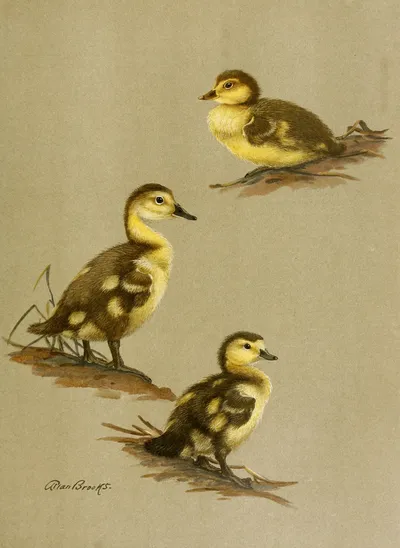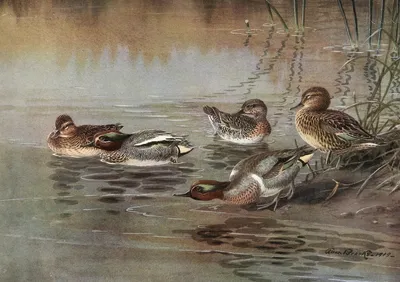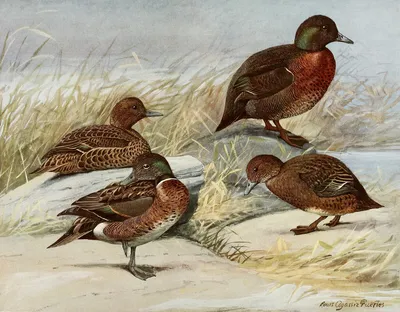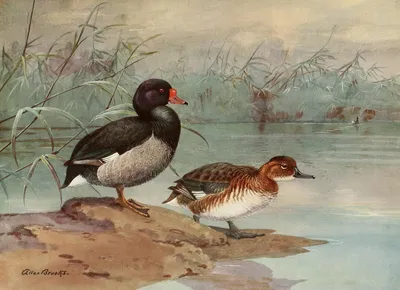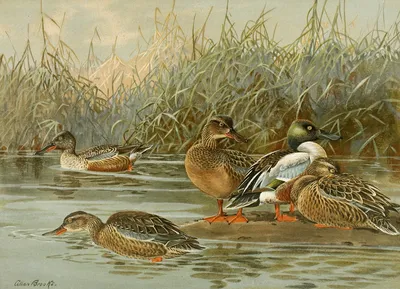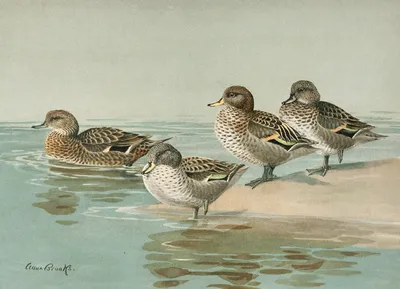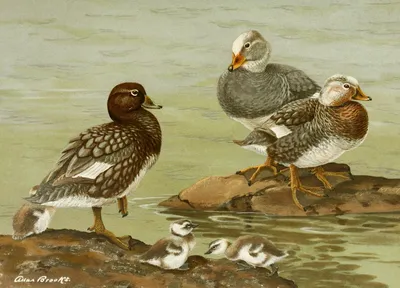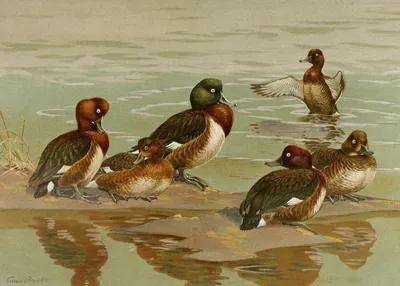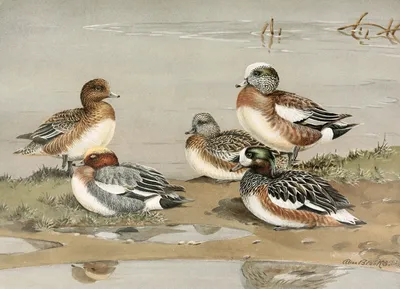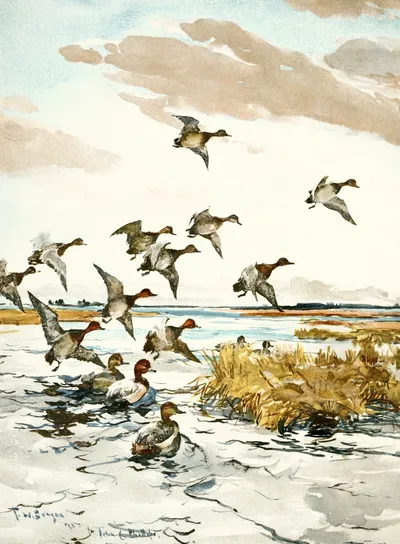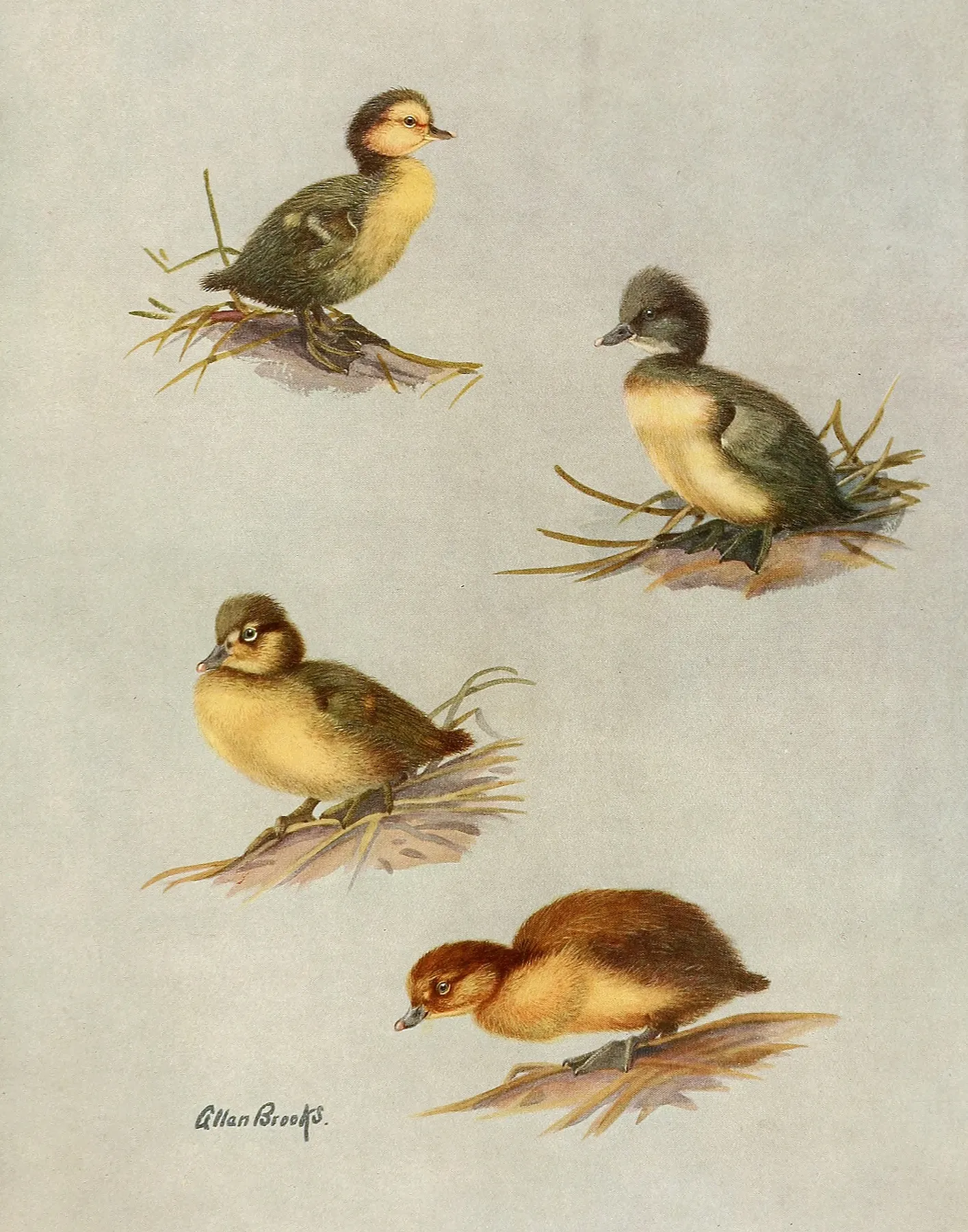
Downy Young Of White-Eyed Duck, Tufted Duck, Scaup Duck, Lesser Scaup Duck (1922-1926)
Ten ways of seeing
- slightly upright 1.27 : 1
First Look
六法者何?一、气韵生动是也;二、骨法用笔是也;三、应物象形是也;四、随类赋彩是也;五、经营位置是也;六、传移模写是也。
—— 南齐·谢赫《古画品录》
The six laws: spirit resonance alive; bone-method in the brush; matching form; colour by kind; planning the placing; copying the masters.
Slightly taller than wide; the eye lands on the bird's head, a little above centre. Then step in close: watch where colour meets line, and whether the line ever breaks. Third, find the darkest small patch: the whole tonal order is measured from there.
Name and Thing
No reliable binomial survives, so the printed title must serve. Neither name nor binomial survives: the printed title must do.
Form and Colour
Bird plates usually choose the perched pose: one foot gripping, one loose, the flight feathers laid in first, coverts over them, then the horny gleam of bill and eye.No colour group is recorded. A single plant, laid out with nothing hidden.
Composition
Slightly taller than wide, the bird set a little above centre, the eye landing at head and bill. No details are appended: a plate for looking, not for keying out. Blank paper is not unfinished work: it is where the eye rests.
Line and Colour
After 1900 photography and colour reproduction ran alongside watercolour: accuracy rose, the cut of the burin disappeared. Take a loupe to three places: petal edge, leaf vein, caption. An unbroken line means engraving; colour crossing the outline means a hand. If you mean to copy it: this is a photomechanical record — match the colours directly, do not imitate the printing grain.
Poetic Resonance
追随燕蓟儿,颖锐物不隔。
—— 唐·杜甫《八哀诗 赠司空王公思礼》
The poem gives the mood first and the picture supplies the form; set the line beside the plate and the bird itself becomes its resting point.
Symbolism
In China the crane is longevity, the magpie joy, the wild goose a letter, the eagle prowess; in the Americas each bird carries a different totem. One bird, unrelated meanings. In a flora it is a species first and a symbol second; the order is worth keeping.
Season and Place
Bound to migration: north in spring, south in autumn, each species answering to a few weeks. Audubon's plates often read 'adult, spring' — plumage at its height. Audubon's Birds of America (1827–1838) came from specimens he shot himself, wired into lifelike poses and drawn from life — which is why the birds look so alive, and why the method is uncomfortable. The year 1922 on the plate is that of publication, not of flowering — the gathering came a year or two earlier. Much of what that generation knew of such birds came from specimens and cages; read locality and season both as hearsay.
The Book and the Hand
“A natural history of the ducks” carries only Allan Brooks's name. The image is public domain; the hand-colouring is still one person's hand.
What to Take Away
Appreciation is not knowledge but habit — one more look each time. Two centuries on, the plant may still flower in some garden; the one on this sheet stopped in the season of 1922.