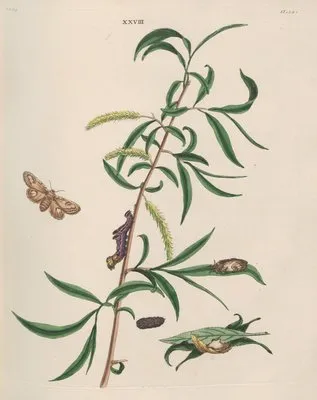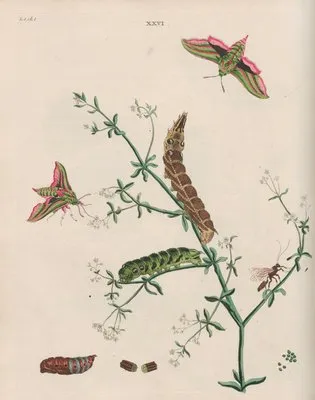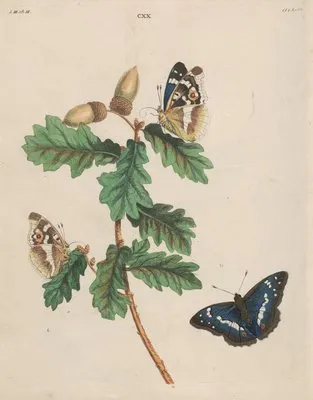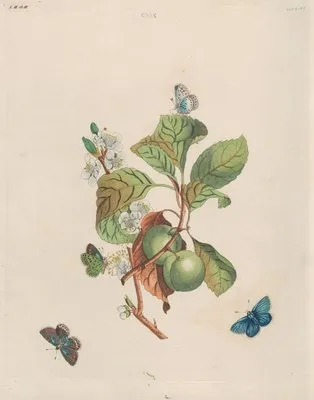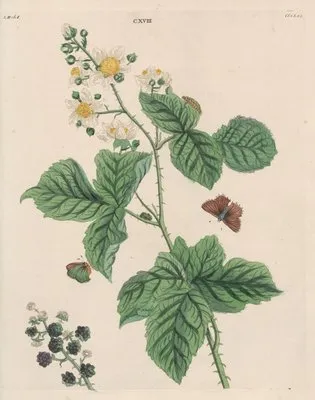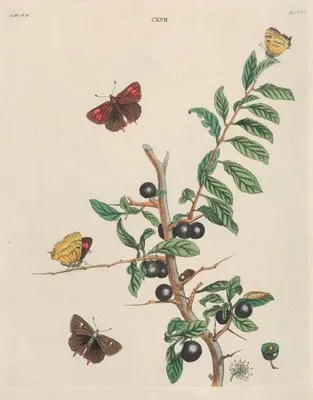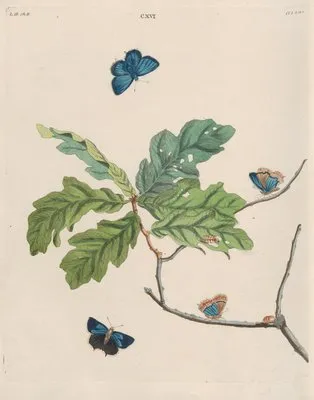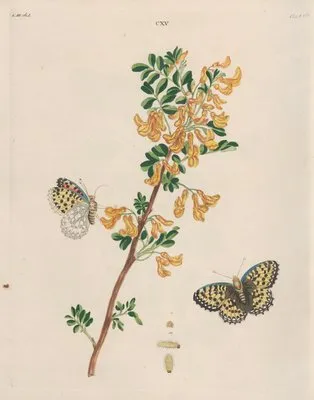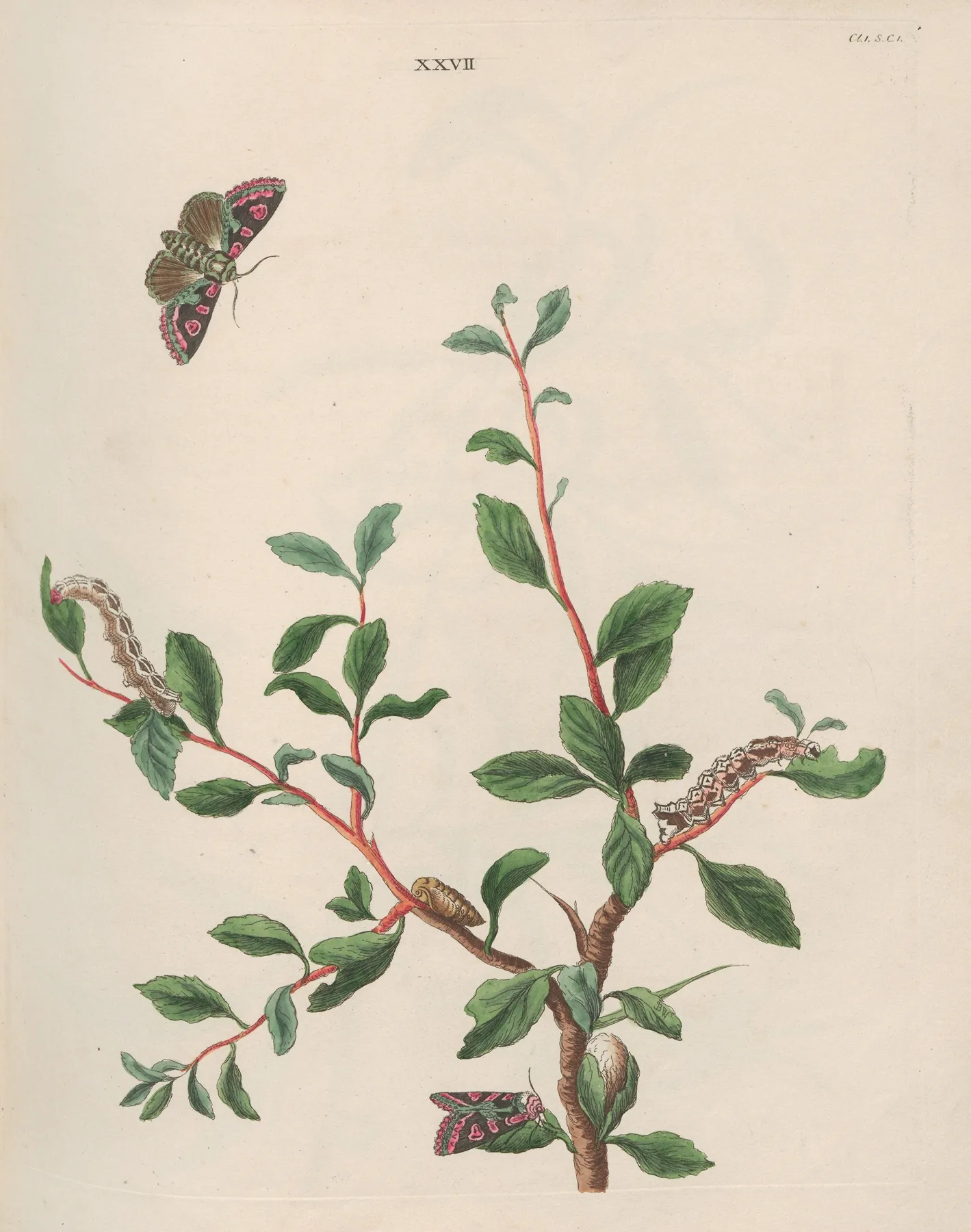
Ealing’s Glory (Phalæna oxyacantha), The Black Thorn (Prunus spinofa) (1773)
李属
Ten ways of seeing
- measured cast amber
- slightly upright 1.27 : 1
First Look
论画以形似,见与儿童邻。
—— 宋·苏轼《书鄢陵王主簿所画折枝》
To judge painting by likeness alone is the view of a child.
Slightly taller than wide; the eye lands above centre. Then step in close: watch where colour meets line, and whether the line ever breaks. Third, find the darkest small patch: the whole tonal order is measured from there. The pose leans left: the upper half carries 11 points further left than the lower — a living thing, not a diagram.
Name and Thing
Only the genus Prunus is given; species-level names came later. The Chinese name 李属 is a modern rendering of the Latin, not an old garden name.
Form and Colour
Measured on this plate: flower colour covers 3.6% of the sheet, foliage 6.6%, the cast amber with a second note of red. No other plate shares exactly this measure. Flowering trees and shrubs put out branches first; blossoms open before or with the leaves, usually five thin, translucent petals around a cluster of fine stamens.No colour group is recorded. Three things fix the habit: leaf arrangement, tepal count, and how the flower is borne.
Composition
The sheet is slightly tall. No details are appended: a plate for looking, not for keying out. The plant covers only 14% of the sheet, centred below centre; the emptiness is where the eye rests.
Line and Colour
Eighteenth-century plates are mostly copper engraving: hatched lines for shadow, then hand-colouring by another hand. There is evidence on the back too: the plate mark pressed into the paper, the slight relief of the pigment, lines worn shallow in a later printing. If you mean to copy it: take its skeleton, its margins and the order of its colours; the burin's hatching is the language of copper — suggest it with pencil density, do not imitate it stroke for stroke.
Poetic Resonance
疏影横斜水清浅,暗香浮动月黄昏。
—— 宋·林逋《山园小梅》
Sparse shadows slant across the shallow water; hidden fragrance drifts in the dusk of the moon.
The poem gives the mood first and the picture supplies the form; set the line beside the plate and the corolla becomes its resting point.
Symbolism
Plum is solitude, peach is marriage, apricot is spring itself, crabapple is a fragile fate; the hibiscus, opening at dawn and falling at dusk, is impermanence. Meanings change their tune: the same flower can say opposite things within a century.
Season and Place
Mid spring: plum first, then peach and apricot, cherry last — the season keeps its order. East Asia and temperate Eurasia. Plum, peach and apricot are Chinese in origin, grown for three thousand years. The year 1749 on the plate is that of publication, not of flowering — the gathering came a year or two earlier. See this kind of plate in the flowering season if you can: once you have met the living flower, you stop reading only colour.
The Book and the Hand
“Benjamin Wilkes” carries only Benjamin Wilkes's name. From drawing to plate the sheet passed through several hands — the engraver aimed at accuracy, the colourist at speed, and between them lies each plate's unevenness.
What to Take Away
If you keep one line, keep Guo Xi's: from afar its momentum, up close its texture. A flora exists to be consulted; look long enough and you forget to consult — someone in 1749 gave a whole day to a single flower.
About this plate
Ealing’s Glory (Phalæna oxyacantha), The Black Thorn (Prunus spinofa) (1773) is plate 94, from Benjamin Wilkes, drawn by Benjamin Wilkes. This public-domain plate is reproduced at high resolution, free to view and download. Publication: English, ?-1749.