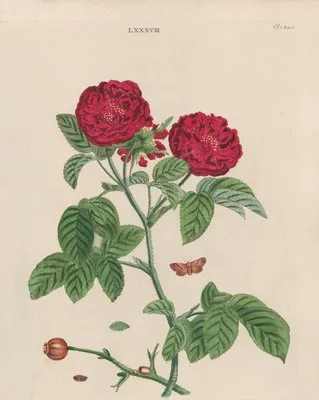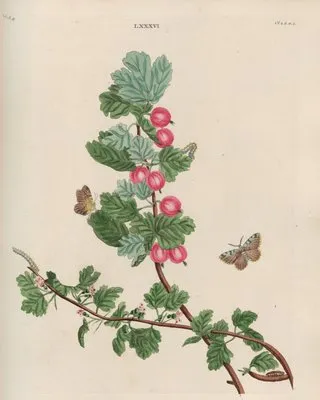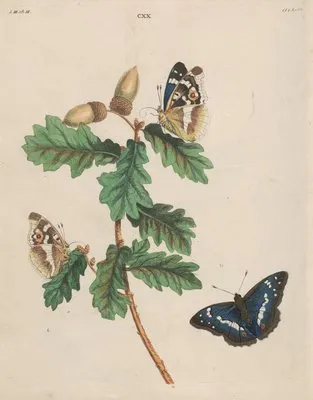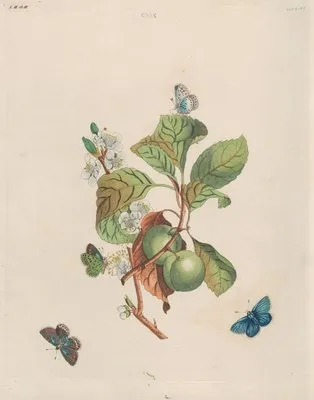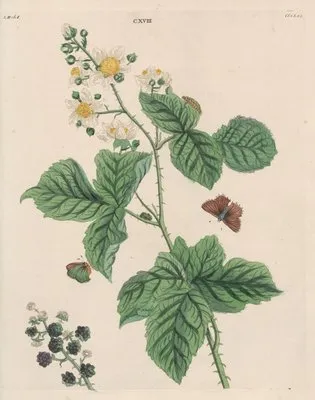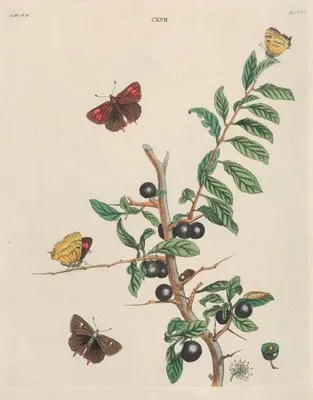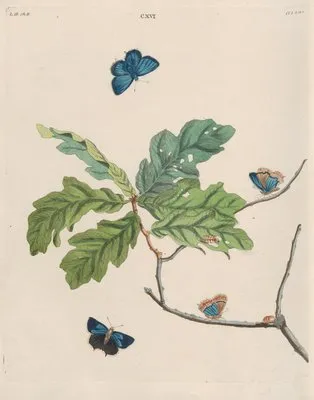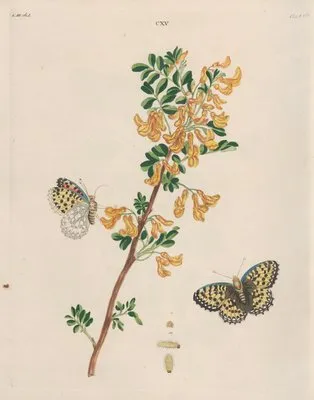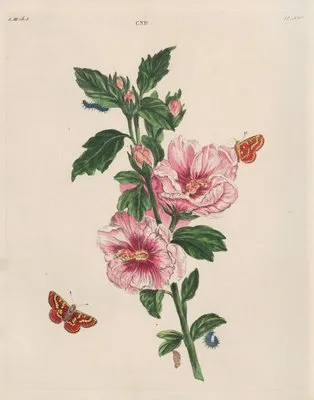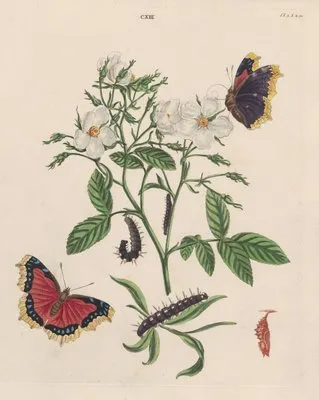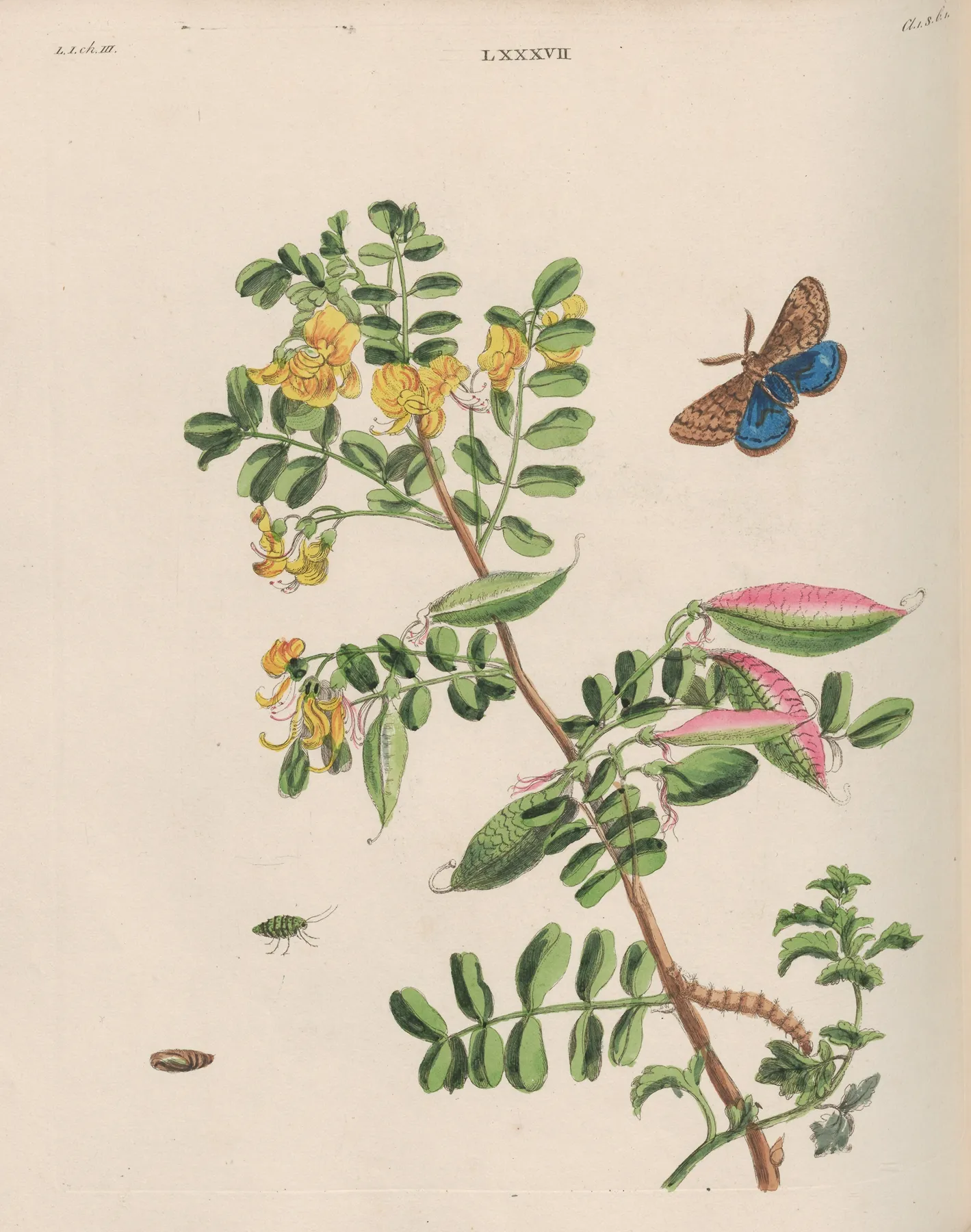
The Brindle-Moth (Phalæna), Bladder Sena (Colutea arborescens) (1773)
鱼鳔槐
Ten ways of seeing
- measured cast amber
- slightly upright 1.27 : 1
First Look
凡画山水,意在笔先。
—— 唐·王维《山水论》
In painting, the intention precedes the brush.
Slightly taller than wide; the eye lands above centre. Then step in close: watch where colour meets line, and whether the line ever breaks. Third, find the darkest small patch: the whole tonal order is measured from there. The pose leans left: the upper half carries 14 points further left than the lower — a living thing, not a diagram.
Name and Thing
No reliable binomial survives, so the printed title must serve. The Chinese name 鱼鳔槐 is a modern rendering of the Latin, not an old garden name.
Form and Colour
Measured on this plate: flower colour covers 5.9% of the sheet, foliage 10.4%, the cast amber with a second note of yellow-green. No other plate shares exactly this measure. Camellias are evergreen shrubs with thick, waxen, serrate leaves; the double flowers overlap like roof tiles and fall whole, petals still attached.No colour group is recorded. Three things fix the habit: leaf arrangement, tepal count, and how the flower is borne.
Composition
The sheet is slightly tall. No details are appended: a plate for looking, not for keying out. The plant covers only 18% of the sheet, centred a little right of centre; the emptiness is where the eye rests.
Line and Colour
Eighteenth-century plates are mostly copper engraving: hatched lines for shadow, then hand-colouring by another hand. Decide first whether it was printed or painted; only then discuss whether it is beautiful. If you mean to copy it: take its skeleton, its margins and the order of its colours; the burin's hatching is the language of copper — suggest it with pencil density, do not imitate it stroke for stroke.
Poetic Resonance
坐拥茅簷日,山茶未用烹。
—— 宋·陆游《朝饥食齑面甚美戏作二首 其一》
The poem gives the mood first and the picture supplies the form; set the line beside the plate and the corolla becomes its resting point.
Symbolism
In China the camellia is the friend that endures; in Europe it became Eastern beauty and unattainability, and after La Dame aux Camélias, a token of brief life. In a flora it is a species first and a symbol second; the order is worth keeping.
Season and Place
Late winter into early spring, blooming in the cold of the first lunar month. Southwest China and Japan, with Yunnan the centre of diversity. The year 1749 on the plate is that of publication, not of flowering — the gathering came a year or two earlier. See this kind of plate in the flowering season if you can: once you have met the living flower, you stop reading only colour.
The Book and the Hand
“Benjamin Wilkes” carries only Benjamin Wilkes's name. The image is public domain; the hand-colouring is still one person's hand.
What to Take Away
Carry three rules away: whole before detail; line before colour; picture before book. Two centuries on, the plant may still flower in some garden; the one on this sheet stopped in the season of 1749.
About this plate
The Brindle-Moth (Phalæna), Bladder Sena (Colutea arborescens) (1773) is plate 34, from Benjamin Wilkes, drawn by Benjamin Wilkes. This public-domain plate is reproduced at high resolution, free to view and download. Publication: English, ?-1749.