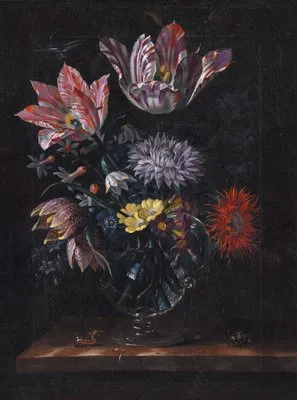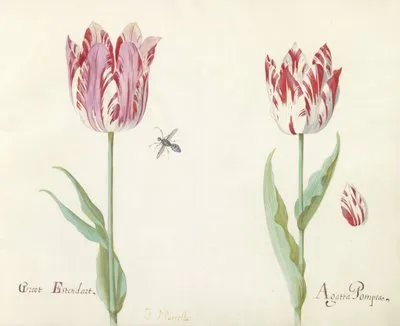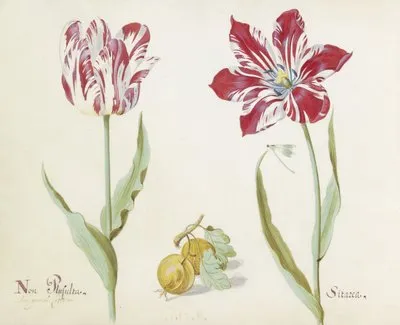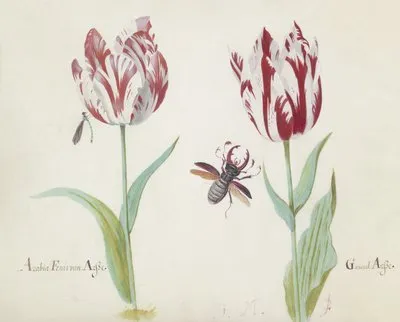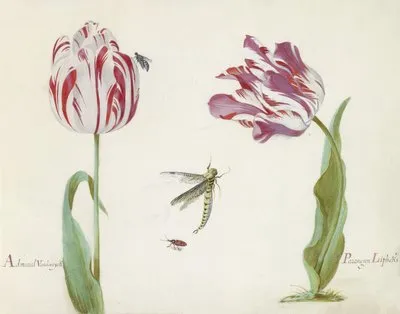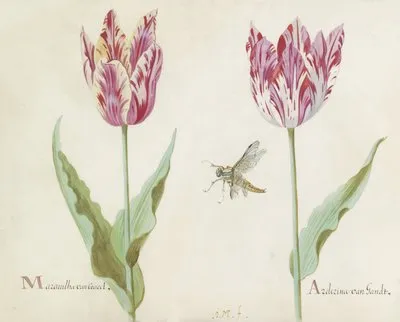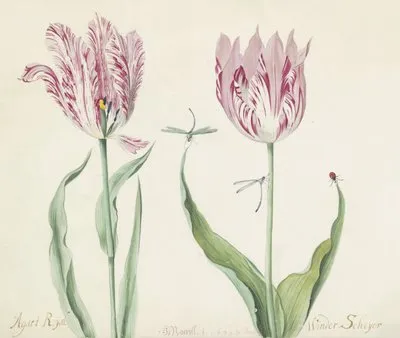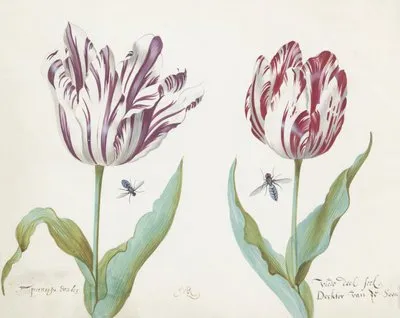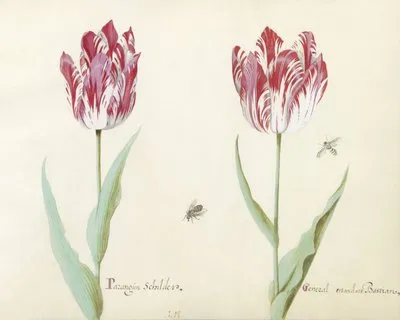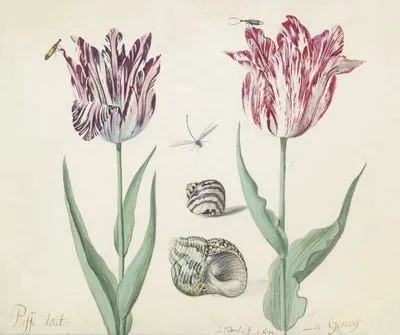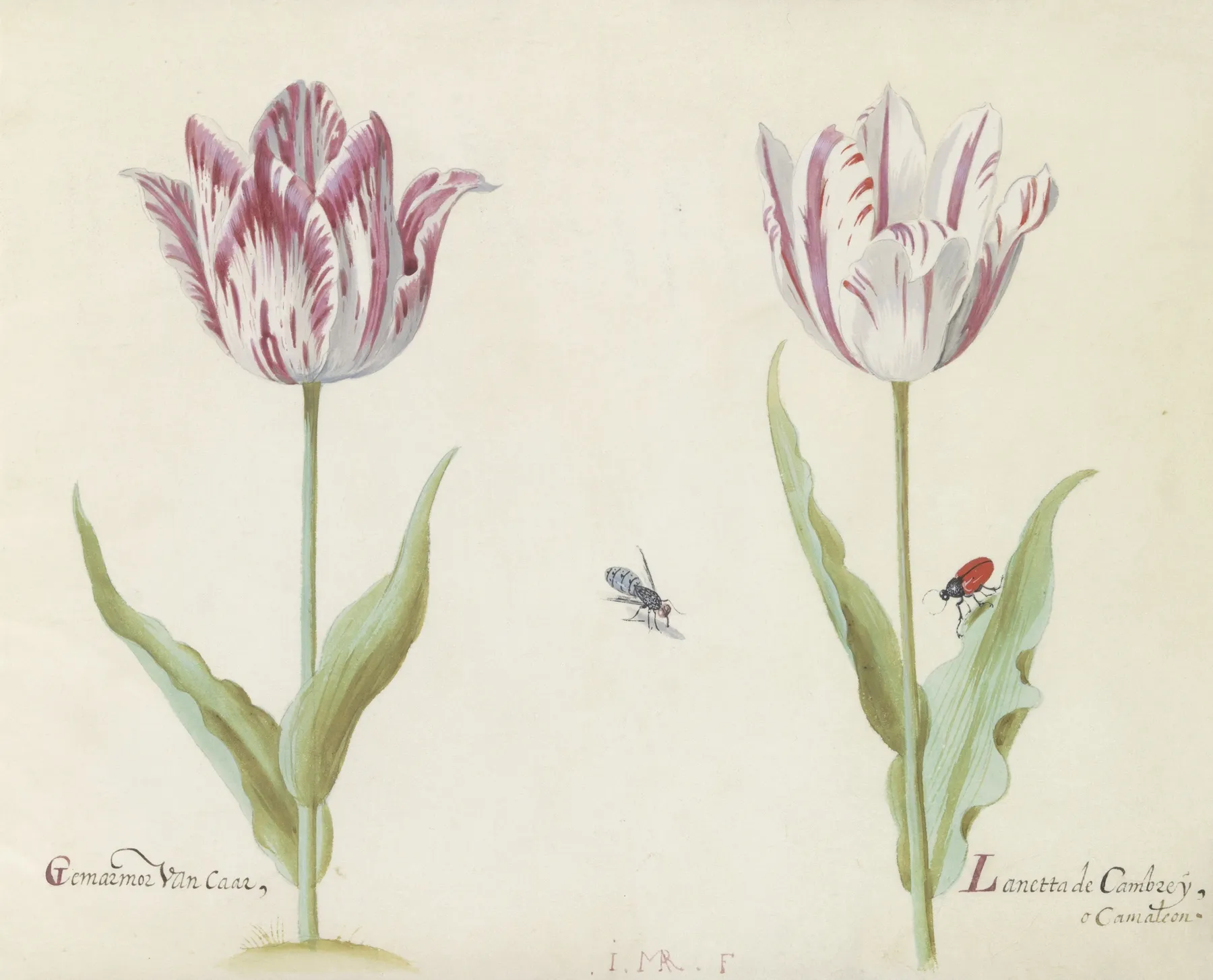
Twee tulpen met mug en kever Gemarmor van Caar Lanetta de Cambrey (1637)
木兰纲
Twee tulpen met mug en kever Gemarmor van Caar Lanetta de Cambrey (1637)
Ten ways of seeing
- measured cast yellow-green
- square 0.81 : 1
First Look
竖划三寸,当千仞之高;横墨数尺,体百里之迥。
—— 南朝宋·宗炳《画山水序》
A vertical stroke of three inches stands for a cliff of a thousand fathoms; a few feet of ink holds a hundred li.
Nearly square: all four corners carry something. See how they are placed. Then step in close: watch where colour meets line, and whether the line ever breaks. Third, find the darkest small patch: the whole tonal order is measured from there. The pose leans left: the upper half carries 9 points further left than the lower — a living thing, not a diagram.
Name and Thing
No reliable binomial survives, so the printed title must serve. The Chinese name 木兰纲 is a modern rendering of the Latin, not an old garden name.
Form and Colour
Measured on this plate: flower colour covers 5.2% of the sheet, foliage 1.8%, the cast yellow-green with a second note of red. No other plate shares exactly this measure. Insect plates show the host plant and all four stages at once — egg, larva, pupa, adult — with wing venation, scales and antennal segments accounted for: the most technical branch of natural-history art.No colour group is recorded. Read the outline, then the colour layers, then the brush.
Composition
The sheet is square. No details are appended: a plate for looking, not for keying out. The plant covers only 13% of the sheet, centred near the centre; the emptiness is where the eye rests.
Line and Colour
Before 1700 most botanical figures came from woodcut: thick, hard lines in relief, colour brushed on afterwards. Take a loupe to three places: petal edge, leaf vein, caption. An unbroken line means engraving; colour crossing the outline means a hand. If you mean to copy it: take its skeleton, its margins and the order of its colours; the burin's hatching is the language of copper — suggest it with pencil density, do not imitate it stroke for stroke.
Poetic Resonance
北城寒食烟火微,落花蝴蝶作团飞。
—— 宋·苏轼《作书寄王晋卿忽忆前年寒食北城之游走笔为此》
The poem gives the mood first and the picture supplies the form; set the line beside the plate and the bird itself becomes its resting point.
Symbolism
In China the butterfly is dream and lovers, the cicada purity, the firefly a lamp for reading; in Europe the insect began as specimen before it became symbol. Meanings change their tune: the same flower can say opposite things within a century.
Season and Place
Set by life stage: butterflies in spring and summer, moths into autumn, beetles from May to July. Four stages on one sheet span a whole year. Merian's Metamorphosis Insectorum Surinamensium (1705) first showed insect stages with their host plants — the result of raising caterpillars in the Surinam forest with her daughters. The year 1613 on the plate is that of publication, not of flowering — the gathering came a year or two earlier. Much of what that generation knew of such birds came from specimens and cages; read locality and season both as hearsay.
The Book and the Hand
“Jacob Marrel” carries only Jacob Marrel's name. A plate is collective work: drawer, engraver and colourist were different hands, and the unnamed ones decided how good it looks.
What to Take Away
Carry three rules away: whole before detail; line before colour; picture before book. The flower of that year is dust, yet its image on paper has outlived every living cousin.
About this plate
Twee tulpen met mug en kever Gemarmor van Caar Lanetta de Cambrey (1637) is plate 88, from Jacob Marrel, drawn by Jacob Marrel. This public-domain plate is reproduced at high resolution, free to view and download. Publication: German, 1613-1681.