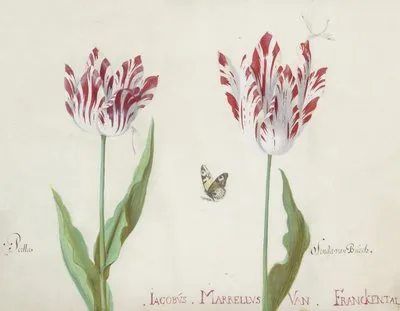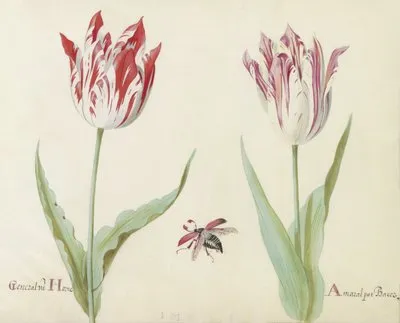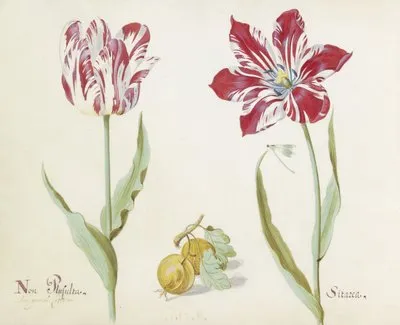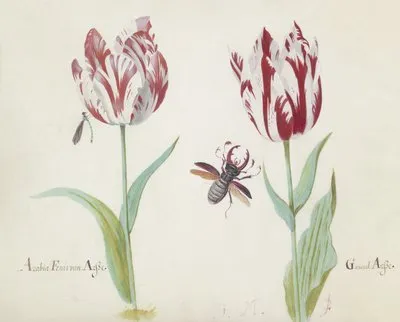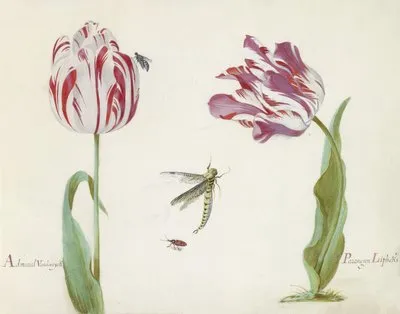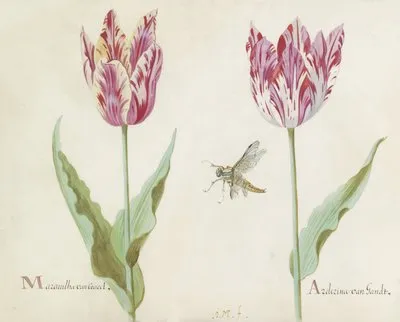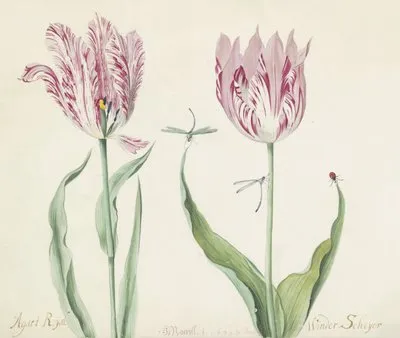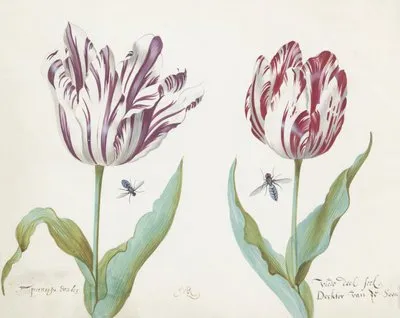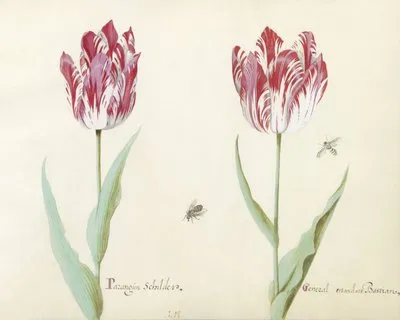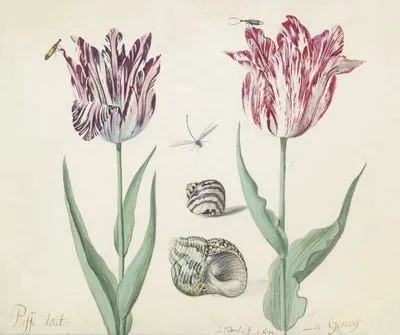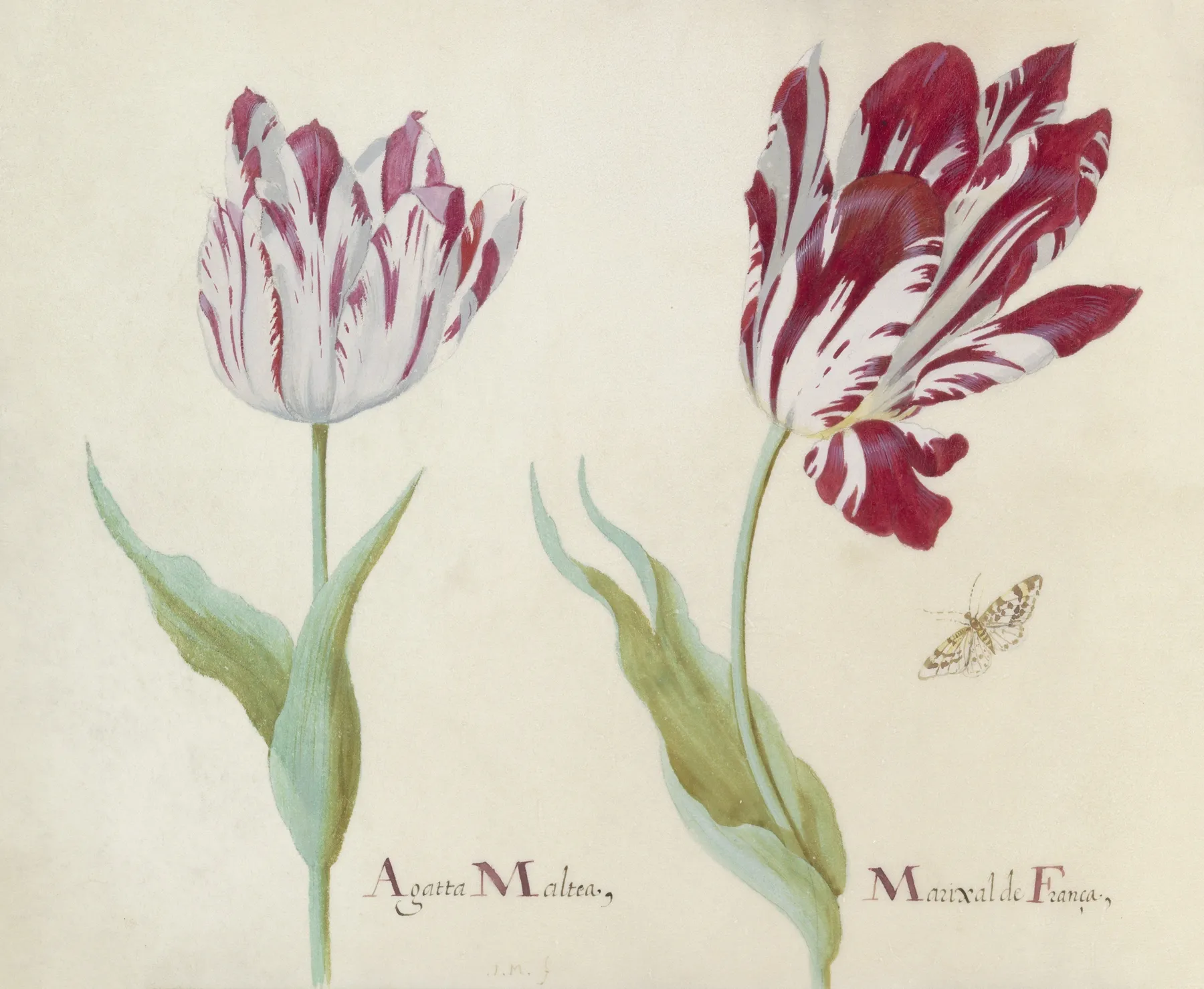
Twee tulpen met vlinder Agatta Maltea Marixal de Franca (1637)
木兰纲
Twee tulpen met vlinder Agatta Maltea Marixal de Franca (1637)
Ten ways of seeing
- measured cast red
- square 0.82 : 1
First Look
江馆清秋,晨起看竹,烟光日影露气,皆浮动于疏枝密叶之间。
—— 清·郑板桥《题画竹》
On an autumn morning at the river lodge I looked at the bamboo: mist, sunlight, dew, all drifting among the sparse and dense leaves.
Nearly square, plant and detail each holding a corner. Then step in close: watch where colour meets line, and whether the line ever breaks. Third, find the darkest small patch: the whole tonal order is measured from there. The pose leans right: the upper half carries 18 points further right than the lower — a living thing, not a diagram.
Name and Thing
No reliable binomial survives, so the printed title must serve. The Chinese name 木兰纲 is a modern rendering of the Latin, not an old garden name.
Form and Colour
Measured on this plate: flower colour covers 10.6% of the sheet, foliage 1.6%, the cast red with a second note of yellow-green. No other plate shares exactly this measure. Camellias are evergreen shrubs with thick, waxen, serrate leaves; the double flowers overlap like roof tiles and fall whole, petals still attached.No colour group is recorded. A single plant, laid out with nothing hidden.
Composition
The sheet is square. No details are appended: a plate for looking, not for keying out. The plant covers only 18% of the sheet, centred a little right of centre; the emptiness is where the eye rests.
Line and Colour
Before 1700 most botanical figures came from woodcut: thick, hard lines in relief, colour brushed on afterwards. Craft leaves franker evidence than inscriptions. If you mean to copy it: take its skeleton, its margins and the order of its colours; the burin's hatching is the language of copper — suggest it with pencil density, do not imitate it stroke for stroke.
Poetic Resonance
自立冬,将残腊,雪片似江梅,血点般山茶。
—— 《双调·新水令·题西湖四时》
The poem gives the mood first and the picture supplies the form; set the line beside the plate and the corolla becomes its resting point.
Symbolism
In China the camellia is the friend that endures; in Europe it became Eastern beauty and unattainability, and after La Dame aux Camélias, a token of brief life. Flower language was added later; the flower knows nothing of it, and that innocence is part of its power.
Season and Place
a single flower may last a fortnight. when it reached Europe in the nineteenth century it was hailed as 'the rose of the East'. The year 1613 on the plate is that of publication, not of flowering — the gathering came a year or two earlier. Read the locality and the flowering season both with a discount: one is hearsay, the other a ten-day peak.
The Book and the Hand
“Jacob Marrel” carries only Jacob Marrel's name. The image is public domain; the hand-colouring is still one person's hand.
What to Take Away
Next time you stand before a flowering plant, give it three minutes: leaf arrangement, direction of the flower, the darkest patch. A flora exists to be consulted; look long enough and you forget to consult — someone in 1613 gave a whole day to a single flower.
About this plate
Twee tulpen met vlinder Agatta Maltea Marixal de Franca (1637) is plate 46, from Jacob Marrel, drawn by Jacob Marrel. This public-domain plate is reproduced at high resolution, free to view and download. Publication: German, 1613-1681.