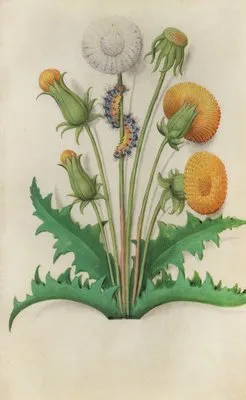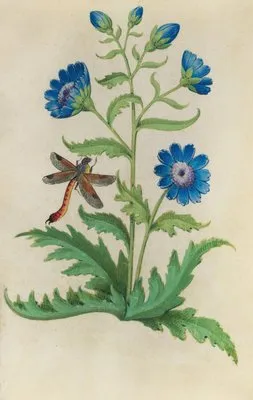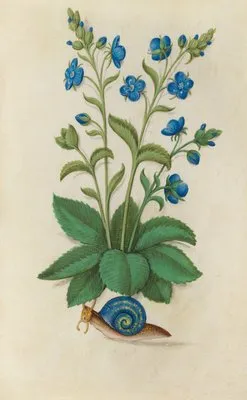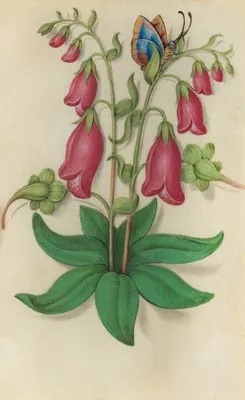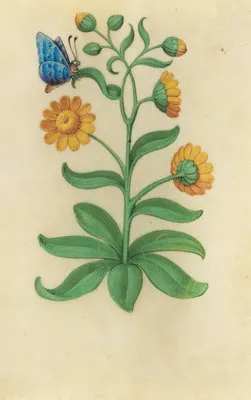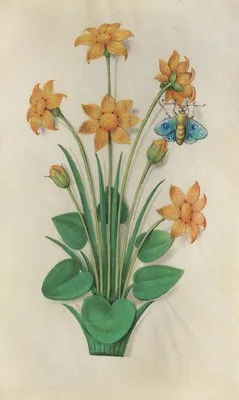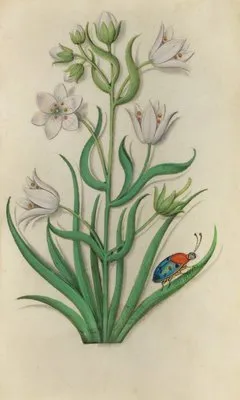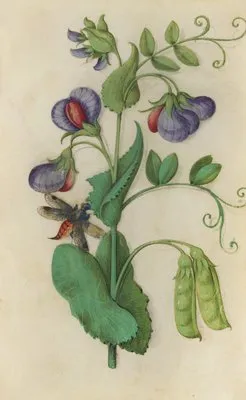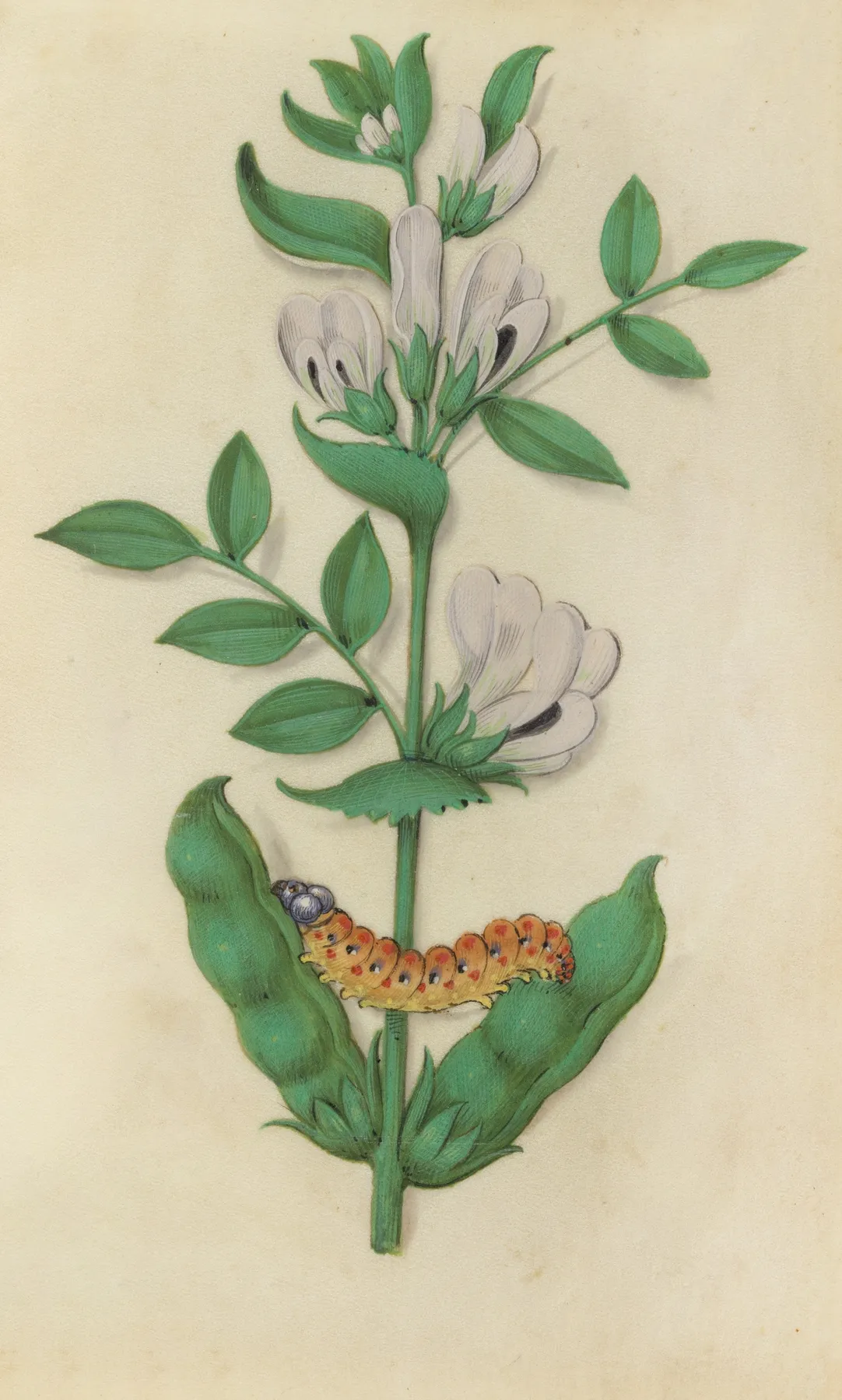
Fava Bean, fruits and flowers (Vicia faba) with a caterpillar
蚕豆
Fava Bean, fruits and flowers (Vicia faba) with a caterpillar
Ten ways of seeing
- measured cast amber
- upright 1.66 : 1
First Look
论画以形似,见与儿童邻。
—— 宋·苏轼《书鄢陵王主簿所画折枝》
To judge painting by likeness alone is the view of a child.
The sheet is vertical: the eye climbs and settles in the upper half. Let the plant stand before you look for detail. Then step in close: watch where colour meets line, and whether the line ever breaks. Third, find where the yellow is deepest: the whole tonal order is measured from that patch.
Name and Thing
The binomial is Fava bean: the first word is the genus it belongs among, the second the epithet that sets it apart. Two words carry a whole provenance. The Chinese name 蚕豆 is a modern rendering of the Latin, not an old garden name.
Form and Colour
Measured on this plate: flower colour covers 2.3% of the sheet, foliage 17.3%, the cast amber with a second note of yellow-green. No other plate shares exactly this measure. Fruit plates pair the whole fruit with a section: the outline identifies the variety, the cut reveals skin thickness, core size and seed arrangement — the evidence of registration. Filed under yellow — a honey-yellow, built in washes from a pale ground. Three things fix the habit: leaf arrangement, tepal count, and how the flower is borne.
Composition
The sheet is tall. No details are appended: a plate for looking, not for keying out. The plant covers only 25% of the sheet, centred near the centre; the emptiness is where the eye rests.
Line and Colour
Before 1700 most botanical figures came from woodcut: thick, hard lines in relief, colour brushed on afterwards. Take a loupe to three places: petal edge, leaf vein, caption. An unbroken line means engraving; colour crossing the outline means a hand. If you mean to copy it: take its skeleton, its margins and the order of its colours; the burin's hatching is the language of copper — suggest it with pencil density, do not imitate it stroke for stroke.
Poetic Resonance
玳瑁筵,葡萄酒,殷勤红袖,莫惜捧金瓯。
—— 《正宫·小梁州·春怀》
The poem gives the mood first and the picture supplies the form; set the line beside the plate and the yellow the fruit becomes its resting point.
Symbolism
In China the pomegranate means many sons, the peach long life, the orange good fortune; in Europe the apple is temptation and knowledge, the grape abundance and sacrifice. This plate leans yellow, which in flower language adds one more degree of feeling. In a flora it is a species first and a symbol second; the order is worth keeping.
Season and Place
a fruit portfolio spans the whole harvest. Temperate fruits came mostly from Eurasia, later from the Americas. Nineteenth-century nurseries printed varietal albums for trade and exhibition: every fruit on the page was a saleable claim. The year 1510 on the plate is that of publication, not of flowering — the gathering came a year or two earlier. The bud and the ripe fruit on one branch tell the season; the name in the title often tells the journey.
The Book and the Hand
“Book of Flower Studies” carries only Master of Claude de France's name. The image is public domain; the hand-colouring is still one person's hand.
What to Take Away
Carry three rules away: whole before detail; line before colour; picture before book. Two centuries on, the plant may still flower in some garden; the one on this sheet stopped in the season of 1510.
About this plate
Fava Bean, fruits and flowers (Vicia faba) with a caterpillar is plate 12, from Book of Flower Studies, drawn by Master of Claude de France. This public-domain plate is reproduced at high resolution, free to view and download. Publication: France, 1510–1515.