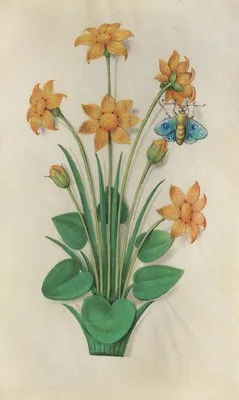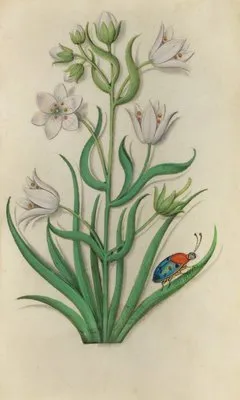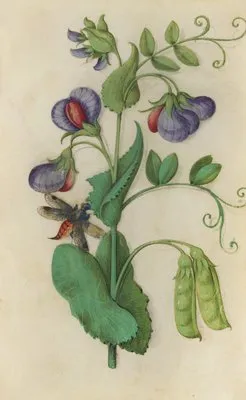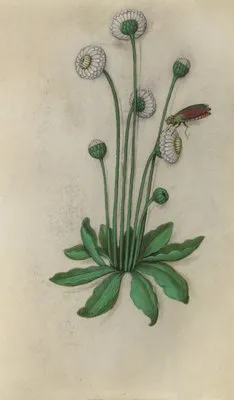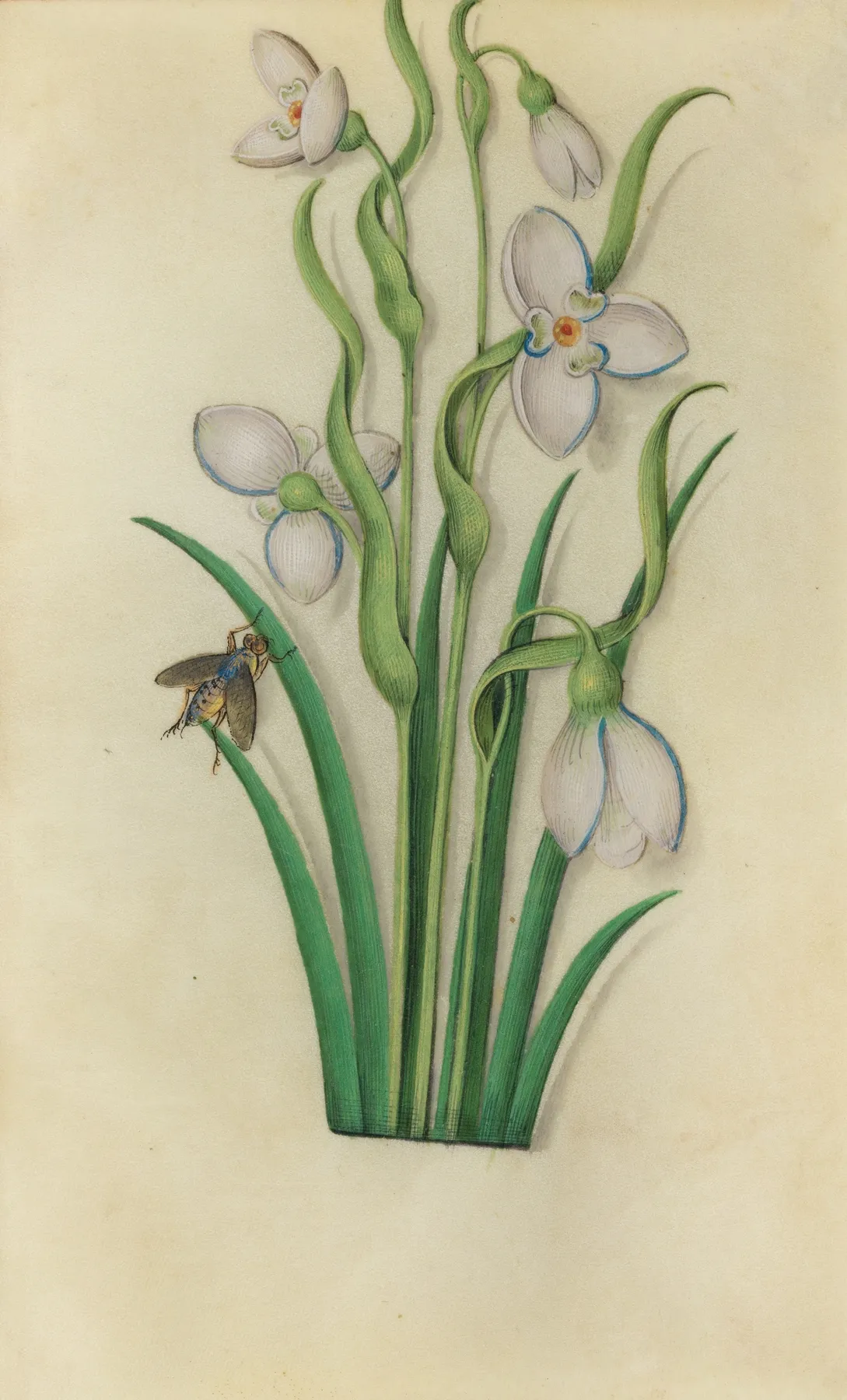
Snowdrop (Galanthus nivalis) with a fly
雪滴花
Snowdrop (Galanthus nivalis) with a fly
Ten ways of seeing
- measured cast yellow-green
- upright 1.65 : 1
First Look
六法者何?一、气韵生动是也;二、骨法用笔是也;三、应物象形是也;四、随类赋彩是也;五、经营位置是也;六、传移模写是也。
—— 南齐·谢赫《古画品录》
The six laws: spirit resonance alive; bone-method in the brush; matching form; colour by kind; planning the placing; copying the masters.
The sheet is vertical: the eye climbs and settles in the upper half. Let the plant stand before you look for detail. Then step in close: watch where colour meets line, and whether the line ever breaks. Third, find where the yellow is deepest: the whole tonal order is measured from that patch.
Name and Thing
Only the genus Galanthus is given; species-level names came later. The Chinese name 雪滴花 is a modern rendering of the Latin, not an old garden name.
Form and Colour
Measured on this plate: flower colour covers 2.7% of the sheet, foliage 14.1%, the cast yellow-green with a second note of amber. No other plate shares exactly this measure. A layered bulb, upright strap leaves, six white tepals and a small golden cup — the Chinese name is 'silver terrace with a golden cup'. Filed under yellow — a honey-yellow, built in washes from a pale ground. Read the outline, then the colour layers, then the brush.
Composition
The sheet is tall. No details are appended: a plate for looking, not for keying out. The plant covers only 24% of the sheet, centred near the centre; the emptiness is where the eye rests.
Line and Colour
Before 1700 most botanical figures came from woodcut: thick, hard lines in relief, colour brushed on afterwards. There is evidence on the back too: the plate mark pressed into the paper, the slight relief of the pigment, lines worn shallow in a later printing. If you mean to copy it: take its skeleton, its margins and the order of its colours; the burin's hatching is the language of copper — suggest it with pencil density, do not imitate it stroke for stroke.
Poetic Resonance
琉璃百顷水仙家,风静湖平响钓车。
—— 宋·苏轼《次韵周长官寿星院同饯鲁少卿》
The poem gives the mood first and the picture supplies the form; set the line beside the plate and the yellow the corolla becomes its resting point.
Symbolism
In China it is the New Year's offering — clear, fragrant, a little otherworldly; in Europe, because of Narcissus, it means self-love and the gaze turned inward. This plate leans yellow, which in flower language adds one more degree of feeling. Meanings change their tune: the same flower can say opposite things within a century.
Season and Place
Late winter into early spring: forced in water in the twelfth month, blooming at the New Year. Native to the Mediterranean, reaching China by sea in the late Tang. The year 1510 on the plate is that of publication, not of flowering — the gathering came a year or two earlier. The bud and the ripe fruit on one branch tell the season; the name in the title often tells the journey.
The Book and the Hand
“Book of Flower Studies” carries only Master of Claude de France's name. A plate is collective work: drawer, engraver and colourist were different hands, and the unnamed ones decided how good it looks.
What to Take Away
Next time you stand before a flowering plant, give it three minutes: leaf arrangement, direction of the flower, the darkest patch. A flora exists to be consulted; look long enough and you forget to consult — someone in 1510 gave a whole day to a single flower.
About this plate
Snowdrop (Galanthus nivalis) with a fly is plate 39, from Book of Flower Studies, drawn by Master of Claude de France. This public-domain plate is reproduced at high resolution, free to view and download. Publication: France, 1510–1515.