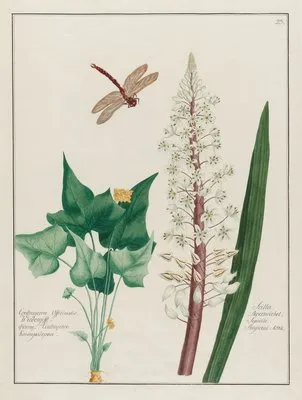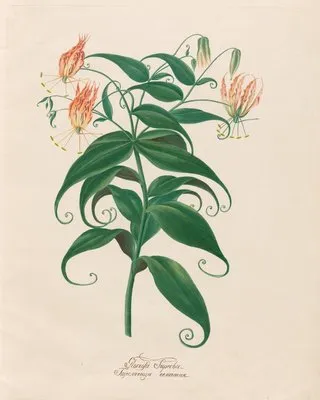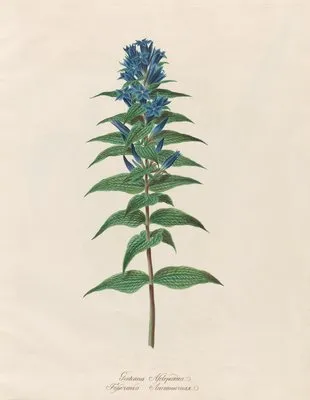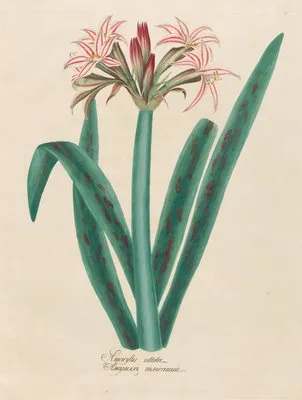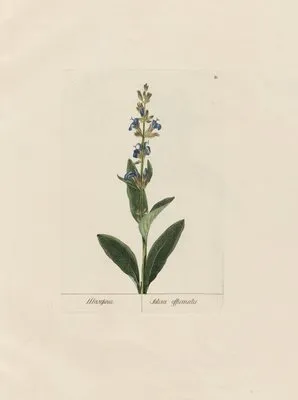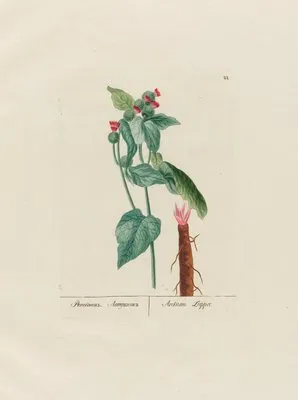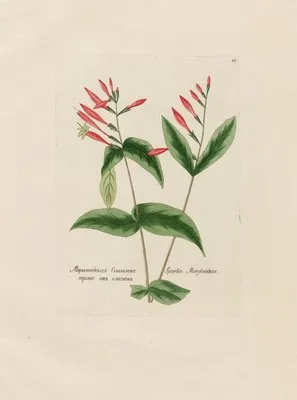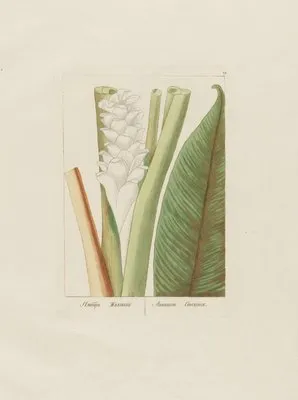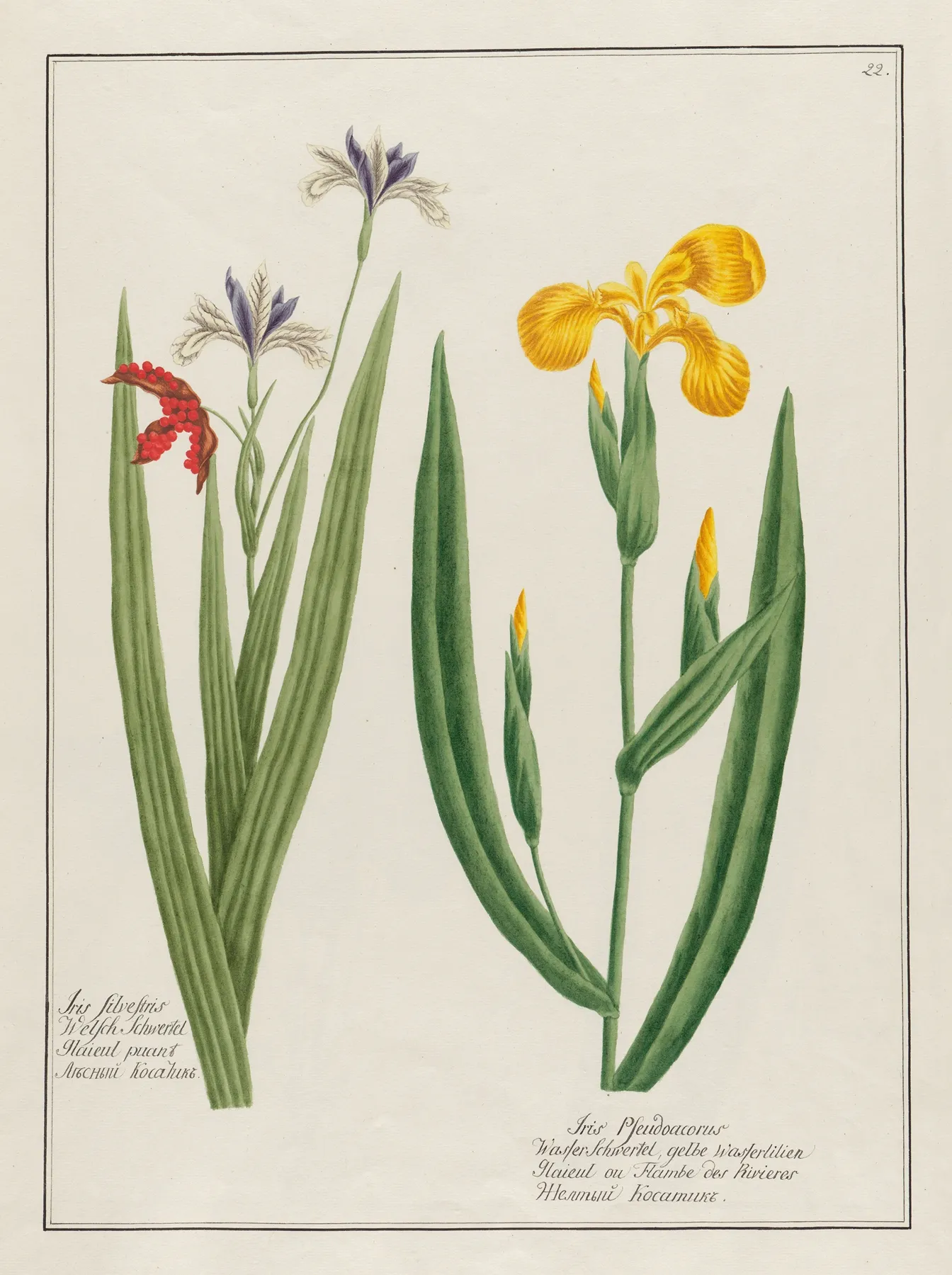
Iris Silvestris … [and] Iris Pseudoacorus
Iris fivefris|Iris fivefris Wetych Tchwertel
Ten ways of seeing
- measured cast yellow-green
- upright 1.34 : 1
First Look
搜尽奇峰打草稿。
—— 清·石涛《苦瓜和尚画语录》
Exhaust the strange peaks, and then make the sketch.
The sheet is vertical: the eye climbs and settles in the upper half. Let the plant stand before you look for detail. Then step in close: watch where colour meets line, and whether the line ever breaks. Third, find the darkest small patch: the whole tonal order is measured from there.
Name and Thing
Only the genus Iris is given; species-level names came later. No established Chinese name exists, so it is cited by its binomial alone.
Form and Colour
Measured on this plate: flower colour covers 3.2% of the sheet, foliage 15.6%, the cast yellow-green with a second note of amber. No other plate shares exactly this measure. Irises carry rhizomes or bulbs, sword-shaped leaves in two ranks, and six tepals — three falls drooping, often bearded or speckled, three standards erect.No colour group is recorded. Read the outline, then the colour layers, then the brush.
Composition
The sheet is tall. No details are appended: a plate for looking, not for keying out. The plant covers only 22% of the sheet, centred near the centre; the emptiness is where the eye rests.
Line and Colour
Eighteenth-century plates are mostly copper engraving: hatched lines for shadow, then hand-colouring by another hand. Craft leaves franker evidence than inscriptions. If you mean to copy it: take its skeleton, its margins and the order of its colours; the burin's hatching is the language of copper — suggest it with pencil density, do not imitate it stroke for stroke.
Poetic Resonance
君家兰杜久萋萋,近养菖蒲绿未齐。
—— 宋·朱熹《寄謝劉彥集菖蒲之貺二首 其一》
The poem gives the mood first and the picture supplies the form; set the line beside the plate and the corolla becomes its resting point.
Symbolism
In China sweet flag hung at the door wards off evil at midsummer; in Europe the iris is the messenger, since Iris was the rainbow goddess who carried divine words. Flower language was added later; the flower knows nothing of it, and that innocence is part of its power.
Season and Place
Late spring to early summer, peaking in April and May, before the summer rains. Temperate north. In China iris and sweet flag belong to the Dragon Boat festival. The year 1797 on the plate is that of publication, not of flowering — the gathering came a year or two earlier. See this kind of plate in the flowering season if you can: once you have met the living flower, you stop reading only colour.
The Book and the Hand
“Collection de curiosites du Royaume des plantes” carries only Petr Martynovich Gofman's name. A plate is collective work: drawer, engraver and colourist were different hands, and the unnamed ones decided how good it looks.
What to Take Away
Carry three rules away: whole before detail; line before colour; picture before book. The flower of that year is dust, yet its image on paper has outlived every living cousin.
About this plate
Iris Silvestris … [and] Iris Pseudoacorus is plate 24, from Collection de curiosites du Royaume des plantes, drawn by Petr Martynovich Gofman. This public-domain plate is reproduced at high resolution, free to view and download. Publication: St. Petersburg, 1797–1810.