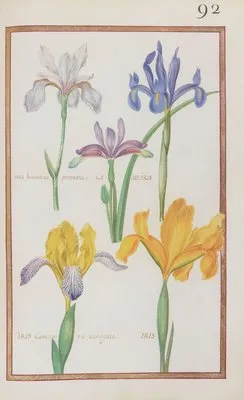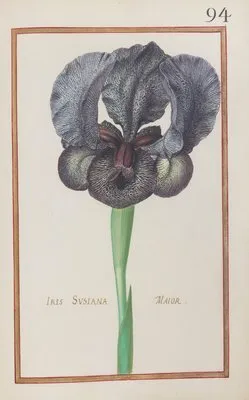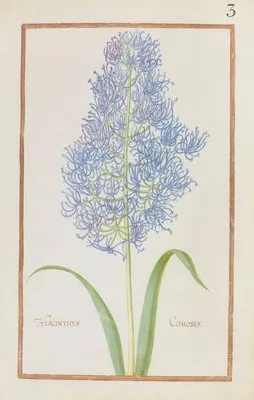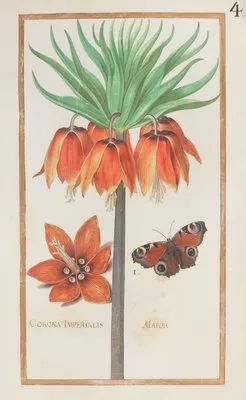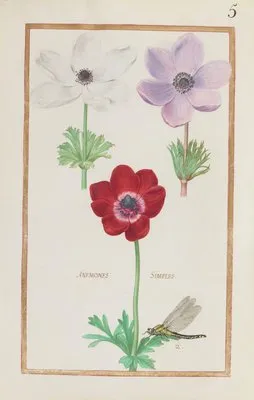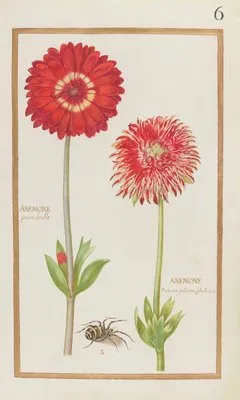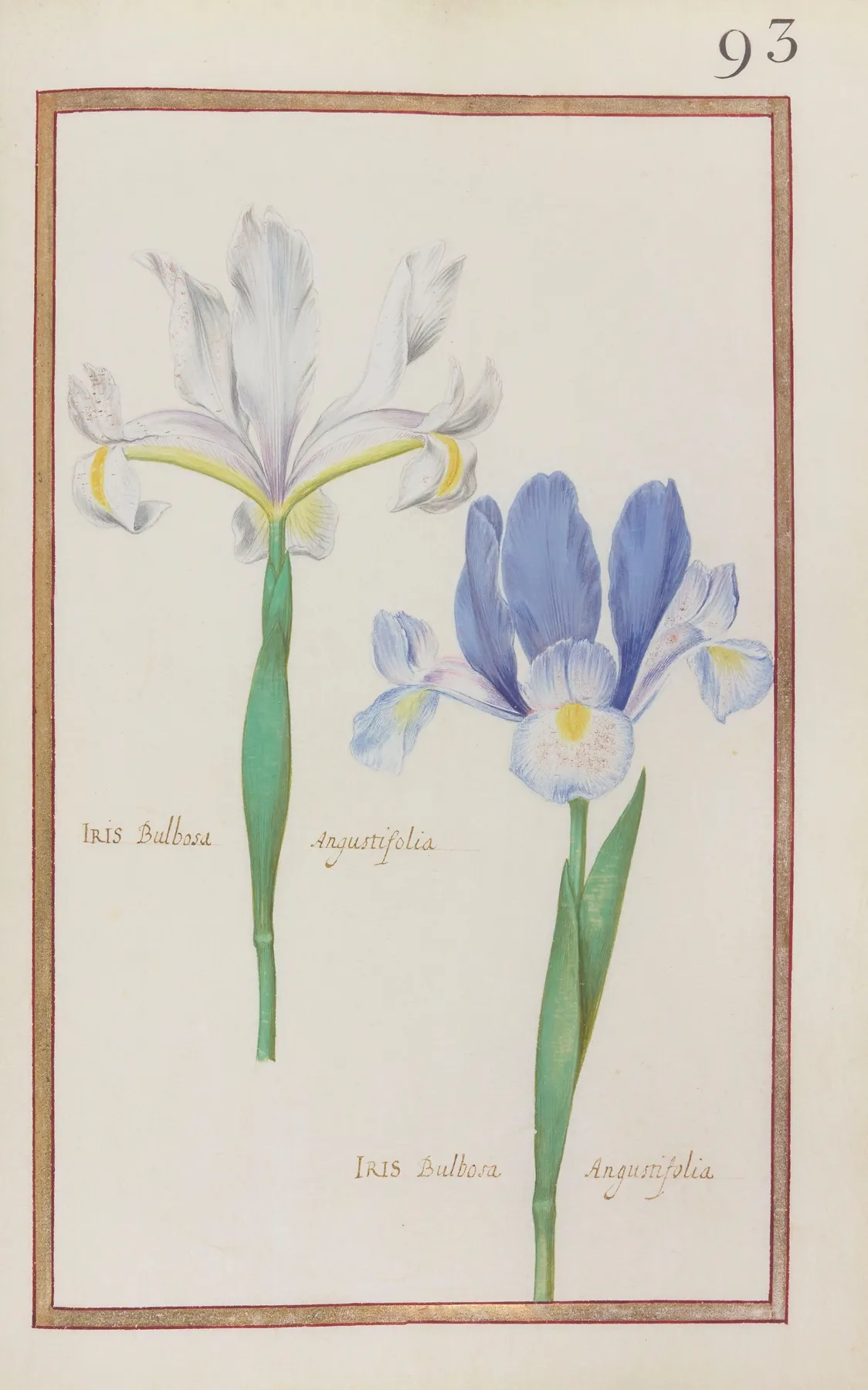
Iris bulbosa angustifolia ; iris bulbosa angustifolia (1624)
天门冬目
Iris bulbosa angustifolia ; iris bulbosa angustifolia (1624)
Ten ways of seeing
- measured cast amber
- upright 1.60 : 1
First Look
真山水之川谷,远望之以取其势,近看之以取其质。
—— 宋·郭熙《林泉高致·山水训》
Mountains and valleys: from afar take their momentum, up close take their texture — the two distances from which any picture is read.
The sheet is vertical: the eye climbs and settles in the upper half. Let the plant stand before you look for detail. Then step in close: watch where colour meets line, and whether the line ever breaks. Third, find the darkest small patch: the whole tonal order is measured from there.
Name and Thing
Only the genus Iris is given; species-level names came later. The Chinese name 天门冬目 is a modern rendering of the Latin, not an old garden name.
Form and Colour
Measured on this plate: flower colour covers 9.6% of the sheet, foliage 2.8%, the cast amber with a second note of violet-blue. No other plate shares exactly this measure. Irises carry rhizomes or bulbs, sword-shaped leaves in two ranks, and six tepals — three falls drooping, often bearded or speckled, three standards erect.No colour group is recorded. Three things fix the habit: leaf arrangement, tepal count, and how the flower is borne.
Composition
The sheet is tall. No details are appended: a plate for looking, not for keying out. The plant covers only 15% of the sheet, centred near the centre; the emptiness is where the eye rests.
Line and Colour
Before 1700 most botanical figures came from woodcut: thick, hard lines in relief, colour brushed on afterwards. Decide first whether it was printed or painted; only then discuss whether it is beautiful. If you mean to copy it: take its skeleton, its margins and the order of its colours; the burin's hatching is the language of copper — suggest it with pencil density, do not imitate it stroke for stroke.
Poetic Resonance
桃李新开映古查,菖蒲犹短出平沙。
—— 唐·李白《送祝八之江東賦得浣紗石》
The poem gives the mood first and the picture supplies the form; set the line beside the plate and the corolla becomes its resting point.
Symbolism
In China sweet flag hung at the door wards off evil at midsummer; in Europe the iris is the messenger, since Iris was the rainbow goddess who carried divine words. In a flora it is a species first and a symbol second; the order is worth keeping.
Season and Place
Late spring to early summer, peaking in April and May, before the summer rains. Temperate north. In China iris and sweet flag belong to the Dragon Boat festival. The year 1624 on the plate is that of publication, not of flowering — the gathering came a year or two earlier. Read the locality and the flowering season both with a discount: one is hearsay, the other a ten-day peak.
The Book and the Hand
“Collection of flowers and insects” carries only Daniel Rabel's name. The image is public domain; the hand-colouring is still one person's hand.
What to Take Away
Appreciation is not knowledge but habit — one more look each time. A flora exists to be consulted; look long enough and you forget to consult — someone in 1624 gave a whole day to a single flower.
About this plate
Iris bulbosa angustifolia ; iris bulbosa angustifolia (1624) is plate 93, from Collection of flowers and insects, drawn by Daniel Rabel. This public-domain plate is reproduced at high resolution, free to view and download. Publication: Paris, 1624.