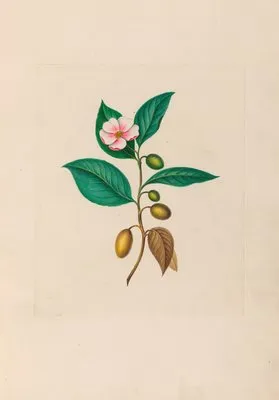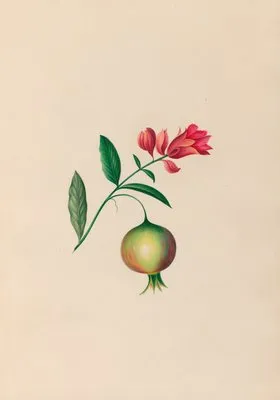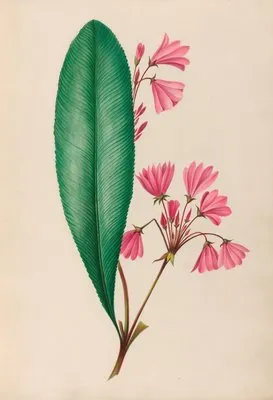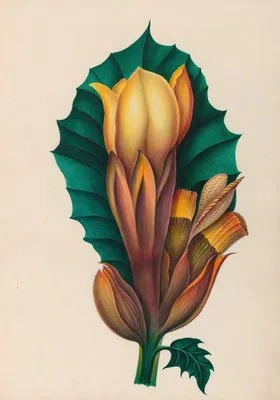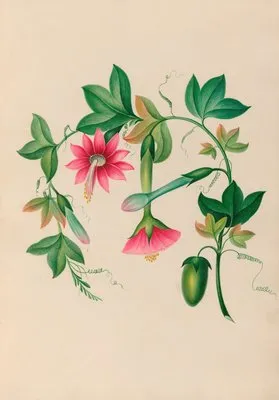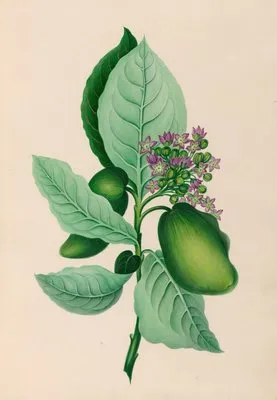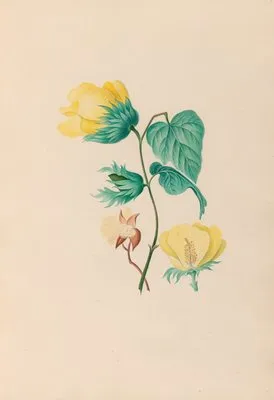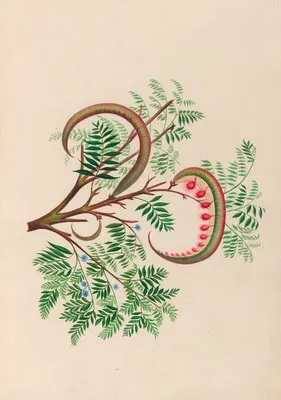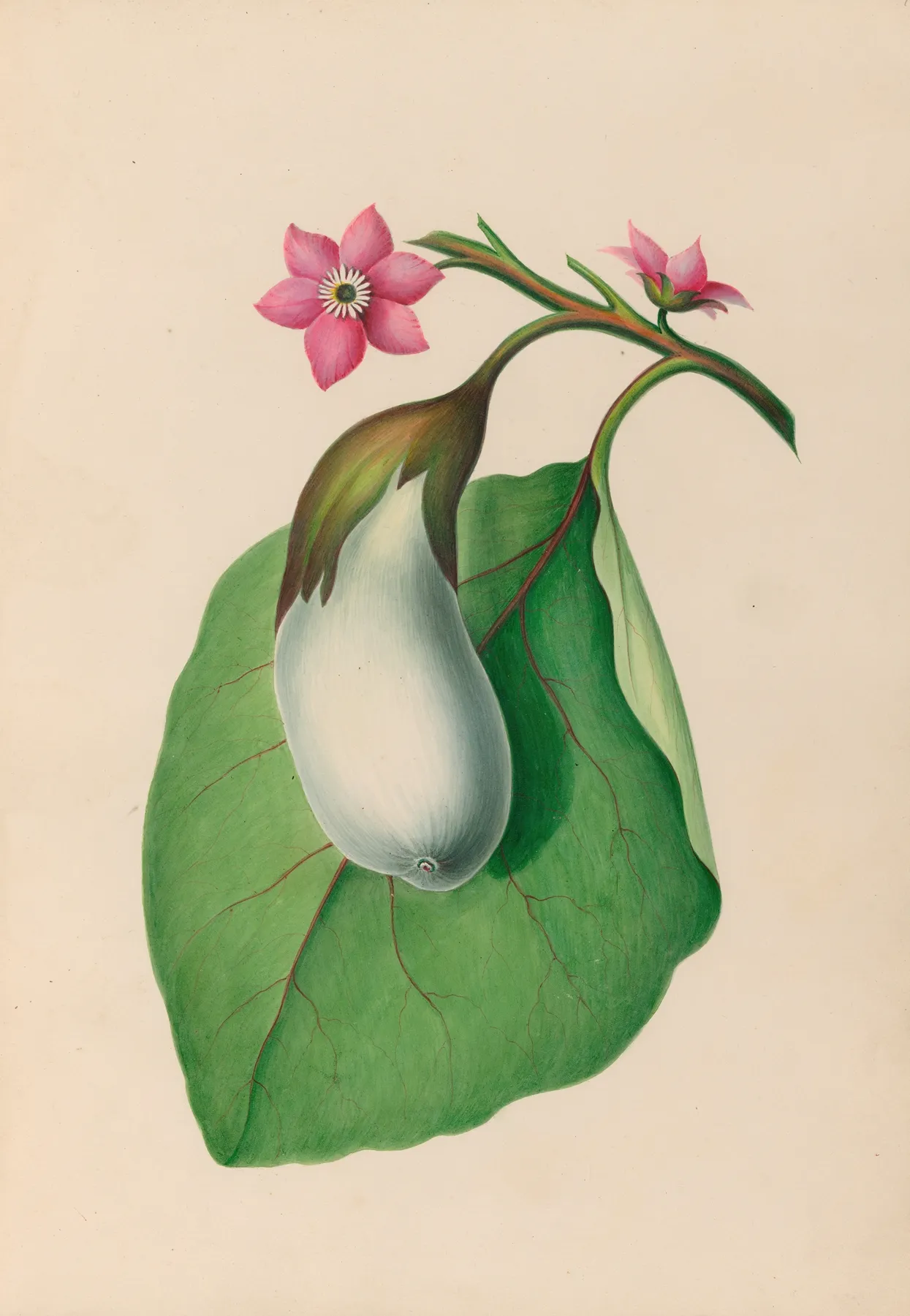
Drawings of tropical flowers and fruits, from South America Pl.07 (1830)
Drawings of tropical flowers and fruits, from South America Pl.07 (1830)
Ten ways of seeing
- measured cast red
- upright 1.45 : 1
First Look
江馆清秋,晨起看竹,烟光日影露气,皆浮动于疏枝密叶之间。
—— 清·郑板桥《题画竹》
On an autumn morning at the river lodge I looked at the bamboo: mist, sunlight, dew, all drifting among the sparse and dense leaves.
The sheet is vertical: the eye climbs and settles in the upper half. Let the plant stand before you look for detail. Then step in close: watch where colour meets line, and whether the line ever breaks. Third, find where the orange is deepest: the whole tonal order is measured from that patch.
Name and Thing
No reliable binomial survives, so the printed title must serve. Neither name nor binomial survives: the printed title must do.
Form and Colour
Measured on this plate: flower colour covers 4.3% of the sheet, foliage 21.2%, the cast red with a second note of yellow-green. No other plate shares exactly this measure. Tropical plants defy temperate habits: heavy, saturated flowers with strong scent, leathery or dissected leaves, stems that climb, swell, or reduce to spines. Filed under orange — an amber orange, built in washes from a pale ground. Three things fix the habit: leaf arrangement, tepal count, and how the flower is borne.
Composition
The sheet is tall. No details are appended: a plate for looking, not for keying out. The plant covers only 28% of the sheet, centred below centre; the emptiness is where the eye rests.
Line and Colour
The first half of the nineteenth century moved from copper to steel to lithography; stipple could render the softest transition. Craft leaves franker evidence than inscriptions. If you mean to copy it: take its skeleton, its margins and the order of its colours; the burin's hatching is the language of copper — suggest it with pencil density, do not imitate it stroke for stroke.
Poetic Resonance
无事将心寄柳条,等闲书字满芭蕉。
—— 唐·李益《逢歸信偶寄》
The poem gives the mood first and the picture supplies the form; set the line beside the plate and the orange the corolla becomes its resting point.
Symbolism
In China these plants carry no classical symbolism; their meaning is newness — new worlds, new species, new trade routes. They show natural history's expanding edge. This plate leans orange, which in flower language adds one more degree of feeling. In a flora it is a species first and a symbol second; the order is worth keeping.
Season and Place
flowering follows the first rains, so a month on the plate often means 'after the rain'. Central and South America, Southeast Asia, India, Ceylon. Eighteenth- and nineteenth-century artists either sailed with the ships or drew from living specimens under glass. The year 1830 on the plate is that of publication, not of flowering — the gathering came a year or two earlier. See this kind of plate in the flowering season if you can: once you have met the living flower, you stop reading only colour.
The Book and the Hand
“Drawings of tropical flowers and fruits, from South America” carries only Charles Empson's name. A plate is collective work: drawer, engraver and colourist were different hands, and the unnamed ones decided how good it looks.
What to Take Away
If you keep one line, keep Guo Xi's: from afar its momentum, up close its texture. The flower of that year is dust, yet its image on paper has outlived every living cousin.
About this plate
Drawings of tropical flowers and fruits, from South America Pl.07 (1830) is plate 7, from Drawings of tropical flowers and fruits, from South America, drawn by Charles Empson. This public-domain plate is reproduced at high resolution, free to view and download. Publication: England, 1830.