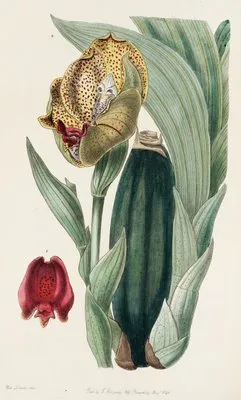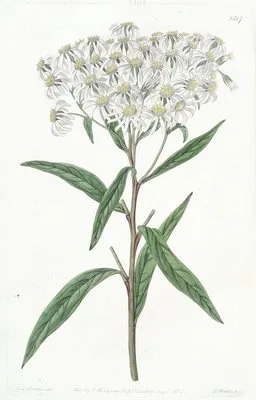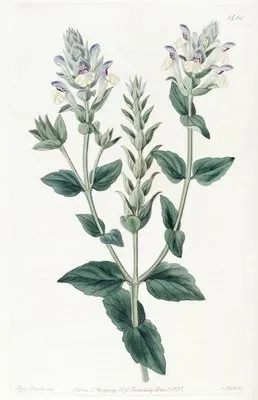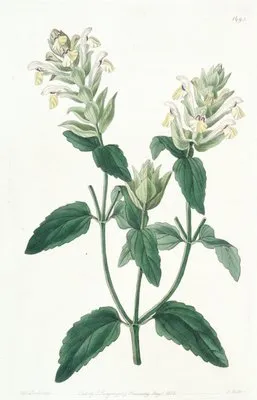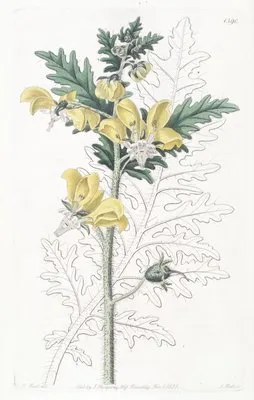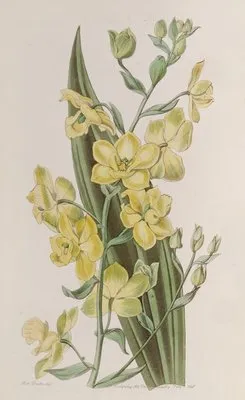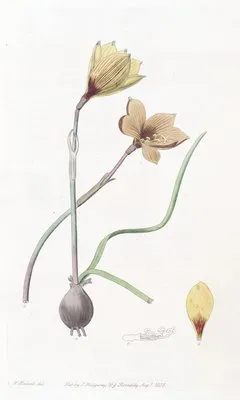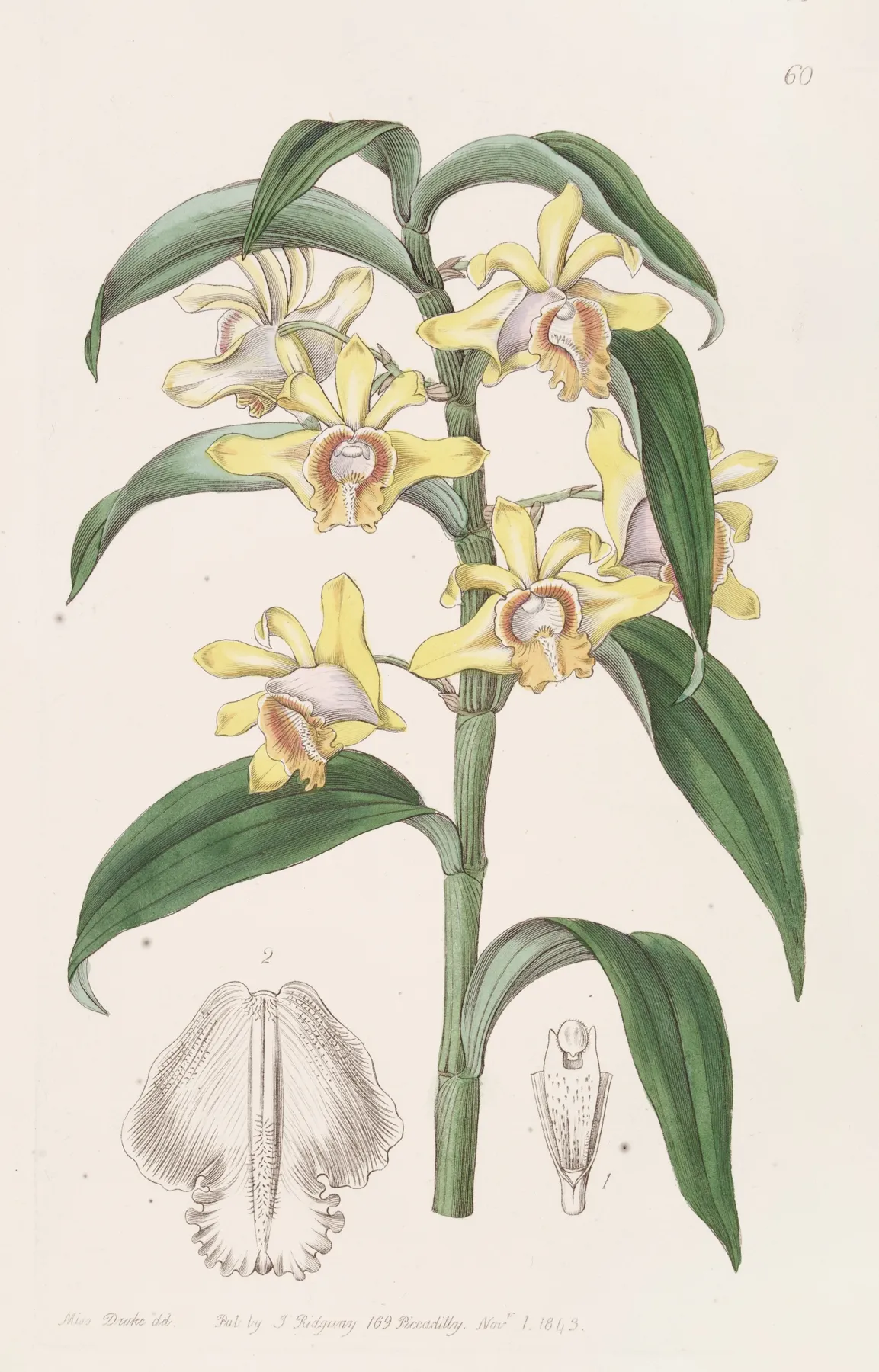
Mr. Rucker’s Dendrobium
Druake ded|Mr. Rucker’s Dendrobium
About this plate
Mr. Rucker’s Dendrobium is plate 737, from Edwards' Botanical Register, drawn by Sydenham Edwards, John Lindley. This public-domain plate is reproduced at high resolution, free to view and download. Publication: London, James Ridgway, 1829-1847.
Twelve ways of seeing
- measured cast yellow-green
- upright 1.56 : 1
- published 1829
- Plate 737
Not a catalogue entry but a way of looking: how to stand, what to notice, how the line was cut, when it flowers, where it came from, who made it — and then the poems and the classics that taught China to see the same flower. Read the twelve in order and the plate opens.
-
First Look
六法者何?一、气韵生动是也;二、骨法用笔是也;三、应物象形是也;四、随类赋彩是也;五、经营位置是也;六、传移模写是也。
—— 南齐·谢赫《古画品录》
The six laws: spirit resonance alive; bone-method in the brush; matching form; colour by kind; planning the placing; copying the masters.
The sheet is vertical: the eye climbs and settles in the upper half. Let the plant stand before you look for detail. Then step in close: watch where colour meets line, and whether the line ever breaks. Third, find the darkest small patch: the whole tonal order is measured from there.
-
Name and Thing
Only the genus Dendrobium is given; species-level names came later. No established Chinese name exists, so it is cited by its binomial alone.
-
Form and Colour
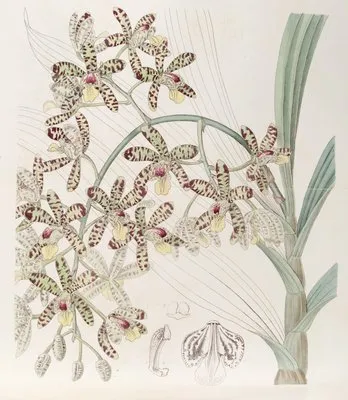
Measured on this plate: flower colour covers 5.6% of the sheet, foliage 9.2%, the cast yellow-green with a second note of amber. No other plate shares exactly this measure. Orchids carry pseudobulbs or fleshy roots; six tepals, one modified into a lip that serves as a landing stage, and a column uniting stamens and pistil — a structure unique to the family.No colour group is recorded. Three things fix the habit: leaf arrangement, tepal count, and how the flower is borne.
-
Composition
Tall and narrow, the plant rising in one movement with generous margins — the upright format of most floras. (about 1.56 : 1) No details are appended: a plate for looking, not for keying out. The plant covers only 26% of the sheet, centred near the centre; the emptiness is where the eye rests. Blank paper is not unfinished work: it is where the eye rests.
-
Line and Colour
The first half of the nineteenth century moved from copper to steel to lithography; stipple could render the softest transition. There is evidence on the back too: the plate mark pressed into the paper, the slight relief of the pigment, lines worn shallow in a later printing.
-
Season
Varies by genus: temperate terrestrials flower in spring and summer, tropical epiphytes almost year-round. The year 1829 on the plate is that of publication, not of flowering — the gathering came a year or two earlier. The best time to read such a plate is its flowering season: three minutes under the tree explains what no text can.
-
Provenance
Worldwide, richest on tropical mountains. Chinese cymbidiums come from the hills of the south; the orchids drawn for European portfolios came largely from the cloud forests of Central America and Southeast Asia. The volume was made in 1829-1847, when most of this knowledge came from living plants under glass.
-
The Book and the Hand
“Edwards' Botanical Register” was drawn by Sydenham Edwards, John Lindley and published 1829-1847. This plate is Plate 737. The image is public domain; the hand-colouring is still one person's hand.
-
Poetic Resonance
汉书扬雄传反离骚云:“灵修既信椒、兰之唼佞兮。
—— 《潜夫论·明暗第六》
The poem gives the mood first and the picture supplies the form; set the line beside the plate and the corolla becomes its resting point.
-
The Written Tradition
释名(闲)、木香、香水兰、女兰、香草、燕尾香、大泽兰、兰泽草、煎泽草、省头草、都梁香、孩儿菊、千金草。气味(叶)辛、平、无毒。
—— 本草纲目·兰草第九十三
Confucius, finding an orchid flowering alone in a valley, is said to have composed the 'Lament for the Orchid'; in the Li Sao, orchids are worn as a girdle of virtue. The difference is not of quality but of question: Europe asks what it is, China asks whom it resembles.
-
Symbolism
In China the orchid is the gentleman who blooms unseen; in Victorian Europe it was luxury and obsession, a single new species worth a fortune. Meanings change their tune: the same flower can say opposite things within a century.
-
What to Take Away
Next time you stand before a flowering plant, give it three minutes: leaf arrangement, direction of the flower, the darkest patch. A flora exists to be consulted; look long enough and you forget to consult — someone in 1829 gave a whole day to a single flower.