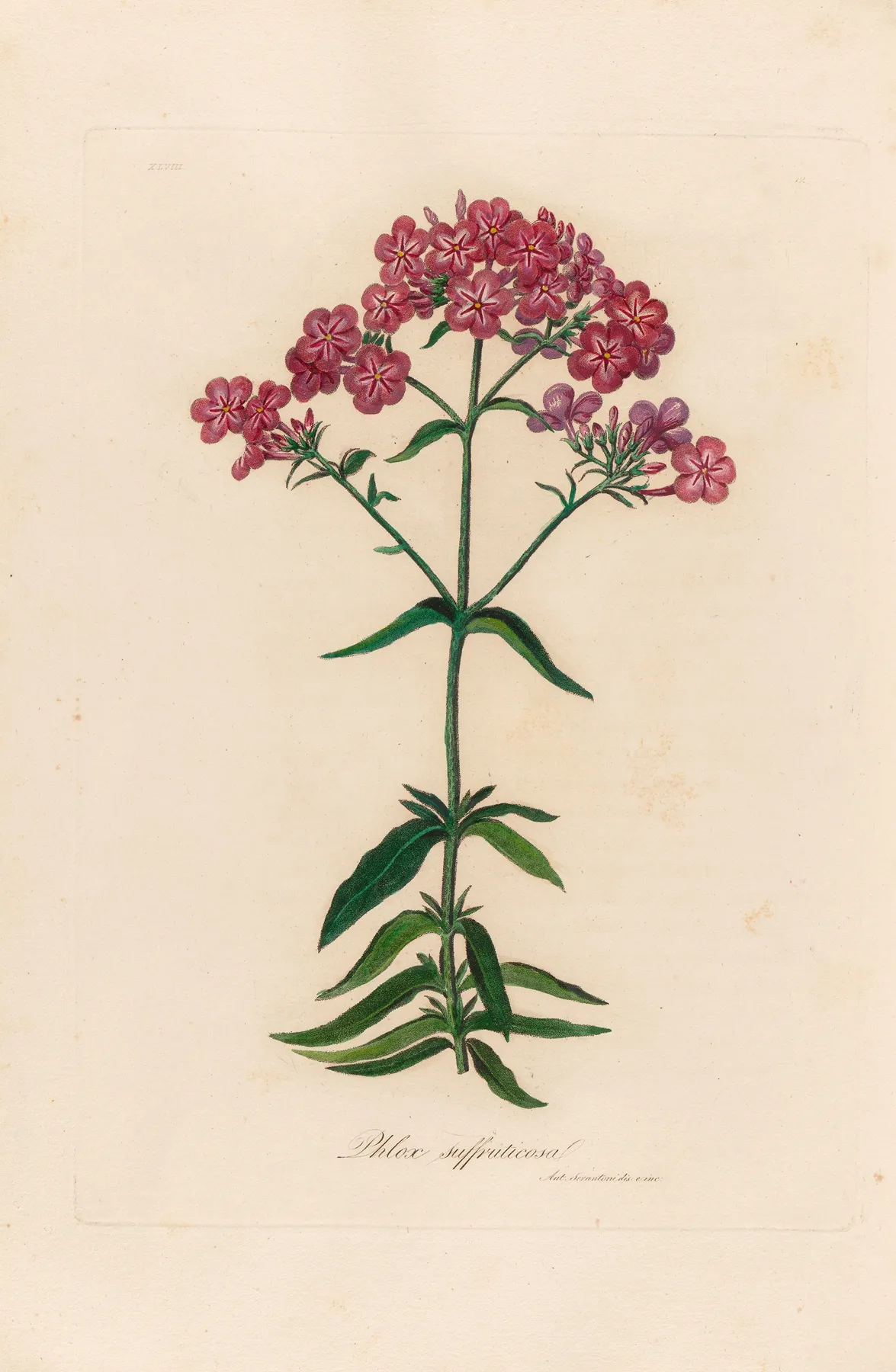
Phlox suffruticosa
Phlox sifp|花荵科
Phlox suffruticosa
About this plate
Phlox suffruticosa is plate 48, from Flora Italiana, drawn by Gaetano Savi. This public-domain plate is reproduced at high resolution, free to view and download. Publication: Pisa, Pressa Niccolò Capurro, 1818-1824.
Twelve ways of seeing
- measured cast red
- upright 1.53 : 1
- published 1818
- Plate 48
Not a catalogue entry but a way of looking: how to stand, what to notice, how the line was cut, when it flowers, where it came from, who made it — and then the poems and the classics that taught China to see the same flower. Read the twelve in order and the plate opens.
-
First Look
夫象物必在于形似,形似须全其骨气。
—— 唐·张彦远《历代名画记》
Likeness is the threshold; bone-and-breath is the point.
The sheet is vertical: the eye climbs and settles in the upper half. Let the plant stand before you look for detail. Then step in close: watch where colour meets line, and whether the line ever breaks. Third, find the darkest small patch: the whole tonal order is measured from there.
-
Name and Thing
The binomial is Phlox suffruticosa: the first word is the genus it belongs among, the second the epithet that sets it apart. Two words carry a whole provenance. The Chinese name 花荵科 is a modern rendering of the Latin, not an old garden name.
-
Form and Colour
Measured on this plate: flower colour covers 5.4% of the sheet, foliage 3.9%, the cast red. No other plate shares exactly this measure. Wildflowers are rarely tidy: small blooms, slender stems, leaves imperfect and often chewed. That untidiness is exactly what records wind, light and soil.No colour group is recorded. A single plant, laid out with nothing hidden.
-
Composition
Tall and narrow, the plant rising in one movement with generous margins — the upright format of most floras. (about 1.53 : 1) No details are appended: a plate for looking, not for keying out. The plant covers only 10% of the sheet, centred above centre; the emptiness is where the eye rests. Cover the margins with your thumb and the plate suffocates; uncover them and the flower breathes again.
-
Line and Colour
The first half of the nineteenth century moved from copper to steel to lithography; stipple could render the softest transition. Craft leaves franker evidence than inscriptions.
-
Season
By latitude and altitude; in the northeastern United States, April to August — each species for two or three weeks, so a wildflower book is arranged by month. The year 1818 on the plate is that of publication, not of flowering — the gathering came a year or two earlier. The best time to read such a plate is its flowering season: three minutes under the tree explains what no text can.
-
Provenance
Native plants of woodland floor, bog, roadside and rock crevice; they resent transplanting and will not mass in a border — the difference between a wildflower and a garden flower. The volume was made in 1818-1824, when most of this knowledge came from living plants under glass.
-
The Book and the Hand
“Flora Italiana” was drawn by Gaetano Savi and published 1818-1824. This plate is Plate 48. The image is public domain; the hand-colouring is still one person's hand.
-
Poetic Resonance
离离原上草,一岁一枯荣。野火烧不尽,春风吹又生。
—— 唐·白居易《赋得古原草送别》
Lush grass on the plain, once a year it withers and thrives; wildfire cannot burn it away — the spring wind blows and it grows again.
The poem gives the mood first and the picture supplies the form; set the line beside the plate and the corolla becomes its resting point.
-
The Written Tradition
庭下如积水空明,水中藻荇交横,盖竹柏影也。
—— 宋·苏轼《记承天寺夜游》
The courtyard seemed flooded with clear water, weeds crossing in it — in fact the shadows of bamboo and cypress.
The Book of Songs names more than 140 plants, most of them wild; Confucius said the Songs teach the names of birds, beasts and plants — natural history begins in the field. The difference is not of quality but of question: Europe asks what it is, China asks whom it resembles.
-
Symbolism
In Chinese verse wildflowers bloom unseen, owing nothing to praise; in the West they mark a place — one species, one landscape's character. Flower language was added later; the flower knows nothing of it, and that innocence is part of its power.
-
What to Take Away
Appreciation is not knowledge but habit — one more look each time. Two centuries on, the plant may still flower in some garden; the one on this sheet stopped in the season of 1818.