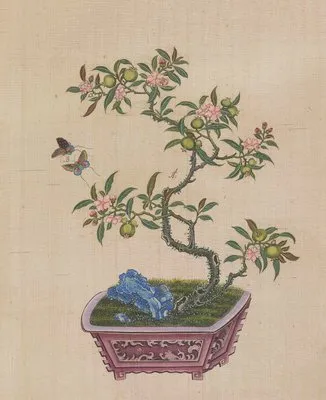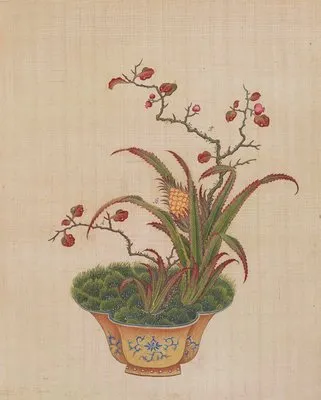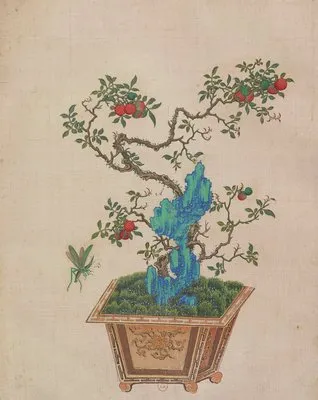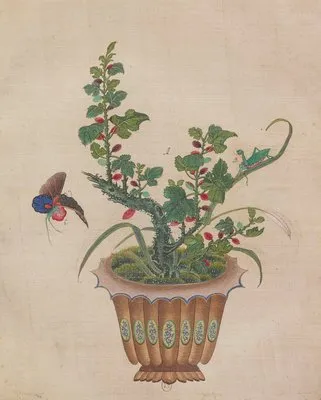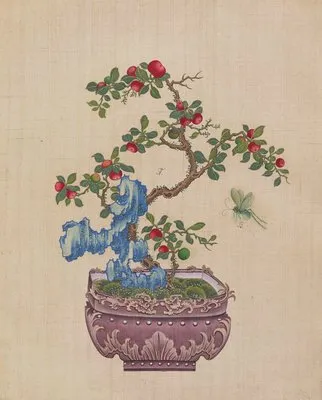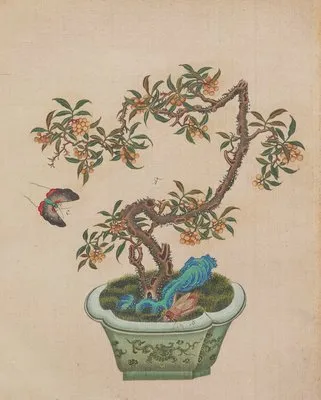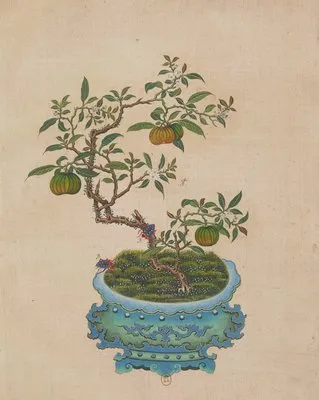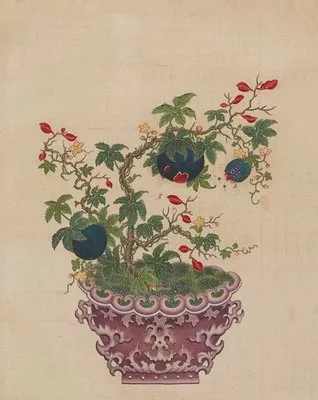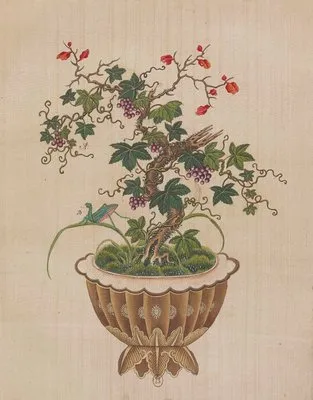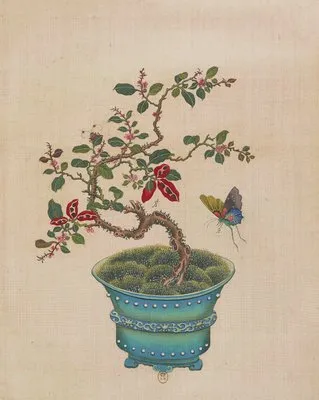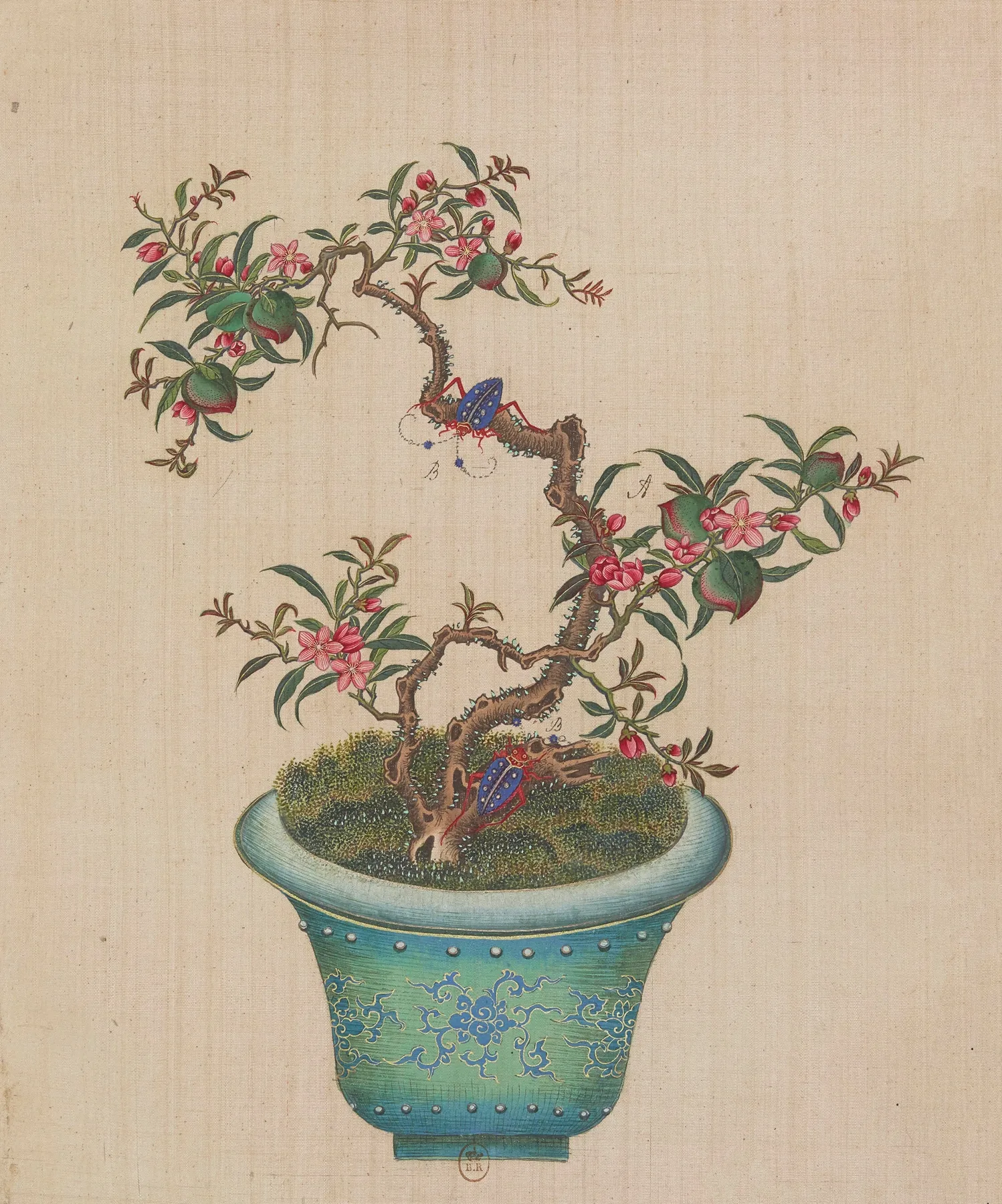
Flowers, birds and insects Pl.12 (18th century)
Flowers, birds and insects Pl.12 (18th century)
Ten ways of seeing
- measured cast amber
- slightly upright 1.20 : 1
First Look
夫象物必在于形似,形似须全其骨气。
—— 唐·张彦远《历代名画记》
Likeness is the threshold; bone-and-breath is the point.
Slightly taller than wide; the eye lands on the bird's head, a little above centre. Then step in close: watch where colour meets line, and whether the line ever breaks. Third, find where the orange is deepest: the whole tonal order is measured from that patch.
Name and Thing
No reliable binomial survives, so the printed title must serve. Neither name nor binomial survives: the printed title must do.
Form and Colour
Measured on this plate: flower colour covers 9.8% of the sheet, foliage 4.3%, the cast amber with a second note of yellow-green. No other plate shares exactly this measure. Bird plates usually choose the perched pose: one foot gripping, one loose, the flight feathers laid in first, coverts over them, then the horny gleam of bill and eye. Filed under orange — an amber orange. Feather colour is structure, not pigment: light bent by barbules. Three things fix the habit: leaf arrangement, tepal count, and how the flower is borne.
Composition
The sheet is slightly tall. No details are appended: a plate for looking, not for keying out. The plant covers only 20% of the sheet, centred below centre; the emptiness is where the eye rests.
Line and Colour
The exact date is lost. Woodcut before 1700, copper in the eighteenth century, steel and lithography from the 1820s, chromolithography by the century's end. There is evidence on the back too: the plate mark pressed into the paper, the slight relief of the pigment, lines worn shallow in a later printing. If you mean to copy it: take its skeleton, its margins and the order of its colours; the burin's hatching is the language of copper — suggest it with pencil density, do not imitate it stroke for stroke.
Poetic Resonance
青山黄鹤楼,白水黑龙潭,野猿啼碎胆。
—— 《中吕·红绣鞋·竹衫儿并刀》
The poem gives the mood first and the picture supplies the form; set the line beside the plate and the orange the bird itself becomes its resting point.
Symbolism
In China the crane is longevity, the magpie joy, the wild goose a letter, the eagle prowess; in the Americas each bird carries a different totem. One bird, unrelated meanings. This plate leans orange, which in flower language adds one more degree of feeling. In a flora it is a species first and a symbol second; the order is worth keeping.
Season and Place
Bound to migration: north in spring, south in autumn, each species answering to a few weeks. Audubon's plates often read 'adult, spring' — plumage at its height. Audubon's Birds of America (1827–1838) came from specimens he shot himself, wired into lifelike poses and drawn from life — which is why the birds look so alive, and why the method is uncomfortable. No firm date survives, so the season is inferred from the subject. Much of what that generation knew of such birds came from specimens and cages; read locality and season both as hearsay.
The Book and the Hand
“Flowers, birds and insects” carries only Anonymous's name. A plate is collective work: drawer, engraver and colourist were different hands, and the unnamed ones decided how good it looks.
What to Take Away
Carry three rules away: whole before detail; line before colour; picture before book. Look long enough at an old plate and you stop seeing the plant and start seeing the person who gave it a day.
About this plate
Flowers, birds and insects Pl.12 (18th century) is plate 12, from Flowers, birds and insects, drawn by Anonymous. This public-domain plate is reproduced at high resolution, free to view and download. Publication: China, 18th century.