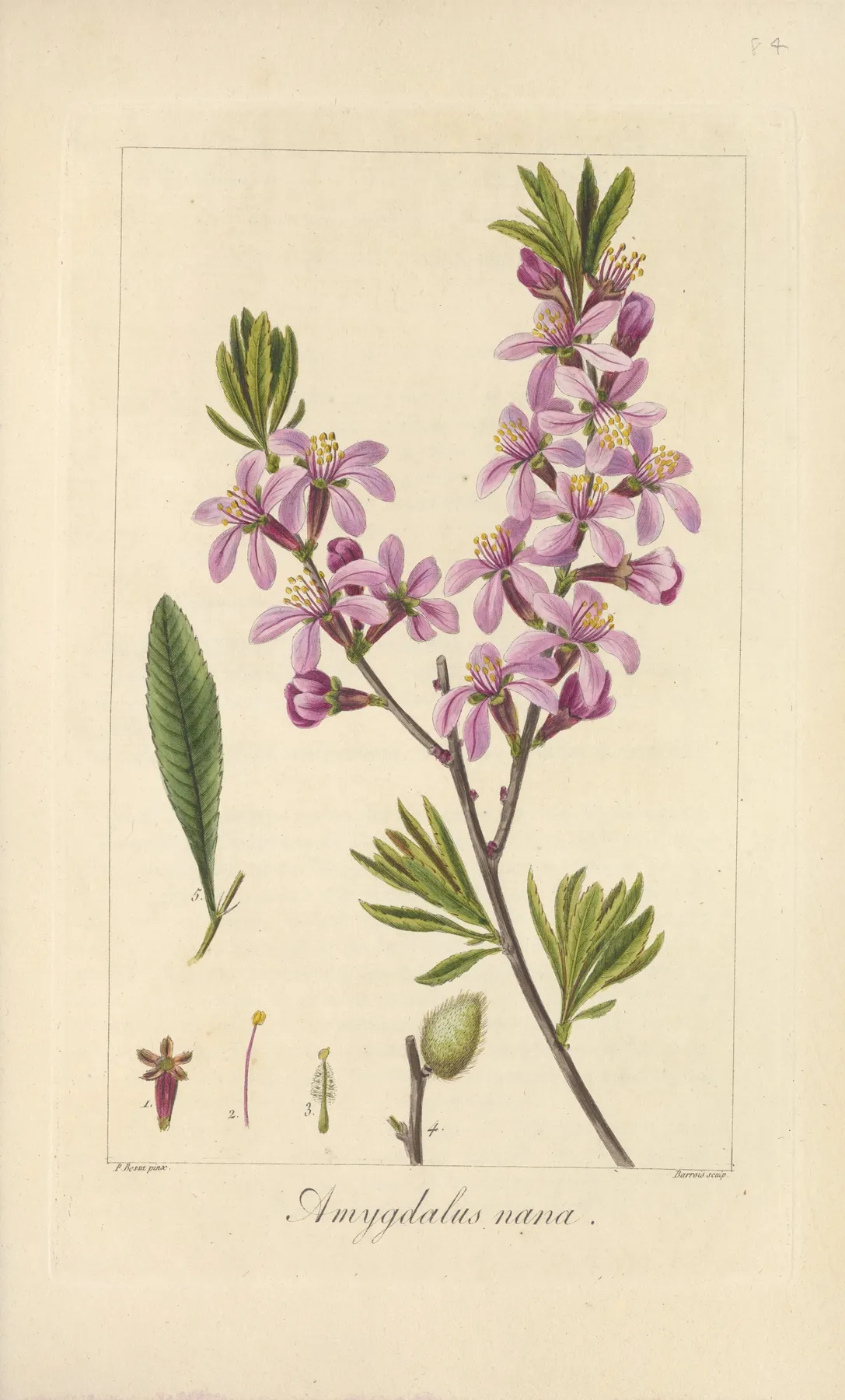
Amygdalus nana
Amygdalus nana|俄罗斯矮杏
Amygdalus nana
Ten ways of seeing
- measured cast yellow-green
- upright 1.66 : 1
First Look
真山水之川谷,远望之以取其势,近看之以取其质。
—— 宋·郭熙《林泉高致·山水训》
Mountains and valleys: from afar take their momentum, up close take their texture — the two distances from which any picture is read.
The sheet is vertical: the eye climbs and settles in the upper half. Let the plant stand before you look for detail. Then step in close: watch where colour meets line, and whether the line ever breaks. Third, find the darkest small patch: the whole tonal order is measured from there.
Name and Thing
The binomial is Amygdalus nana: the first word is the genus it belongs among, the second the epithet that sets it apart. Here the epithet nana means “dwarf” — the name records the feature the namer noticed first. The Chinese name 俄罗斯矮杏 is a modern rendering of the Latin, not an old garden name.
Form and Colour
Measured on this plate: flower colour covers 9.8% of the sheet, foliage 1.4%, the cast yellow-green with a second note of crimson. No other plate shares exactly this measure. Flowering trees and shrubs put out branches first; blossoms open before or with the leaves, usually five thin, translucent petals around a cluster of fine stamens.No colour group is recorded. A single plant, laid out with nothing hidden.
Composition
The sheet is tall. No details are appended: a plate for looking, not for keying out. The plant covers only 13% of the sheet, centred near the centre; the emptiness is where the eye rests.
Line and Colour
The first half of the nineteenth century moved from copper to steel to lithography; stipple could render the softest transition. Take a loupe to three places: petal edge, leaf vein, caption. An unbroken line means engraving; colour crossing the outline means a hand. If you mean to copy it: take its skeleton, its margins and the order of its colours; the burin's hatching is the language of copper — suggest it with pencil density, do not imitate it stroke for stroke.
Poetic Resonance
疏影横斜水清浅,暗香浮动月黄昏。
—— 宋·林逋《山园小梅》
Sparse shadows slant across the shallow water; hidden fragrance drifts in the dusk of the moon.
The poem gives the mood first and the picture supplies the form; set the line beside the plate and the corolla becomes its resting point.
Symbolism
Plum is solitude, peach is marriage, apricot is spring itself, crabapple is a fragile fate; the hibiscus, opening at dawn and falling at dusk, is impermanence. In a flora it is a species first and a symbol second; the order is worth keeping.
Season and Place
Mid spring: plum first, then peach and apricot, cherry last — the season keeps its order. East Asia and temperate Eurasia. Plum, peach and apricot are Chinese in origin, grown for three thousand years. The year 1816 on the plate is that of publication, not of flowering — the gathering came a year or two earlier. See this kind of plate in the flowering season if you can: once you have met the living flower, you stop reading only colour.
The Book and the Hand
“Herbier général de l'amateur” carries only Jean Claude Michel Mordant de Launay's name. A plate is collective work: drawer, engraver and colourist were different hands, and the unnamed ones decided how good it looks.
What to Take Away
Appreciation is not knowledge but habit — one more look each time. Two centuries on, the plant may still flower in some garden; the one on this sheet stopped in the season of 1816.
About this plate
Amygdalus nana is plate 42, from Herbier général de l'amateur, drawn by Jean Claude Michel Mordant de Launay. This public-domain plate is reproduced at high resolution, free to view and download. Publication: Paris, Audot, Libraire, 1816-1827.