Camellia sasanqua
Camelliv sasangua|茶梅
Camellia sasanqua
About this plate
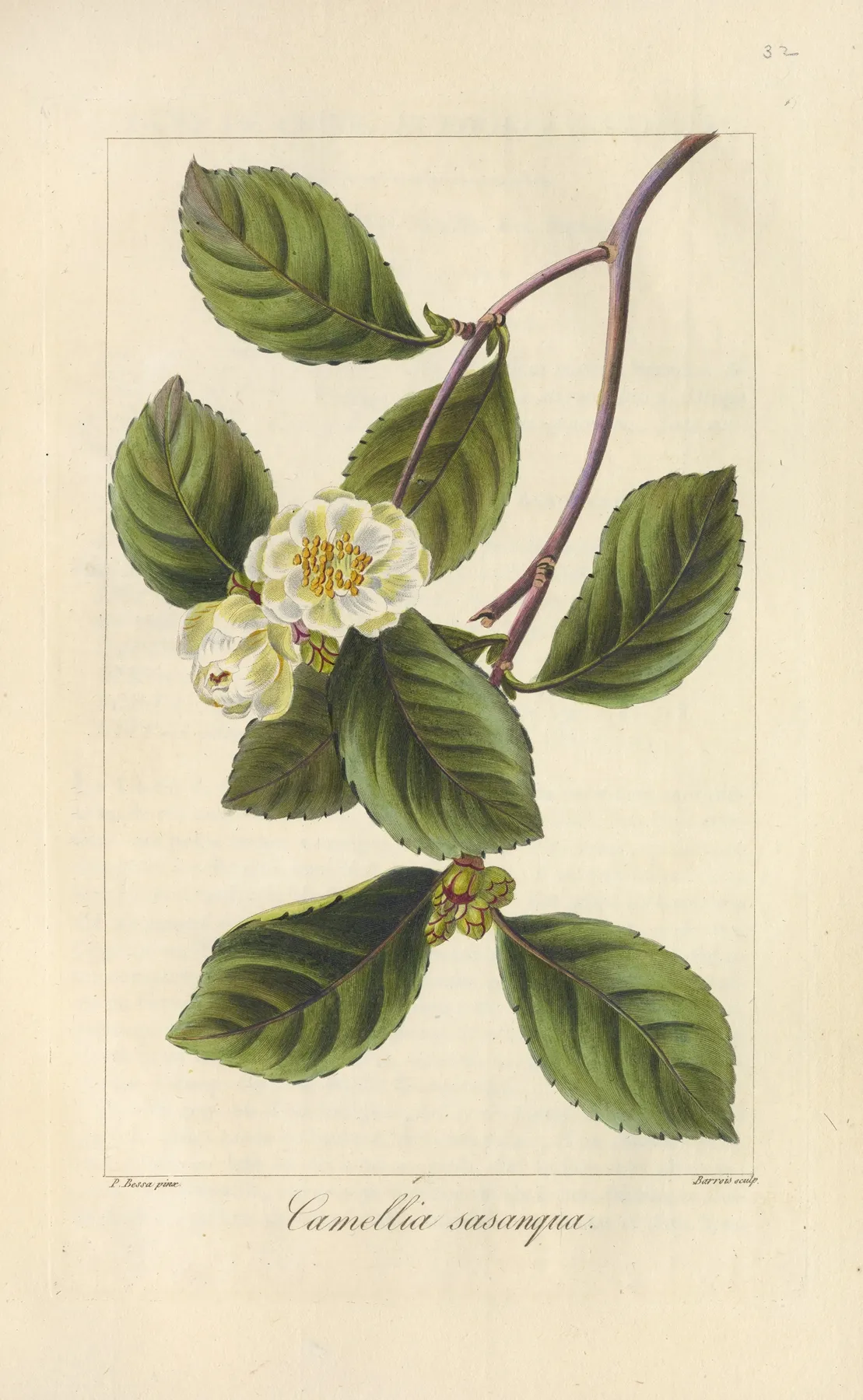
Camellia sasanqua is plate 16, from Herbier général de l'amateur, drawn by Jean Claude Michel Mordant de Launay. This public-domain plate is reproduced at high resolution, free to view and download. Publication: Paris, Audot, Libraire, 1816-1827.
Twelve ways of seeing
One plate, read twelve times over: its name, its colour, the burin and the brush, the shape of the sheet, the season, the soil it came from, the book it belongs to, its language of flowers, the poem it answers to, the lore behind it, how to look, and what remains.
-
The Name
The plate is titled “Camellia sasanqua”, numbered Plate 16. Its binomial is Camellia sasanqua; the genus name Camellia means what it still means in Latin: Camellia honours Georg Kamel, the Moravian Jesuit who first described the plant in the Philippines. The Chinese name 茶梅 is a modern rendering of the Latin, not an old garden name — between a plant and its names there is always translation.
-
Form and Colour
Camellias are evergreen shrubs with thick, waxen, serrate leaves; the double flowers overlap like roof tiles and fall whole, petals still attached. No colour group is recorded for this plate, but the palette still belongs to its season. A single plant, laid out on the sheet with nothing hidden.
-
Line and Colour
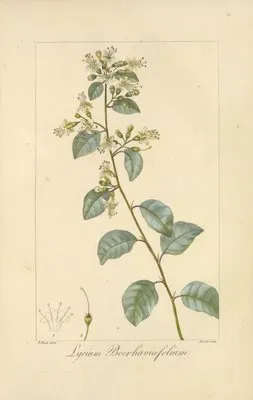
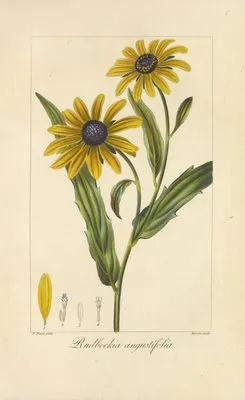
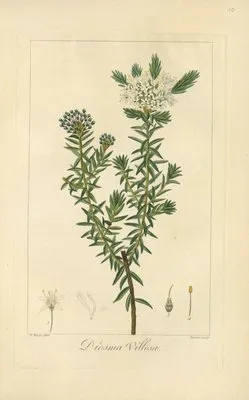
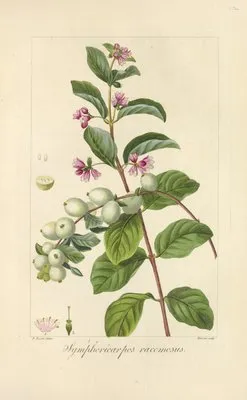
The first half of the nineteenth century moved from copper to steel to lithography. Stipple could render the softest transition — Redouté's roses depend on it — while lithography suited broad, gentle washes. Look closely at the line and the colour: an unbroken line means engraving, colour crossing the outline by half a millimetre means hand-colouring. Craft leaves franker evidence than inscriptions.
-
Composition
Tall and narrow, the plant rising in one movement with generous margins above and below — the upright format of most floras. (about 1.62 : 1). No details are appended: this is a plate for looking, not for keying out.
-
Season
Late winter into early spring, blooming in the cold of the first lunar month; a single flower may last a fortnight. The year 1816 on the plate is the year of publication, not of flowering — the gathering came a year or two earlier.
-
Provenance
Southwest China and Japan, with Yunnan the centre of diversity; when it reached Europe in the nineteenth century it was hailed as 'the rose of the East'. The volume was made in 1816-1827, when most of this knowledge came from living plants under glass rather than from the wild.
-
The Book
“Herbier général de l'amateur” was drawn by Jean Claude Michel Mordant de Launay and published 1816-1827. This plate is Plate 16. The image is in the public domain; the hand-colouring on the paper is still one person's hand, two centuries ago.
-
Symbolism
In China the camellia is the friend that endures; in Europe it became Eastern beauty and unattainability, and after La Dame aux Camélias, a token of brief life. Flower language was added later; the flower knows nothing of it, and that innocence is part of its power.
-
Poetic Resonance
落红不是无情物,化作春泥更护花。
—— 清·龚自珍《己亥杂诗》
Fallen petals are not heartless things; turned to spring mud, they shelter the flowers still to come.
The poem gives the mood first and the picture supplies the form; set the line beside the plate and the corolla becomes its resting point.
-
Classical Lore
Ming flower manuals list dozens of camellia varieties; the Bencao Gangmu presses oil from the seeds and brews the leaves — the plant belongs to both flower lore and pharmacy. Chinese flower books ranked plants by character; European floras described them by form and name. This plate belongs to the second tradition, yet bears reading by the first. A flora asks what it is; a flower book asks what it means. Read both or half-read the plate.
-
How to Look
See whether the petals overlap like tiles and whether the leaf's waxen sheen is rendered. The camellia's signature is falling whole — a fallen bloom in the frame is a deliberate touch. And read the caption and number: not part of the picture, but the door through which it entered knowledge.
-
Afterword
A flora exists to be consulted; look long enough and you forget to consult — someone in 1816 gave a whole day to a single flower.