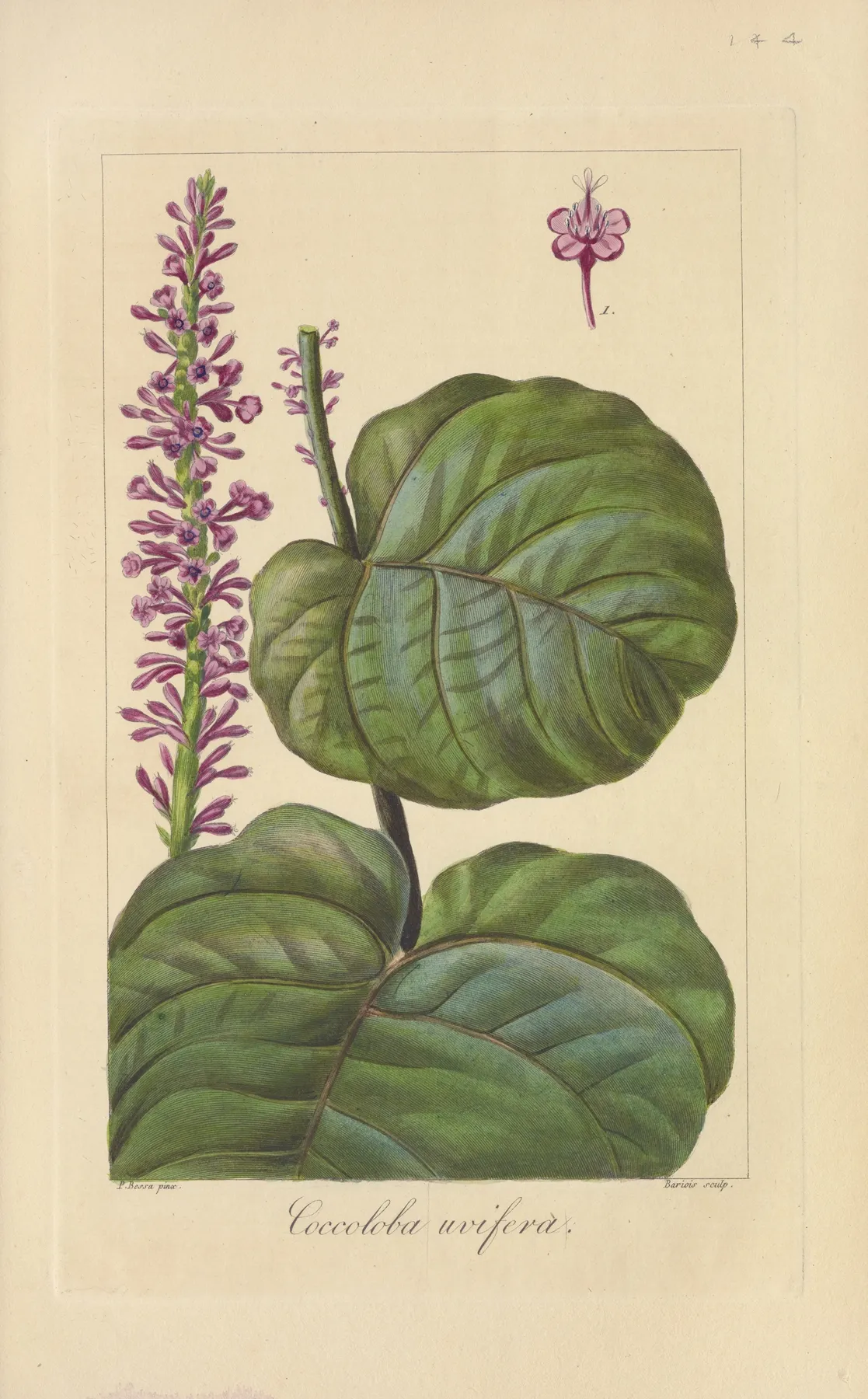
Coccoloba uvifera
Cocoloba wiferirs|海葡萄
Coccoloba uvifera
About this plate
Coccoloba uvifera is plate 72, from Herbier général de l'amateur, drawn by Jean Claude Michel Mordant de Launay. This public-domain plate is reproduced at high resolution, free to view and download. Publication: Paris, Audot, Libraire, 1816-1827.
Twelve ways of seeing
- measured cast yellow-green
- upright 1.61 : 1
- published 1816
- Plate 72
Not a catalogue entry but a way of looking: how to stand, what to notice, how the line was cut, when it flowers, where it came from, who made it — and then the poems and the classics that taught China to see the same flower. Read the twelve in order and the plate opens.
-
First Look
凡画山水,意在笔先。
—— 唐·王维《山水论》
In painting, the intention precedes the brush.
The sheet is vertical: the eye climbs and settles in the upper half. Let the plant stand before you look for detail. Then step in close: watch where colour meets line, and whether the line ever breaks. Third, find where the orange is deepest: the whole tonal order is measured from that patch.
-
Name and Thing
The binomial is Coccoloba uvifera: the first word is the genus it belongs among, the second the epithet that sets it apart. Two words carry a whole provenance. The Chinese name 海葡萄 is a modern rendering of the Latin, not an old garden name.
-
Form and Colour
Measured on this plate: flower colour covers 12.7% of the sheet, foliage 17.6%, the cast yellow-green with a second note of red. No other plate shares exactly this measure. Fruit plates pair the whole fruit with a section: the outline identifies the variety, the cut reveals skin thickness, core size and seed arrangement — the evidence of registration. Filed under orange — an amber orange, built in washes from a pale ground. Read the outline, then the colour layers, then the brush.
-
Composition
Tall and narrow, the plant rising in one movement with generous margins — the upright format of most floras. (about 1.61 : 1) No details are appended: a plate for looking, not for keying out. The plant takes about 35% of the sheet, centred below centre — the easy measure most florists kept to. Blank paper is not unfinished work: it is where the eye rests.
-
Line and Colour
The first half of the nineteenth century moved from copper to steel to lithography; stipple could render the softest transition. Decide first whether it was printed or painted; only then discuss whether it is beautiful.
-
Season
Late summer into autumn, variety by variety; a fruit portfolio spans the whole harvest. The year 1816 on the plate is that of publication, not of flowering — the gathering came a year or two earlier. The best time to read such a plate is its flowering season: three minutes under the tree explains what no text can.
-
Provenance
Temperate fruits came mostly from Eurasia, later from the Americas. Nineteenth-century nurseries printed varietal albums for trade and exhibition: every fruit on the page was a saleable claim. In the same volume the kin are shelved together; set several plates side by side.
-
The Book and the Hand
“Herbier général de l'amateur” was drawn by Jean Claude Michel Mordant de Launay and published 1816-1827. This plate is Plate 72. The image is public domain; the hand-colouring is still one person's hand.
-
Poetic Resonance
荔枝新熟鸡冠色,烧酒初开琥珀香。
—— 唐·白居易《荔枝楼对酒》
The poem gives the mood first and the picture supplies the form; set the line beside the plate and the orange the fruit becomes its resting point.
-
The Written Tradition
庭下如积水空明,水中藻荇交横,盖竹柏影也。
—— 宋·苏轼《记承天寺夜游》
The courtyard seemed flooded with clear water, weeds crossing in it — in fact the shadows of bamboo and cypress.
The Book of Songs has a quince given and a jade pendant returned — fruit as ritual gift already in pre-Qin China. Keep the line; it will surface the next time you meet the same plant.
-
Symbolism
In China the pomegranate means many sons, the peach long life, the orange good fortune; in Europe the apple is temptation and knowledge, the grape abundance and sacrifice. This plate leans orange, which in flower language adds one more degree of feeling. Meanings change their tune: the same flower can say opposite things within a century.
-
What to Take Away
Carry three rules away: whole before detail; line before colour; picture before book. Two centuries on, the plant may still flower in some garden; the one on this sheet stopped in the season of 1816.