Adelomyia maculata
鳞斑蜂鸟属
Adelomyia maculata
Spotted Adelomyia
About this plate
Ecuador
In the letterpress accompanying my plate of A. melanogenys, I stated that the range of that species extended “from the Caraccas to Ecuador and Peru,” but I find that the birds ranging over these countries are referable to two very distinct species.
Those from the Caraccas, from which my figures were taken, are much smaller in size and have much broader tail-feathers than those from Ecuador. The question then arises, which of the two should bear the specific name of melanogenys? This unfortunately I have no means of determining; I have therefore thought it desirable to give a name to the bird inhabiting Ecuador. That the A. maculata ranges widely I know; for I have seen examples from Ecuador, Peru, and the banks of the Napo. There appears to be no outward difference in the sexes, at least I find no perceptible variation in the colouring of the great number of specimens now before me. If it should ultimately prove that the terms melanogenys, Sabinæ, and maculata are all one and the same species, then a new name must be proposed for the little bird collected by Mr. Dyson in the Caraccas. If, on the other hand, the term melanogenys be allowed to stand as the specific designation of that bird, so much the better; as, by that means, much confusion will be obviated.
It will be observed that, although any brilliant colouring is denied to the under surface of most of the members of the genus Adelomyia, the green of their backs and upper surface is more than usually lustrous.
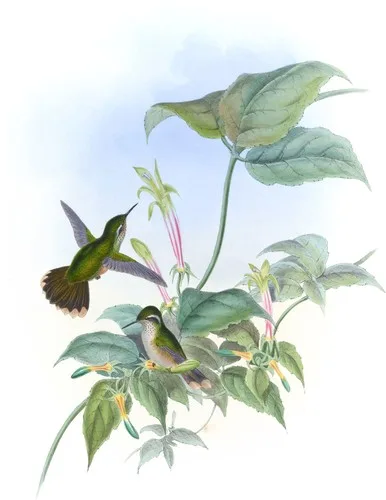
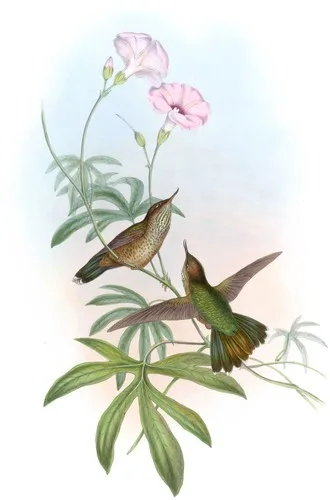
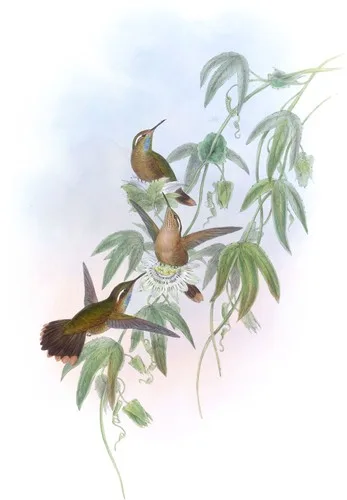
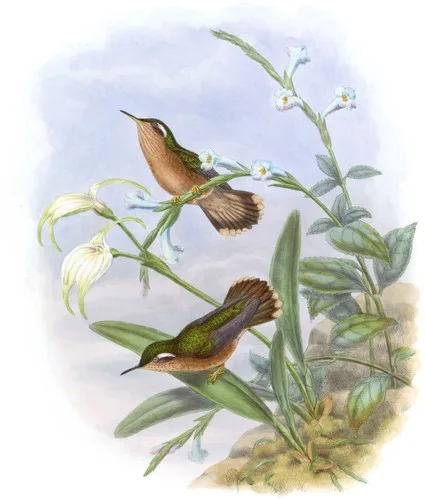
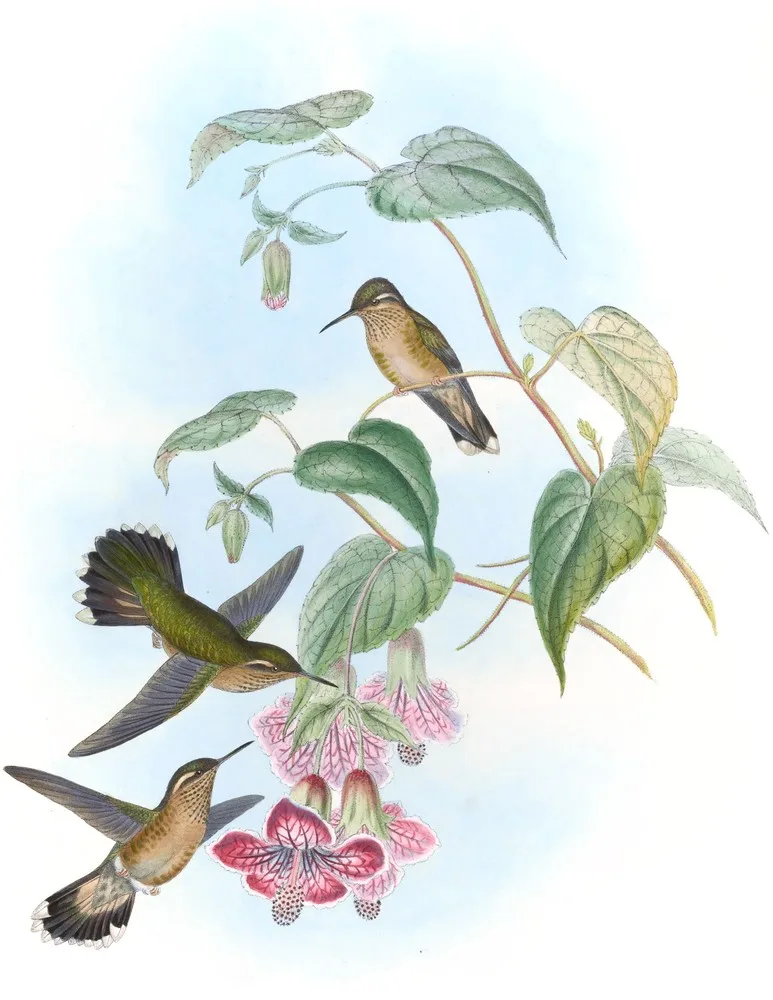
All the upper surface shining bronzy green; wings deep brownish purple; two centre tail-feathers greenish purple glossed with bronze; the remainder of the same hue on the outer webs and across the inner web near the tip, the basal portion of the inner web and the tips of both webs being buffy white; under surface mingled buff and bronzy green, assuming a spotted character on the throat.
The figures are of the natural size. The plant is the Abutilon insigne.