Cœligena Prunelli
Cœligena Prunelli
Prunelle’s Cœligene
About this plate
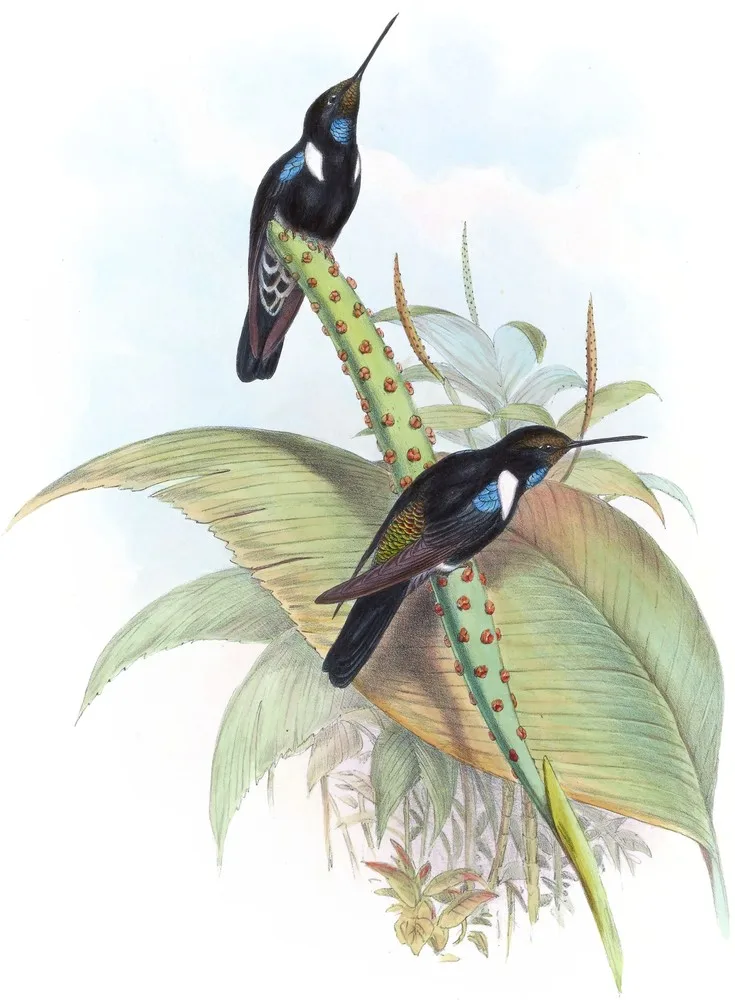
Andes of New Granada. Common in collections from Bogota.
This, like most of the straight-billed Humming-birds, is a native of Columbia and New Grenada; it is a most interesting and attractive species, and is plentifully sent to this country from Bogota: seldom indeed does a collection arrive from that part of South America which does not contain examples.
M. Bourcier gives the environs of Facativa, in Columbia, as one of the localities in which specimens have been procured. The conspicuous white mark on the side of the chest, beautifully relieved by the black of the surrounding parts, the glittering glaucous green of the shoulders, and the variegated colouring of the back, all tend to render it remarkably different from its congeners. The specific name, bestowed upon this bird by M. Bourcier, is intended as a compliment to Dr. Prunelle, one of the scientific celebrities of the city of Lyons.
The sexes present no marked difference in their colouring, but the female is rather less brilliant, and somewhat smaller than her mate.
General plumage dark purplish-black; a bronzy gloss on the forehead; a narrow mark of bluish-green on the lower part of the throat; on each side the chest a large and conspicuous patch of white; wing-coverts steel-blue with green reflexions; wings dark purplish-brown; tail dark velvety purplish-black; under tailcoverts fringed with white; back and upper tail-coverts, when viewed from behind a mass of colour, of which language can convey no idea, being a mingling of crimson, green, purple and red, changing with the direction of the rays of light, or perfectly iridescent; bill black; feet fleshy-brown.
The figures are of the natural size. The plant is a portion of the Chamædorea Ernesti-Augusti.
References
- Trochilus Prunelli, Boure. Ann. de la Soc. Sci. de Lyon, tom. vi. 1843, p. 36. pl. 1.—Ib. Rev. Zool. 1843, p. 70.
- Mellisuga Prunellei, Gray and Mitch. Gen. of Birds, vol. i. p. 112, Mellisuga, sp. 11.
- Homophania Prunellii, Reich. Aufz. der Col., p. 10.
- Bourcieria prunellii, Bonap. Rev. et Mag. de Zool. 1854, p. 292.
Twelve ways of seeing
- upright 1.36 : 1
- published 1854
- Pl. 257, Vol. IV
Not a catalogue entry but a way of looking: how to stand, what to notice, how the line was cut, when it flowers, where it came from, who made it — and then the poems and the classics that taught China to see the same flower. Read the twelve in order and the plate opens.
-
First Look
凡画山水,意在笔先。
—— 唐·王维《山水论》
In painting, the intention precedes the brush.
The sheet is vertical: the eye climbs and settles on the bird. Take the posture before the plumage. Then step in close: watch where colour meets line, and whether the line ever breaks. Third, find the darkest small patch: the whole tonal order is measured from there.
-
Name and Thing
No reliable binomial survives, so the printed title must serve. Neither name nor binomial survives: the printed title must do.
-
Form and Colour
The smallest of birds: a needle-fine bill, a forked tubular tongue, wings beating so fast the bird hovers and even flies backwards. Its colour is not pigment but structure — light bent by feather barbules, changing with the angle.No colour group is recorded. A single plant, laid out with nothing hidden.
-
Composition
Tall and narrow, the bird perched mid-branch with generous margins above and below. (about 1.36 : 1) No details are appended: a plate for looking, not for keying out. Old plates set the plant slightly off centre, with unequal margins — that small imbalance is what keeps it alive.
-
Line and Colour
In the later nineteenth century chromolithography took over: colour printed rather than painted, line demoted. Take a loupe to three places: petal edge, leaf vein, caption. An unbroken line means engraving; colour crossing the outline means a hand.
-
Season
In tropical America they are present all year, their season set by flowers; temperate hummingbirds follow the bloom north and back, thousands of kilometres a year. The year 1854 on the plate is that of publication, not of flowering — the gathering came a year or two earlier. The best time to read such a plate is its flowering season: three minutes under the tree explains what no text can.
-
Provenance
Americas only, from southern Alaska to Tierra del Fuego, richest in the Andes. China has no hummingbirds and no classical record of them; the name arrives with late-Qing travel writing. The volume was made in 1849-1887, when most of this knowledge came from living plants under glass.
-
The Book and the Hand
“Gould's Hummingbirds” was drawn by John Gould and published 1849-1887. This plate is Pl. 257, Vol. IV, book page 257. The image is public domain; the hand-colouring is still one person's hand.
-
Poetic Resonance
穿花蛱蝶深深见,点水蜻蜓款款飞。
—— 唐·杜甫《曲江二首》
Butterflies thread the flowers, seen deep within; dragonflies touch the water and fly on, slow and deliberate.
The poem gives the mood first and the picture supplies the form; set the line beside the plate and the bird itself becomes its resting point.
-
The Written Tradition
写气图貌,既随物以宛转;属采附声,亦与心而徘徊。
—— 南朝梁·刘勰《文心雕龙·物色》
In tracing the spirit and drawing the shape one follows the object; in choosing colour and sound one lingers with the heart.
Gould's Hummingbirds (1849–1887) used hand-coloured lithography over gold leaf so the iridescence survived on paper — a monument to Victorian printing and collecting alike. The difference is not of quality but of question: Europe asks what it is, China asks whom it resembles.
-
Symbolism
For the Aztecs the hummingbird was warrior and sun; for Victorian Europe it was the ultimate ornament, millions killed for breast jewellery. China has no tradition here — and that blank is itself a history of exchange. In a flora it is a species first and a symbol second; the order is worth keeping.
-
What to Take Away
Carry three rules away: whole before detail; line before colour; picture before book. A flora exists to be consulted; look long enough and you forget to consult — someone in 1854 gave a whole day to a single flower.