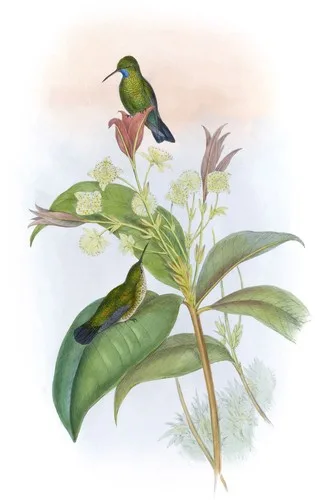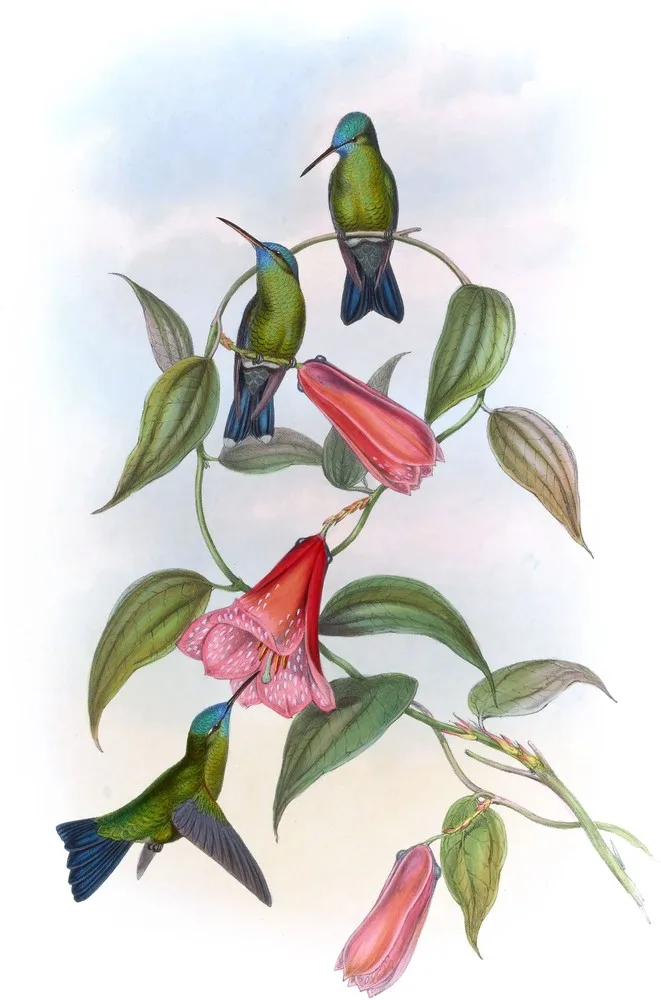
Eucephala smaragdo-cærulea
Eucephala smaragdo-cærulea
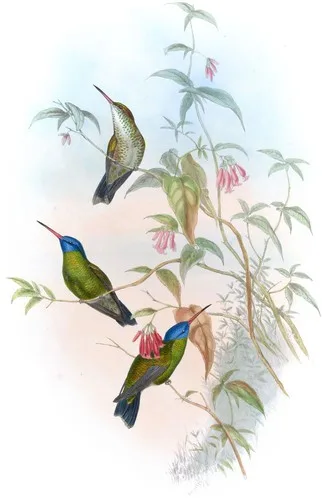
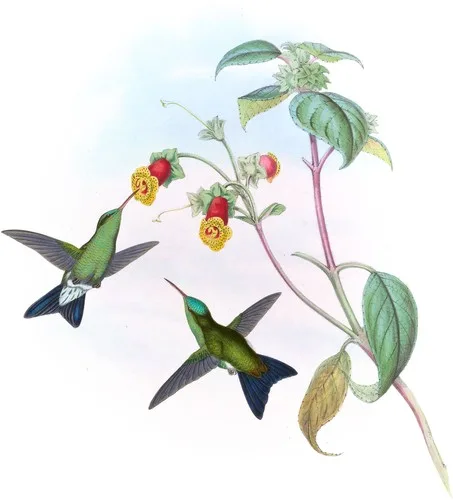
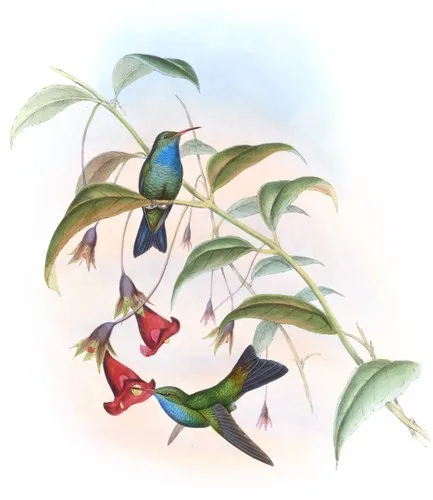
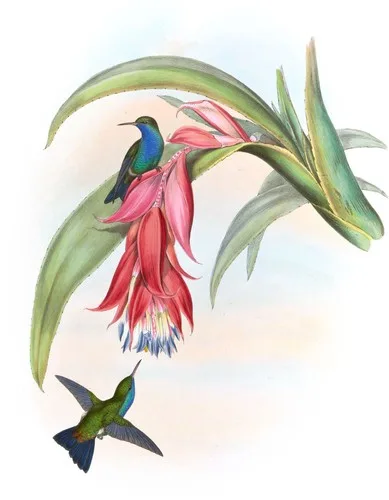
Green and Blue Sapphire
About this plate
Brazil, from Rio de Janeiro towards the interior
It is to Mr. Reeves of Rio de Janeiro that I am indebted for a specimen of this rare species of HummingBird, of which I have as yet seen but two examples; the one in my own collection, and another in that of M. Verreaux of Paris.
Mr. Reeves states that the bird inhabits Novo Friburgo, and that the specimen he sent me was killed on the skirts of the virgin forest. This species forms another link in the chain of evidence which assures us that many new Humming-Birds are yet to be found in the far-distant and unexplored interior of the great country of Brazil; for if we find so fine a bird as the present inhabiting a district but a short distance from the capital, where man is widely spread and daily engaged in collecting specimens, no doubt many other species will be discovered when the country is more closely searched.
It will be seen that I first described this species in the ‘Proceedings of the Zoological Society’ for 1860, and that I therein proposed for it the generic term of Augasma; in the present work, however, I retain it under the name of Eucephala. We really have not sufficient examples of this and one or two other nearly allied Humming-Birds to enable us to determine whether they should be generically separated or not.
This elegantly formed bird is about the size of Thalurania furcata; it is therefore a rather large species. Those who are acquainted with the T. chlorocephala of M. Bourcier will find in this a very near ally; I have not the least doubt, however, of its being quite distinct. In M. Verreaux’s specimen the white tippings of the outer tail-feathers are nearly obsolete, while in mine they are conspicuous; in my specimen, also, the two middle tail-feathers are marked with green on their upper surface, while in M. Verreaux’s (which I believe to be an older bird than mine) these feathers are uniform in colour throughout.
Having only seen two specimens, I cannot of course say whether the sexes offer any difference in the colouring of their plumage and other external characters.
Crown of the head and throat glittering greenish blue, imperceptibly passing into the glittering green of the breast; back of the neck and upper surface golden green; upper tail-coverts grass-green; under tailcoverts green, inclining to purple on some of the feathers; thighs brown; tail bluish black, the two outer feathers on each side slightly tipped with white; bill black, with the exception of the basal half of the under mandible, which is flesh-colour.
The figures are of the natural size. The plant is the Lepageria rosea.
References
- Augasma smaragdineum, Gould in Proc. of Zool. Soc., part xxviii. p. 305.
Twelve ways of seeing
- upright 1.51 : 1
- published 1861
- Pl. 331, Vol. V
Not a catalogue entry but a way of looking: how to stand, what to notice, how the line was cut, when it flowers, where it came from, who made it — and then the poems and the classics that taught China to see the same flower. Read the twelve in order and the plate opens.
-
First Look
夫象物必在于形似,形似须全其骨气。
—— 唐·张彦远《历代名画记》
Likeness is the threshold; bone-and-breath is the point.
The sheet is vertical: the eye climbs and settles on the bird. Take the posture before the plumage. Then step in close: watch where colour meets line, and whether the line ever breaks. Third, find the darkest small patch: the whole tonal order is measured from there.
-
Name and Thing
No reliable binomial survives, so the printed title must serve. Neither name nor binomial survives: the printed title must do.
-
Form and Colour
The smallest of birds: a needle-fine bill, a forked tubular tongue, wings beating so fast the bird hovers and even flies backwards. Its colour is not pigment but structure — light bent by feather barbules, changing with the angle.No colour group is recorded. Read the outline, then the colour layers, then the brush.
-
Composition
Tall and narrow, the bird perched mid-branch with generous margins above and below. (about 1.51 : 1) No details are appended: a plate for looking, not for keying out. Blank paper is not unfinished work: it is where the eye rests.
-
Line and Colour
In the later nineteenth century chromolithography took over: colour printed rather than painted, line demoted. Take a loupe to three places: petal edge, leaf vein, caption. An unbroken line means engraving; colour crossing the outline means a hand.
-
Season
In tropical America they are present all year, their season set by flowers; temperate hummingbirds follow the bloom north and back, thousands of kilometres a year. The year 1861 on the plate is that of publication, not of flowering — the gathering came a year or two earlier. The plate records ten days of peak; the other three hundred are leaf, fruit and rest.
-
Provenance
Americas only, from southern Alaska to Tierra del Fuego, richest in the Andes. China has no hummingbirds and no classical record of them; the name arrives with late-Qing travel writing. The localities on the plate are those of a century ago; plants travel and places change their names.
-
The Book and the Hand
“Gould's Hummingbirds” was drawn by John Gould and published 1849-1887. This plate is Pl. 331, Vol. V, book page 331. The image is public domain; the hand-colouring is still one person's hand.
-
Poetic Resonance
夫列子御风而行,泠然善也,旬有五日而后反。
—— 《庄子·逍遥游》
Liezi rode the wind and came back after fifteen days, so light was his going.
The poem gives the mood first and the picture supplies the form; set the line beside the plate and the bird itself becomes its resting point.
-
The Written Tradition
竖划三寸,当千仞之高;横墨数尺,体百里之迥。
—— 南朝宋·宗炳《画山水序》
A vertical stroke of three inches stands for a cliff of a thousand fathoms; a few feet of ink holds a hundred li. Smallness of scale was never the obstacle.
Gould's Hummingbirds (1849–1887) used hand-coloured lithography over gold leaf so the iridescence survived on paper — a monument to Victorian printing and collecting alike. The difference is not of quality but of question: Europe asks what it is, China asks whom it resembles.
-
Symbolism
For the Aztecs the hummingbird was warrior and sun; for Victorian Europe it was the ultimate ornament, millions killed for breast jewellery. China has no tradition here — and that blank is itself a history of exchange. In a flora it is a species first and a symbol second; the order is worth keeping.
-
What to Take Away
Next time you watch a bird: posture first, then where the plumage is deepest, and only then the field guide. Two centuries on, the plant may still flower in some garden; the one on this sheet stopped in the season of 1861.