Hylocharis sapphirina
棕喉红嘴蜂鸟
Hylocharis sapphirina
Red-throated Sapphire
Ten ways of seeing
- upright 1.49 : 1
First Look
真山水之川谷,远望之以取其势,近看之以取其质。
—— 宋·郭熙《林泉高致·山水训》
Mountains and valleys: from afar take their momentum, up close take their texture — the two distances from which any picture is read.
The sheet is vertical: the eye climbs and settles on the bird. Take the posture before the plumage. Then step in close: watch where colour meets line, and whether the line ever breaks. Third, find the darkest small patch: the whole tonal order is measured from there.
Name and Thing
The binomial is Hylocharis sapphirina: the first word is the genus it belongs among, the second the epithet that sets it apart. Two words carry a whole provenance. The Chinese name 棕喉红嘴蜂鸟 is a modern rendering of the Latin, not an old garden name.
Form and Colour
The smallest of birds: a needle-fine bill, a forked tubular tongue, wings beating so fast the bird hovers and even flies backwards. Its colour is not pigment but structure — light bent by feather barbules, changing with the angle.No colour group is recorded. A single plant, laid out with nothing hidden.
Composition
Tall and narrow, the bird perched mid-branch with generous margins above and below. No details are appended: a plate for looking, not for keying out. Old plates set the plant slightly off centre, with unequal margins — that small imbalance is what keeps it alive.
Line and Colour
In the later nineteenth century chromolithography took over: colour printed rather than painted, line demoted. Take a loupe to three places: petal edge, leaf vein, caption. An unbroken line means engraving; colour crossing the outline means a hand. If you mean to copy it: block in the broad shapes and colours first, detail last; lithographic softness comes from thin washes — two or three pale layers will get you close.
Poetic Resonance
穿花蛱蝶深深见,点水蜻蜓款款飞。
—— 唐·杜甫《曲江二首》
Butterflies thread the flowers, seen deep within; dragonflies touch the water and fly on, slow and deliberate.
The poem gives the mood first and the picture supplies the form; set the line beside the plate and the bird itself becomes its resting point.
Symbolism
For the Aztecs the hummingbird was warrior and sun; for Victorian Europe it was the ultimate ornament, millions killed for breast jewellery. China has no tradition here — and that blank is itself a history of exchange. Flower language was added later; the flower knows nothing of it, and that innocence is part of its power.
Season and Place
In tropical America they are present all year, their season set by flowers. Americas only, from southern Alaska to Tierra del Fuego, richest in the Andes. China has no hummingbirds and no classical record of them. The year 1861 on the plate is that of publication, not of flowering — the gathering came a year or two earlier. The bud and the ripe fruit on one branch tell the season; the name in the title often tells the journey.
The Book and the Hand
“Gould's Hummingbirds” carries only John Gould's name. From drawing to plate the sheet passed through several hands — the engraver aimed at accuracy, the colourist at speed, and between them lies each plate's unevenness.
What to Take Away
Appreciation is not knowledge but habit — one more look each time. A flora exists to be consulted; look long enough and you forget to consult — someone in 1861 gave a whole day to a single flower.
About this plate
Brazil
The true habitat of this species is the eastern portion of Brazil, over which it would appear to be universally distributed, as I find in my collections specimens from the neighbourhood of Para on the Amazon, with others from Bahia, Rio de Janeiro, and Minas Geraes; and that this is not the limit of its range in either direction is more than probable.
My valued correspondent, Mr. Thomas Reeves of Rio de Janeiro, informs me that “it arrives in Rio during the months of July and August, and departs again in November; that, although it is not common, it cannot be said to be rare; that it frequents the sides of the forests, and at Novo Friburgo will occasionally enter the gardens, but in such situations is rather shy.”
This species has a remarkably large fleshy red-coloured bill, much dilated at the base, and in some specimens denuded of the feathers at. the base of the upper mandible in a truncate form, as if they had been pulled out to a certain distance in a straight line across the forehead: I notice this peculiarity, in order to lead those who may be favourably situated for observing them, to ascertain whether this may not be induced by some peculiarity in its habits analogous to the denudation of the face in some other birds.
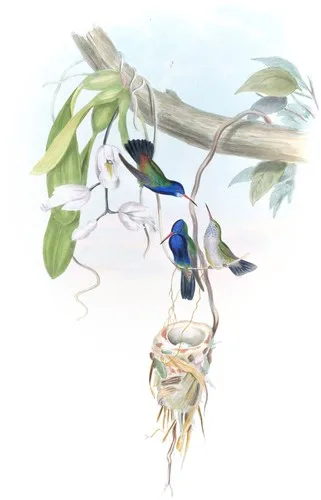
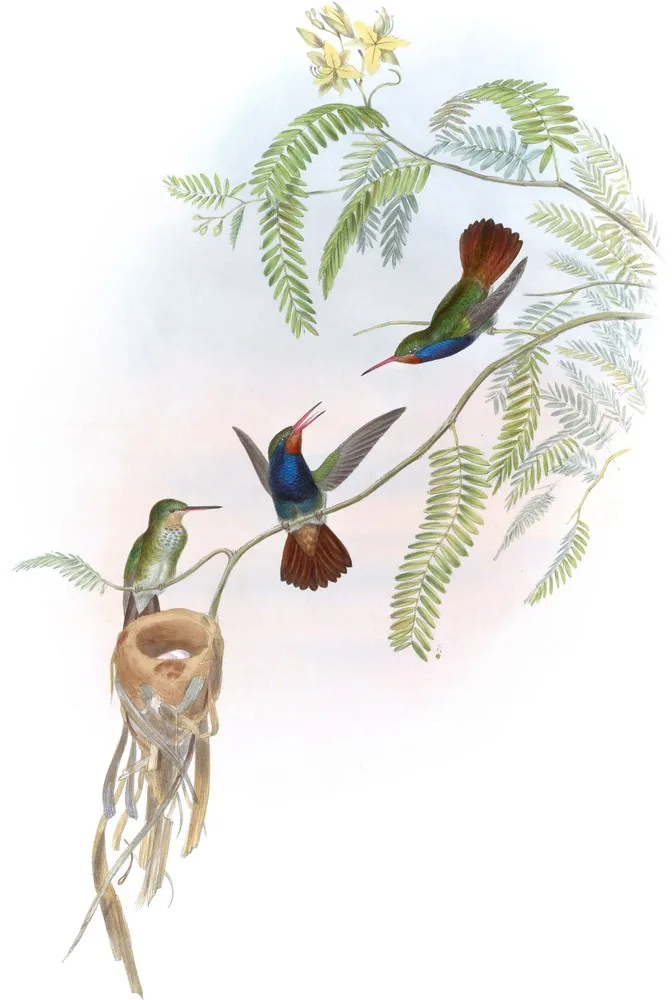
I am indebted to Mr. Reeves for a nest and eggs of this species, accompanied by an accurate drawing of another example, which I have taken the liberty of copying in the accompanying Plate.
The nest is composed of a dull brown cottony vegetable material, bound together externally with green mosses, and decorated with numerous pieces of greyish-white lichens, dead leaves, portions of the glossy brown involucres of some composite plant and similar substances; the eggs, as usual, are white, and two in number, seven-sixteenths of an inch in length, by five-sixteenths of an inch in diameter. It would seem that the nest varies according to the nature of the materials at hand; the one figured being formed of a paler coloured substance, destitute of the lichens and moss, but decorated on its lower part with pendent, narrow, pale, greyish brown ribbon-like strips of the inner lining of the bark of trees.
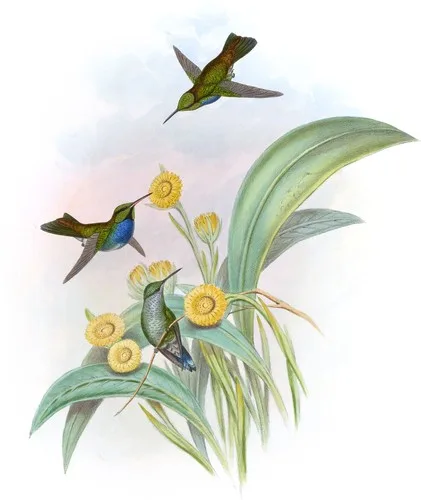
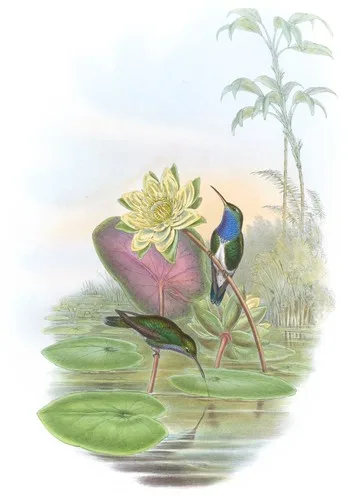
The male has the head, upper surface, upper and under wing-coverts, flanks and abdomen rich deep shining green; chin rufous; fore part of the neck and the breast rich sapphirine blue, with violet reflexions; upper tail-coverts bronzy brown; tail-feathers chestnut, the two centre ones with a bronzy hue, the remainder edged with blackish brown; wings purple-brown; under tail-coverts light chestnut; bill fleshy red, except at the point, which is black; feet brown.
The female has the upper surface green as in the male, the crown approaching to brown; the throat pale rufous; only a trace of the blue on the throat; the under surface much paler, and fading into white on the centre of the abdomen; tail-feathers dark brown, the lateral ones tipped with greyish, and the middle feathers glossed with deep bronze.
The Plate represents both sexes of the natural size.
References
- Trochilus Sapphirinus, Gmel. Edit. Linn. Syst. Nat., tom. i. p. 496.—Lath. Ind. Orn., tom. i. p. 313.—Shaw, Gen. Zool., vol. viii. p. 324.—Jard. Nat. Lib. Humming-Birds, vol. i. p. 147. pl. 28.
- Le Saphir, Butt. Hist. des Ois., tom. vi. p. 26.—Vieill. Ois. dor., tom. i. p. 73. pl. 35, and p. 106. pl. 58.
- Sapphire Humming-Bird, Lath. Gen. Syn., tom. ii. p. 775.—Ib. Gen. Hist., vol. iv. p. 327.
- Ornismya sapphirina, Less. Hist. Nat. des Ois. Mou., p. 172. pls. 55, 56, 57.—Ib. Les Troch., p. 53. pl. 14.
- Hylocharis sapphirina, Gray and Mitch. Gen. of Birds, vol. i. p. 115, Hylocharis, sp. 36.
- Hylocharis sapphirinus, Bonap. Consp. Gen. Av., p. 74, Hylocharis, sp. 1.
- Trochilus fulvifrons, Lath. Ind. Orn. Supp., p. 39.
- Orange faced Humming-Bird, Lath. Gen. Syn. Supp., vol. ii. p. 172.
- Sapphire Humming-Bird, var. A, Lath. Gen. Hist., vol. iv. p. 328.