Ramphomicron heteropogon
刺嘴蜂鸟属
Ramphomicron heteropogon
Columbian Thorn-bill
About this plate
New Granada
The high lands of the great country of Columbia, from Venezuela to some distance to the northward of Santa Fe de Bogota, are the natural habitat of this fine species.
It is there very generally spread over the temperate regions of the country, never ascending to the snow-capped hills, nor descending to the hot plains below, but frequenting the warmer valleys, where a luxuriant vegetation teeming with insect life affords it a never-ceasing supply of nourishment. Its comparatively short and feeble bill points out that minute insects constitute its principal food; and as its structure is so similar to the other species of the genus, we may infer, that, like them, it tranquilly flits about among the low shrubs in secluded valleys, and does not ascend to the loftier trees, as do many of the Trochilidæ.
Of all the Humming-Birds sent in collections from Santa Fé de Bogota, the present species occurs in the greatest abundance; and it must indeed be very numerous in the districts resorted to by the wholesale collectors of that city. These specimens are either captured in nets, or killed with the blow-pipe by the Indians. Considerable variation occurs in the size of specimens from different localities. The Venezuelan examples, particularly those from Pamplona, are much larger, and have the luminous throat-mark more extensive than in those from Bogota; the colder climate of which place, due in a great measure to its elevated position, appears to prevent the birds from attaining the size and brilliancy of their more luxuriantly situated brethren. I have reason to believe that the old females have the beard-like appendage, though less strongly developed than in the male, inasmuch as among the numerous examples sent to Europe very small specimens so dressed frequently occur. If this supposition be correct, the latter style of plumage will doubtless be found in the very old females of the other species of the genus; but this is a point which can only be ascertained by dissection.
The young of the year of both sexes are totally devoid of the luminous gorget, the under surface being of a uniform colour; or if the uniformity be broken, it is only by a few speckled markings, like those that occur in the young of R. Herrani, R. microrhyncha, &c.
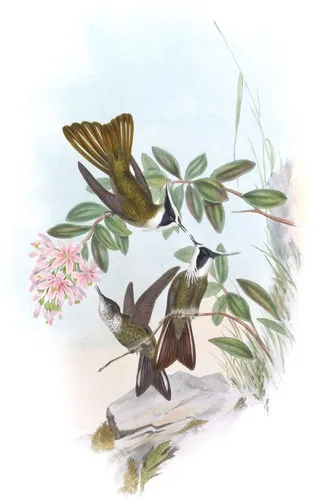
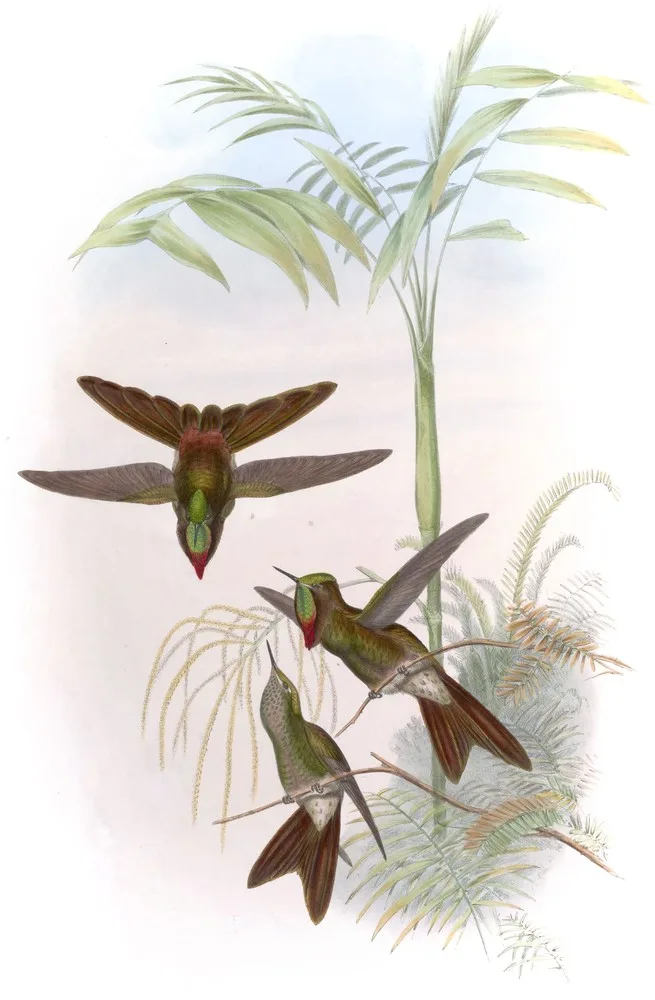
Forehead and crown of the head deep shining green; upper surface and wing-coverts rich greenish bronze; wings purplish brown; tail deep bronzy brown; down the centre of the throat a series of pendent plumes, the upper portion of which is shining metallic green, tinged on each side with orange, and the lower portion deep metallic purplish lilac; sides of the neck and under surface bronzy green, fading into pale brown on the lower part of the abdomen; across the vent an irregular mark of greyish white; under tail-coverts buff, with bronzy centres; bill black; legs purplish grey; soles of the feet yellowish; claws dark purplish brown.
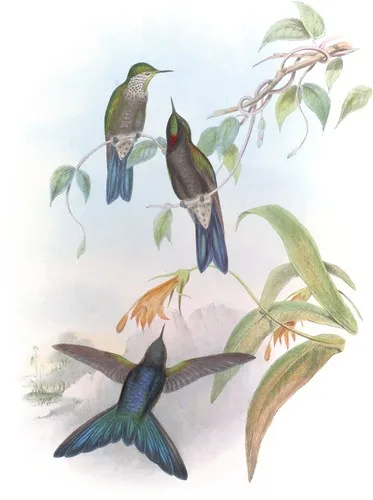
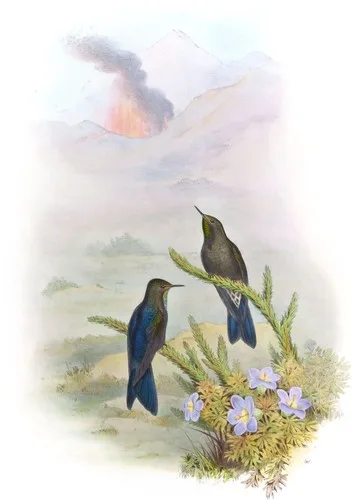
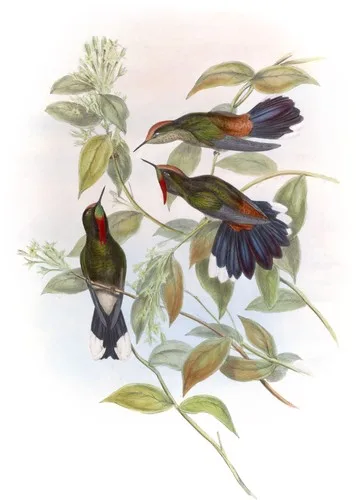
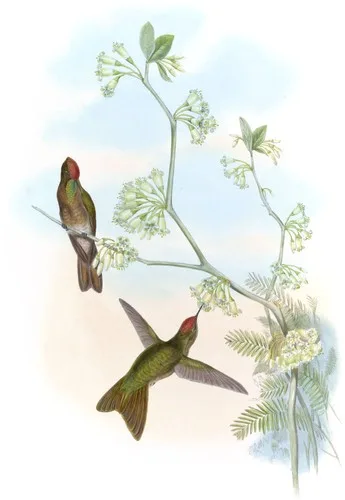
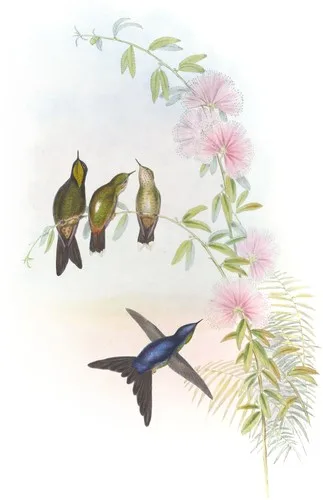
Two males, and a female or a young bird of the year, are figured on the accompanying Plate, from Pamplonan specimens received from Mr. Linden.
References
- Ornismya heteropogon, Boiss. in Rev. Zool., 1839, p. 355.—Ib. Mag. de Zool., 1840, Ois. pl. 12.
- Trochilus coruscus, Fras. in Proc. of Zool. Soc., part viii. p. 15.
- Mellisuga heteropogon, Gray and Mitch. Gen. of Birds, vol. i. p. 112, Mellisuga, sp. 28.
- Ramphomicron heteropogon, Bonap. Consp. Gen. Av., p. 79, Ramphomicron, sp. 2.
Twelve ways of seeing
One plate, read twelve times over: its name, its colour, the burin and the brush, the shape of the sheet, the season, the soil it came from, the book it belongs to, its language of flowers, the poem it answers to, the lore behind it, how to look, and what remains.
-
The Name
The plate is titled “Ramphomicron heteropogon”, numbered Pl. 184, Vol. III (book page 184). Its binomial is Ramphomicron heteropogon: the genus places it among its kin, the epithet records a place, a shape or a person. The Chinese name 刺嘴蜂鸟属 is a modern rendering of the Latin, not an old garden name — between a plant and its names there is always translation.
-
Form and Colour
The smallest of birds: a needle-fine bill, a forked tubular tongue, wings beating so fast the bird hovers and even flies backwards. Its colour is not pigment but structure — light bent by feather barbules, changing with the angle. No colour group is recorded for this plate, but the palette still belongs to its season. A single plant, laid out on the sheet with nothing hidden.
-
Line and Colour
In the later nineteenth century chromolithography took over: colour printed rather than painted, line demoted. Images grew more accurate and less personal. Look closely at the line and the colour: an unbroken line means engraving, colour crossing the outline by half a millimetre means hand-colouring. Craft leaves franker evidence than inscriptions.
-
Composition
Tall and narrow, the plant rising in one movement with generous margins above and below — the upright format of most floras. (about 1.53 : 1). No details are appended: this is a plate for looking, not for keying out.
-
Season
In tropical America they are present all year, their season set by flowers; temperate hummingbirds follow the bloom north and back, thousands of kilometres a year. The year 1852 on the plate is the year of publication, not of flowering — the gathering came a year or two earlier.
-
Provenance
Americas only, from southern Alaska to Tierra del Fuego, richest in the Andes. China has no hummingbirds and no classical record of them; the name arrives with late-Qing travel writing. The volume was made in 1849-1887, when most of this knowledge came from living plants under glass rather than from the wild.
-
The Book
“Gould's Hummingbirds” was drawn by John Gould and published 1849-1887. This plate is Pl. 184, Vol. III, book page 184. The image is in the public domain; the hand-colouring on the paper is still one person's hand, two centuries ago.
-
Symbolism
For the Aztecs the hummingbird was warrior and sun; for Victorian Europe it was the ultimate ornament, millions killed for breast jewellery. China has no tradition here — and that blank is itself a history of exchange. Flower language was added later; the flower knows nothing of it, and that innocence is part of its power.
-
Poetic Resonance
穿花蛱蝶深深见,点水蜻蜓款款飞。
—— 唐·杜甫《曲江二首》
Butterflies thread the flowers, seen deep within; dragonflies touch the water and fly on, slow and deliberate.
The poem gives the mood first and the picture supplies the form; set the line beside the plate and the bird itself becomes its resting point.
-
Classical Lore
Gould's Hummingbirds (1849–1887) used hand-coloured lithography over gold leaf so the iridescence survived on paper — a monument to Victorian printing and collecting alike. Chinese flower books ranked plants by character; European floras described them by form and name. This plate belongs to the second tradition, yet bears reading by the first. Printed in 1852, at the moment the two traditions began to see each other.
-
How to Look
Look at the metallic throat and back: structural colour that needed gold leaf or layered washes to match. Then bill length against corolla depth — bird and flower evolved together. Stand back for the habit, step close for the meeting of line and colour.
-
Afterword
A flora exists to be consulted; look long enough and you forget to consult — someone in 1852 gave a whole day to a single flower.