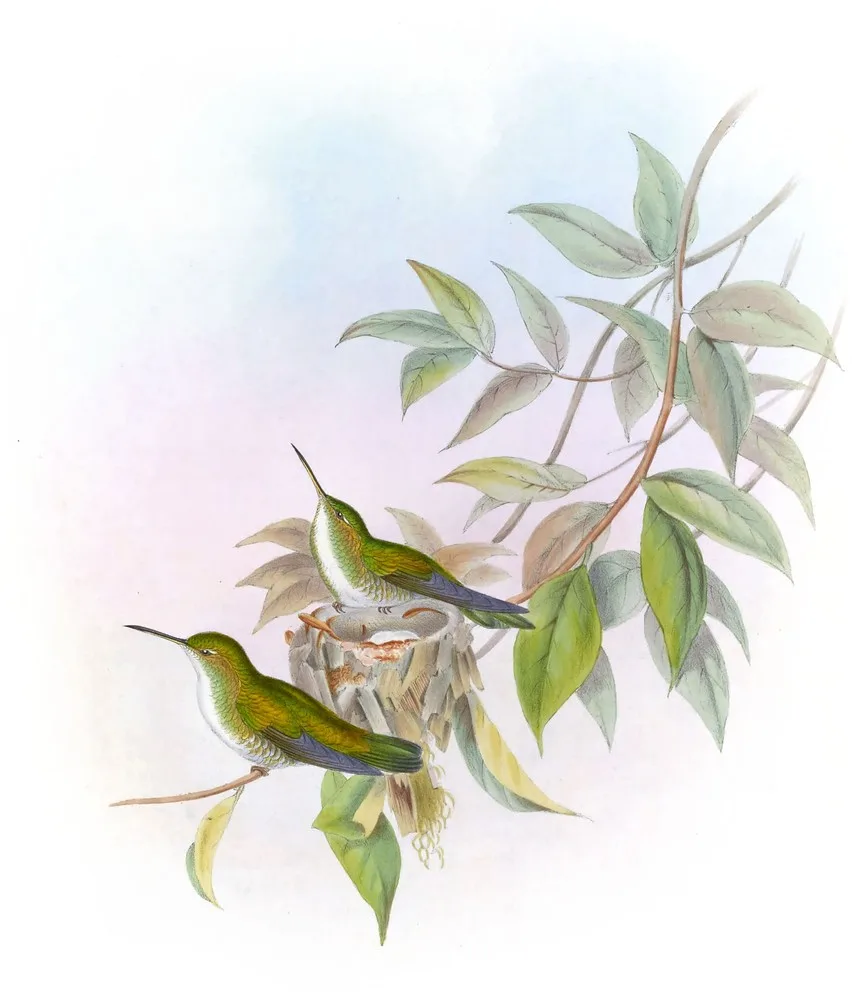
Thaumatias brevirostris
Thaumatias brevirostris
Short-billed Emerald
About this plate
South-eastern Brazil
References
- Ornismya brevirostris, Less. Hist. Nat. des Ois. Mou., pp. xxxv et 211. p: 77.—Less. Traité d’Orn., p. 283.
- Basilinna brevirostris, Less. Ind. Gen. et Syn. des Ois. duGenre Trochilus, p. xxvi.—lb. Rev. Zool. 1839, p. 15.
- Polytmus brevirostris, Gray and Mitch. Gen. of Birds, vol. i. p. 108, Polytmus, sp. 44.
- Thaumatias brevirostris, Bonap. Consp. Gen. Av., p. 78, Thaumatias, sp. 2.
- Thaumantias brevirostris, Bonap. Rev. et Mag. de Zool. 1854, p. 255.
- Agyrtria brevirostris, Reichenb. Aufz. der Colibris, p. 10.
Ten ways of seeing
- slightly upright 1.17 : 1
- published 1861
- Pl. 298, Vol. V
Not a catalogue entry but a way of looking: how to stand, what to notice, how the line was cut — then, halfway, a line of Chinese poetry: how the ancients saw this same flower. After it, the flower's language, its season and homeland, its book; and at the end one line of classical prose — and a pair of eyes to take away.
-
First Look
竖划三寸,当千仞之高;横墨数尺,体百里之迥。
—— 南朝宋·宗炳《画山水序》
A vertical stroke of three inches stands for a cliff of a thousand fathoms; a few feet of ink holds a hundred li.
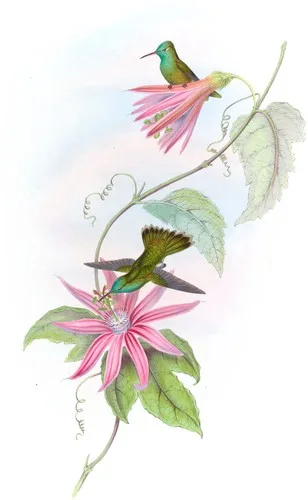
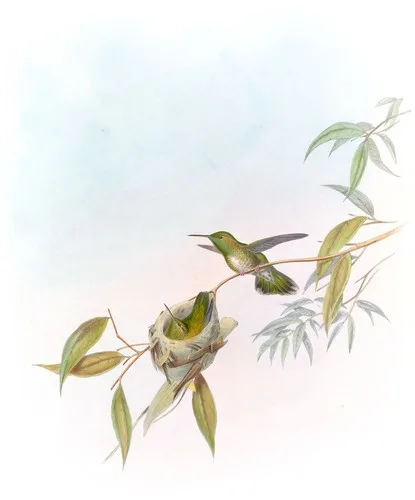
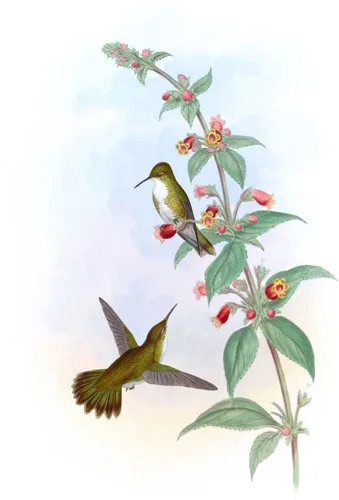
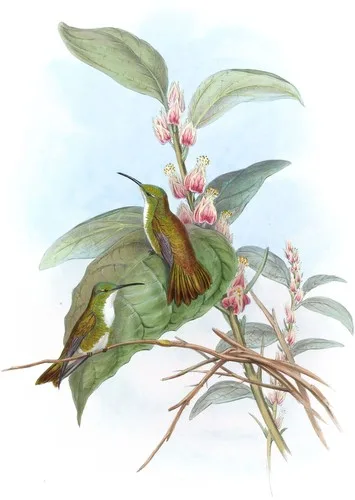
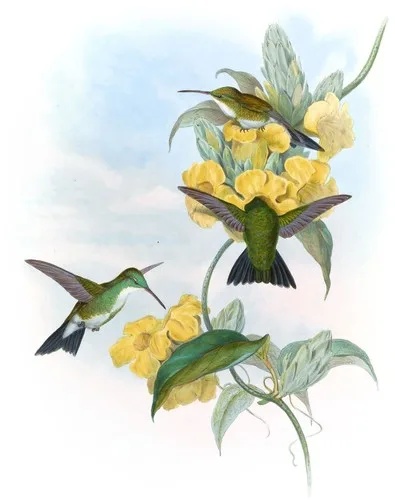
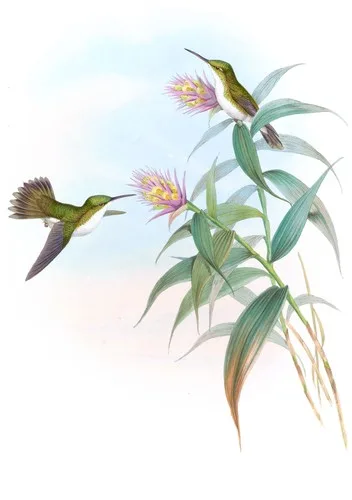
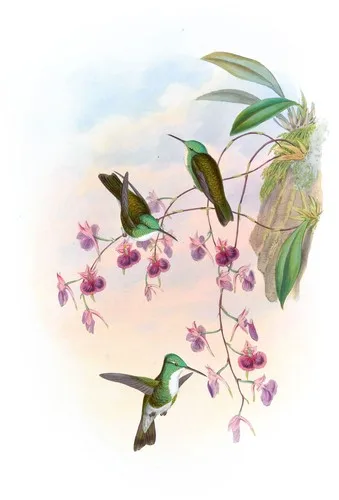
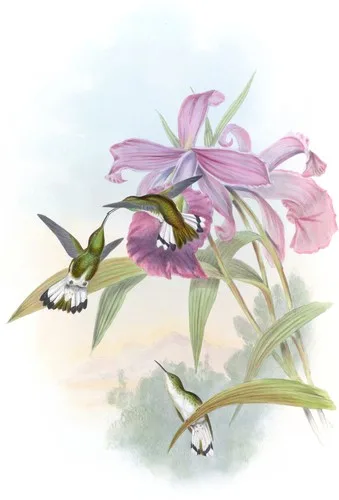
Slightly taller than wide; the eye lands on the bird's head, a little above centre. Then step in close: watch where colour meets line, and whether the line ever breaks. Third, find the darkest small patch: the whole tonal order is measured from there.
-
Name and Thing
The binomial is Thaumatias brevirostris: the first word is the genus it belongs among, the second the epithet that sets it apart. Two words carry a whole provenance. No established Chinese name exists, so it is cited by its binomial alone.
-
Form and Colour
The smallest of birds: a needle-fine bill, a forked tubular tongue, wings beating so fast the bird hovers and even flies backwards. Its colour is not pigment but structure — light bent by feather barbules, changing with the angle.No colour group is recorded. Three things fix the habit: leaf arrangement, tepal count, and how the flower is borne.
-
Composition
Slightly taller than wide, the bird set a little above centre, the eye landing at head and bill. (about 1.17 : 1) No details are appended: a plate for looking, not for keying out. Blank paper is not unfinished work: it is where the eye rests.
-
Line and Colour
In the later nineteenth century chromolithography took over: colour printed rather than painted, line demoted. Craft leaves franker evidence than inscriptions. If you mean to copy it: block in the broad shapes and colours first, detail last; lithographic softness comes from thin washes — two or three pale layers will get you close.
-
Poetic Resonance
穿花蛱蝶深深见,点水蜻蜓款款飞。
—— 唐·杜甫《曲江二首》
Butterflies thread the flowers, seen deep within; dragonflies touch the water and fly on, slow and deliberate.
The poem gives the mood first and the picture supplies the form; set the line beside the plate and the bird itself becomes its resting point.
-
Symbolism
For the Aztecs the hummingbird was warrior and sun; for Victorian Europe it was the ultimate ornament, millions killed for breast jewellery. China has no tradition here — and that blank is itself a history of exchange. Meanings change their tune: the same flower can say opposite things within a century.
-
Season and Place
In tropical America they are present all year, their season set by flowers. the name arrives with late-Qing travel writing. The year 1861 on the plate is that of publication, not of flowering — the gathering came a year or two earlier. Read the locality and the flowering season both with a discount: one is hearsay, the other a ten-day peak.
-
The Book and the Hand
“Gould's Hummingbirds” was drawn by John Gould and published 1849-1887. This plate is Pl. 298, Vol. V, book page 298. The image is public domain; the hand-colouring is still one person's hand.
-
The Written Tradition
竖划三寸,当千仞之高;横墨数尺,体百里之迥。
—— 南朝宋·宗炳《画山水序》
A vertical stroke of three inches stands for a cliff of a thousand fathoms; a few feet of ink holds a hundred li. Smallness of scale was never the obstacle.
Gould's Hummingbirds (1849–1887) used hand-coloured lithography over gold leaf so the iridescence survived on paper — a monument to Victorian printing and collecting alike. The difference is not of quality but of question: Europe asks what it is, China asks whom it resembles.
What to Take Away
Carry three rules away: whole before detail; line before colour; picture before book. The flower of that year is dust, yet its image on paper has outlived every living cousin.