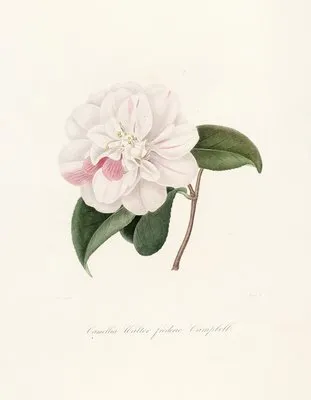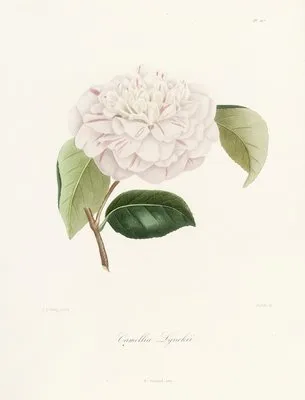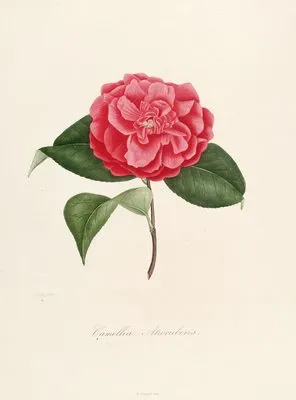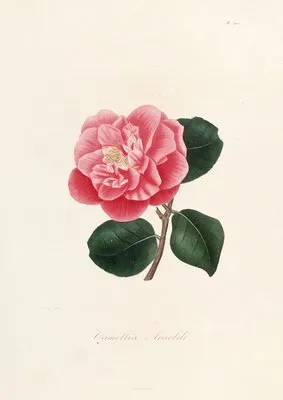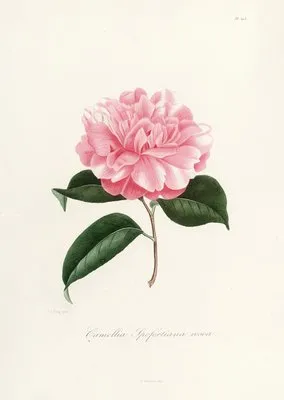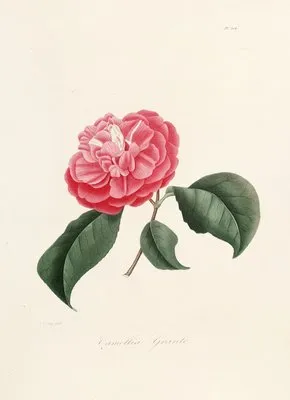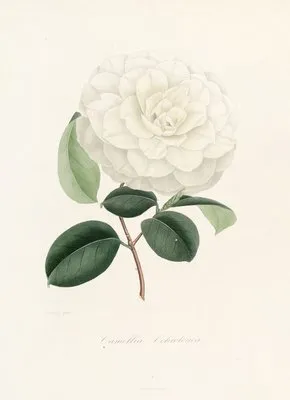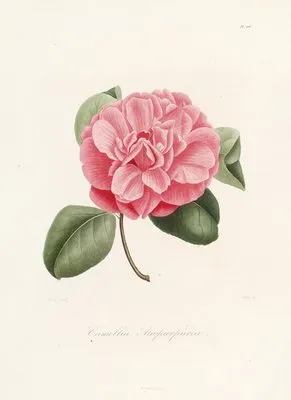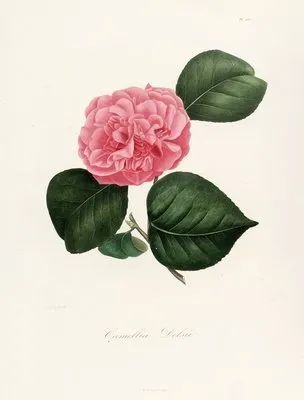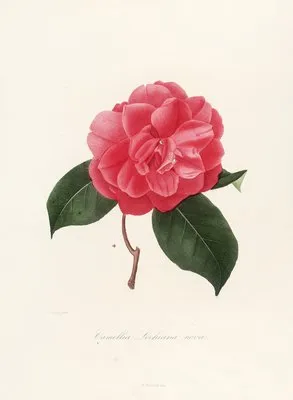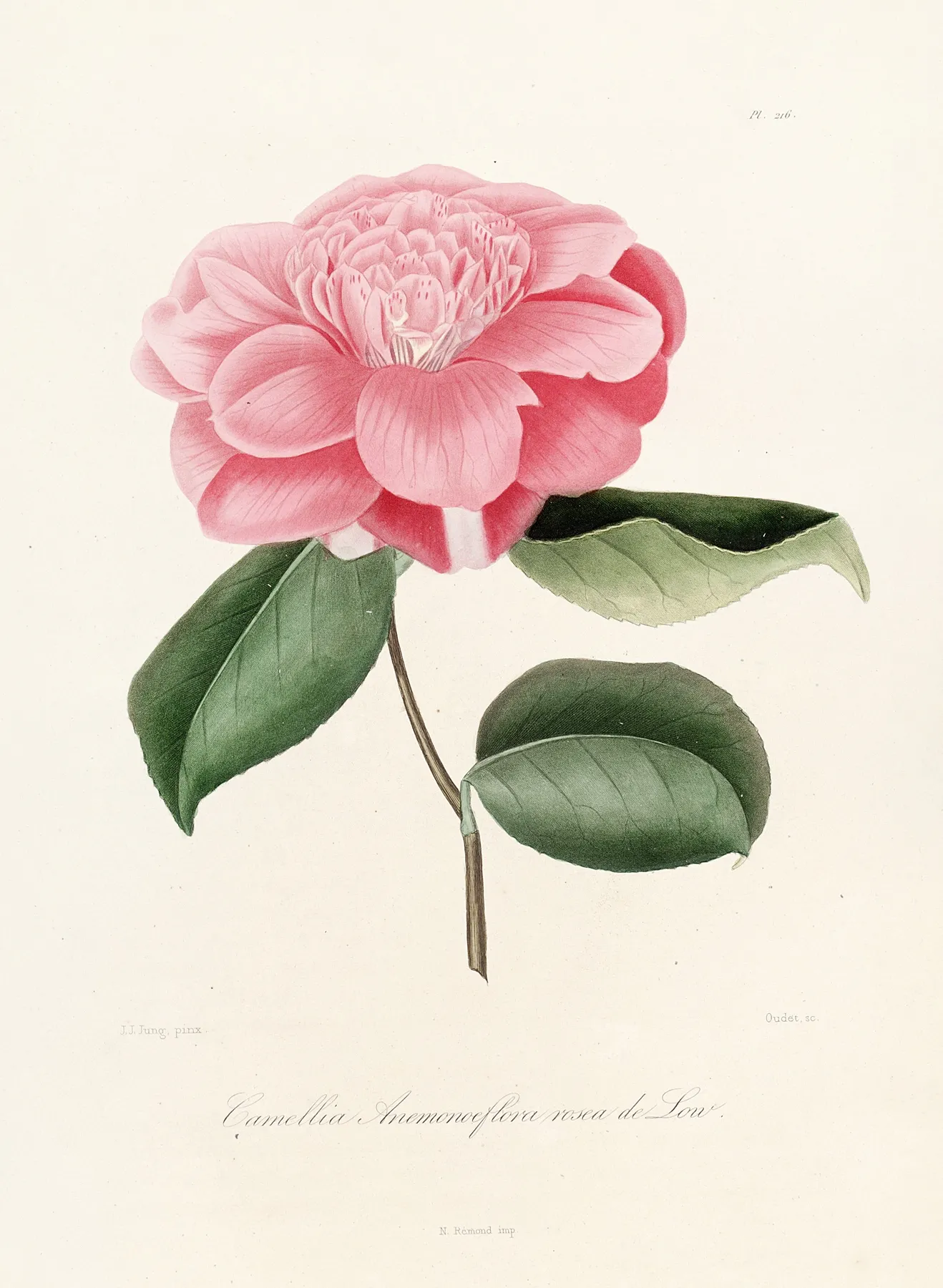
Iconographie du genre Camellia Pl.016
Oudet,sc J.J Jung, pinx CameMa memonoeftoranasea de Low N. Rémond imp.
Iconographie du genre Camellia Pl.016
Ten ways of seeing
- measured cast red
- upright 1.37 : 1
First Look
凡画山水,意在笔先。
—— 唐·王维《山水论》
In painting, the intention precedes the brush.
The sheet is vertical: the eye climbs and settles in the upper half. Let the plant stand before you look for detail. Then step in close: watch where colour meets line, and whether the line ever breaks. Third, find the darkest small patch: the whole tonal order is measured from there.
Name and Thing
Only the genus Camellia is given; species-level names came later. No established Chinese name exists, so it is cited by its binomial alone.
Form and Colour
Measured on this plate: flower colour covers 9.8% of the sheet, foliage 7.2%, the cast red. No other plate shares exactly this measure. Camellias are evergreen shrubs with thick, waxen, serrate leaves; the double flowers overlap like roof tiles and fall whole, petals still attached.No colour group is recorded. Three things fix the habit: leaf arrangement, tepal count, and how the flower is borne.
Composition
The sheet is tall. No details are appended: a plate for looking, not for keying out. The plant covers only 22% of the sheet, centred above centre; the emptiness is where the eye rests.
Line and Colour
The first half of the nineteenth century moved from copper to steel to lithography; stipple could render the softest transition. Decide first whether it was printed or painted; only then discuss whether it is beautiful. If you mean to copy it: take its skeleton, its margins and the order of its colours; the burin's hatching is the language of copper — suggest it with pencil density, do not imitate it stroke for stroke.
Poetic Resonance
瓦盆社酿,石鼎山茶。
—— 宋·范成大《朝中措》
The poem gives the mood first and the picture supplies the form; set the line beside the plate and the corolla becomes its resting point.
Symbolism
In China the camellia is the friend that endures; in Europe it became Eastern beauty and unattainability, and after La Dame aux Camélias, a token of brief life. In a flora it is a species first and a symbol second; the order is worth keeping.
Season and Place
a single flower may last a fortnight. Southwest China and Japan, with Yunnan the centre of diversity. The year 1841 on the plate is that of publication, not of flowering — the gathering came a year or two earlier. The bud and the ripe fruit on one branch tell the season; the name in the title often tells the journey.
The Book and the Hand
“Iconographie du genre Camellia” carries only Lorenzo Berlese's name. From drawing to plate the sheet passed through several hands — the engraver aimed at accuracy, the colourist at speed, and between them lies each plate's unevenness.
What to Take Away
Appreciation is not knowledge but habit — one more look each time. Two centuries on, the plant may still flower in some garden; the one on this sheet stopped in the season of 1841.
About this plate
Iconographie du genre Camellia Pl.016 is plate 16, from Iconographie du genre Camellia, drawn by Lorenzo Berlese. This public-domain plate is reproduced at high resolution, free to view and download. Publication: Paris, H. Cousin, 1841-1843.