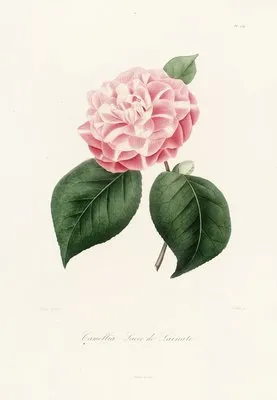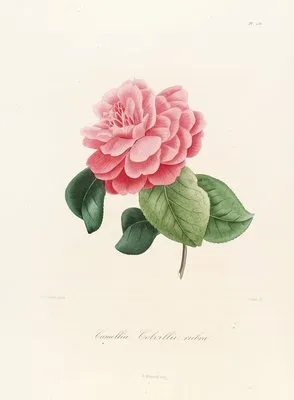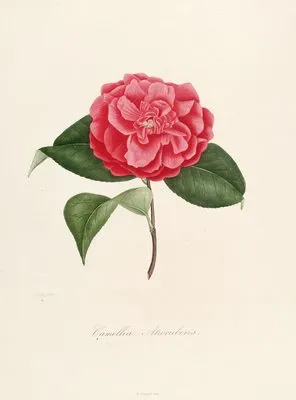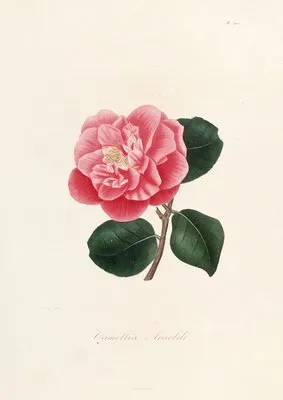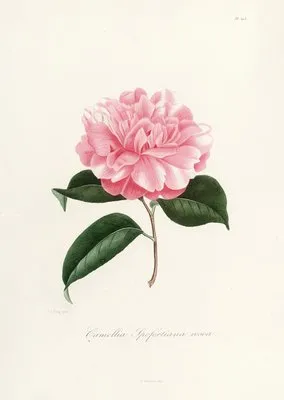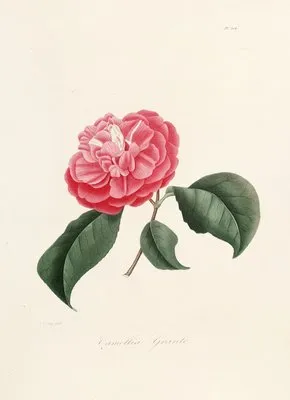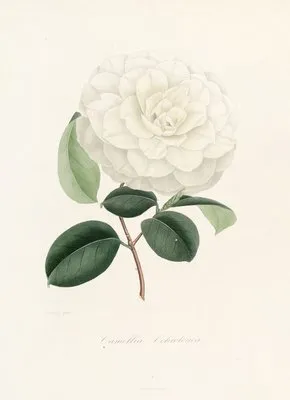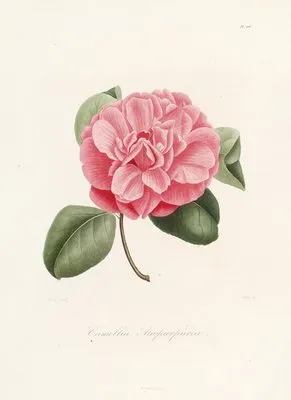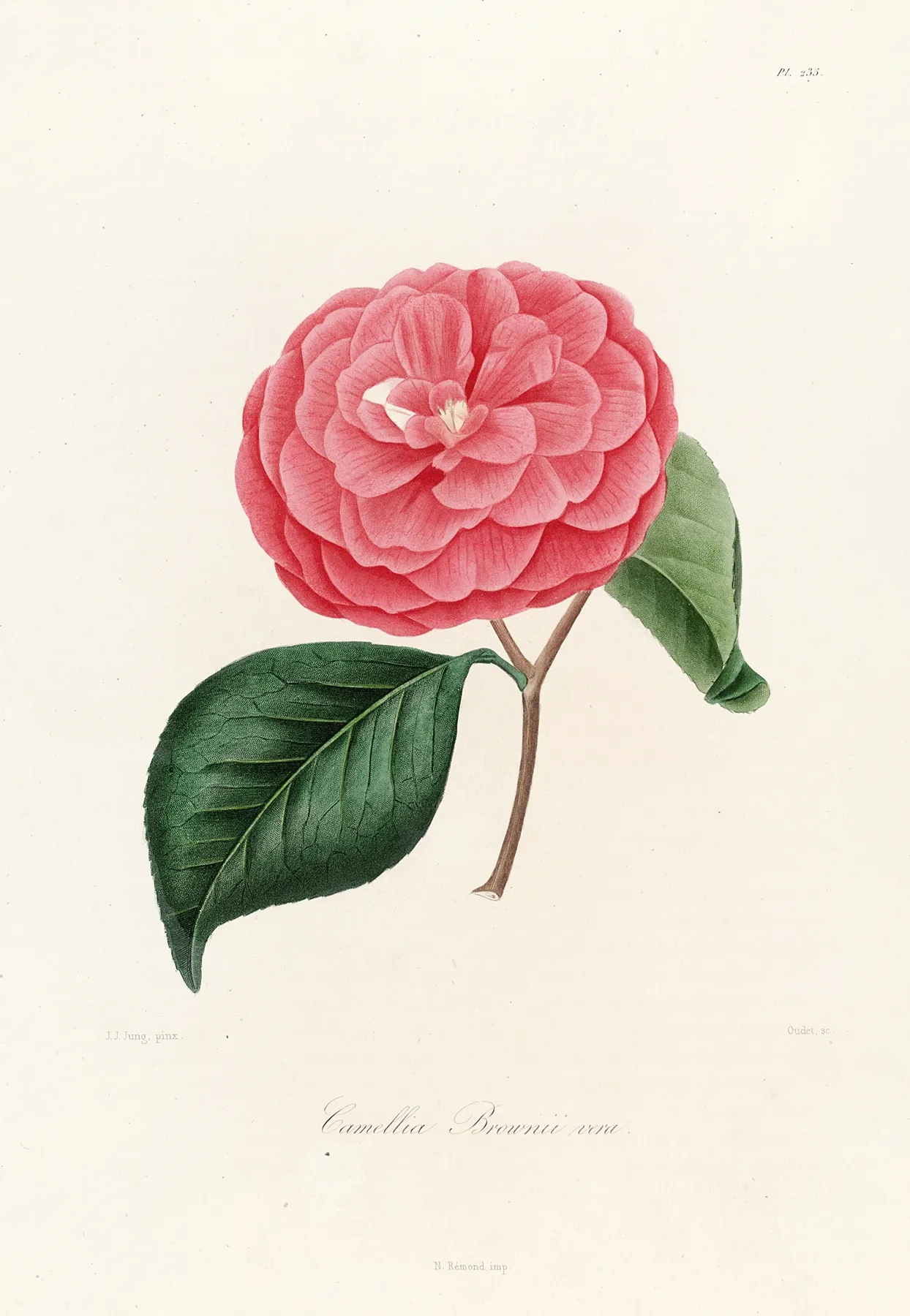
Iconographie du genre Camellia Pl.035
Brownii vvu|J.J. Jung, pinx. Camellia Brownii vvu. N. Rémond, inmp.
Iconographie du genre Camellia Pl.035
Ten ways of seeing
- measured cast red
- upright 1.45 : 1
First Look
真山水之川谷,远望之以取其势,近看之以取其质。
—— 宋·郭熙《林泉高致·山水训》
Mountains and valleys: from afar take their momentum, up close take their texture — the two distances from which any picture is read.
The sheet is vertical: the eye climbs and settles in the upper half. Let the plant stand before you look for detail. Then step in close: watch where colour meets line, and whether the line ever breaks. Third, find the darkest small patch: the whole tonal order is measured from there. The pose leans right: the upper half carries 17 points further right than the lower — a living thing, not a diagram.
Name and Thing
Only the genus Camellia is given; species-level names came later. No established Chinese name exists, so it is cited by its binomial alone.
Form and Colour
Measured on this plate: flower colour covers 11.2% of the sheet, foliage 6.5%, the cast red. No other plate shares exactly this measure. Camellias are evergreen shrubs with thick, waxen, serrate leaves; the double flowers overlap like roof tiles and fall whole, petals still attached.No colour group is recorded. Three things fix the habit: leaf arrangement, tepal count, and how the flower is borne.
Composition
The sheet is tall. No details are appended: a plate for looking, not for keying out. The plant covers only 19% of the sheet, centred above centre; the emptiness is where the eye rests.
Line and Colour
The first half of the nineteenth century moved from copper to steel to lithography; stipple could render the softest transition. Decide first whether it was printed or painted; only then discuss whether it is beautiful. If you mean to copy it: take its skeleton, its margins and the order of its colours; the burin's hatching is the language of copper — suggest it with pencil density, do not imitate it stroke for stroke.
Poetic Resonance
茭粽叶包蒸米饭,野山茶点石菖蒲。
—— 《偈颂一百零二首·紫芝峰下》
The poem gives the mood first and the picture supplies the form; set the line beside the plate and the corolla becomes its resting point.
Symbolism
In China the camellia is the friend that endures; in Europe it became Eastern beauty and unattainability, and after La Dame aux Camélias, a token of brief life. Meanings change their tune: the same flower can say opposite things within a century.
Season and Place
Late winter into early spring, blooming in the cold of the first lunar month. Southwest China and Japan, with Yunnan the centre of diversity. The year 1841 on the plate is that of publication, not of flowering — the gathering came a year or two earlier. The bud and the ripe fruit on one branch tell the season; the name in the title often tells the journey.
The Book and the Hand
“Iconographie du genre Camellia” carries only Lorenzo Berlese's name. A plate is collective work: drawer, engraver and colourist were different hands, and the unnamed ones decided how good it looks.
What to Take Away
If you keep one line, keep Guo Xi's: from afar its momentum, up close its texture. A flora exists to be consulted; look long enough and you forget to consult — someone in 1841 gave a whole day to a single flower.
About this plate
Iconographie du genre Camellia Pl.035 is plate 35, from Iconographie du genre Camellia, drawn by Lorenzo Berlese. This public-domain plate is reproduced at high resolution, free to view and download. Publication: Paris, H. Cousin, 1841-1843.