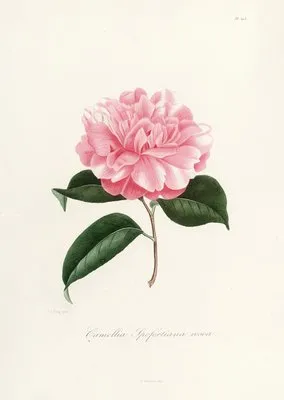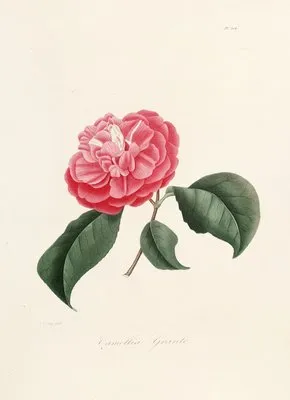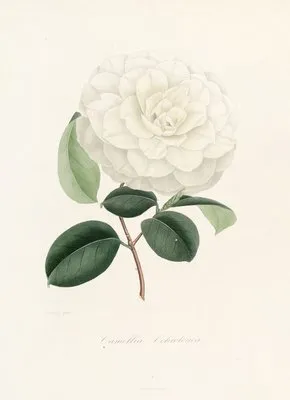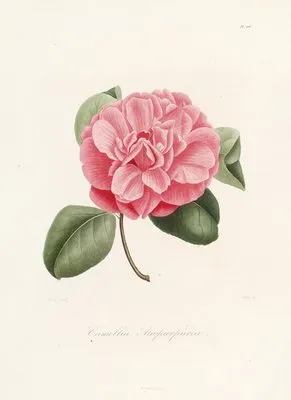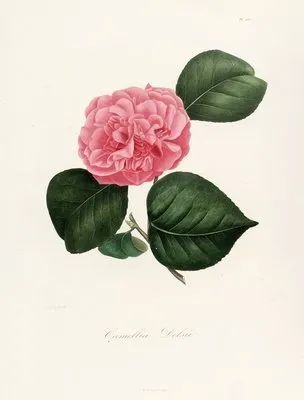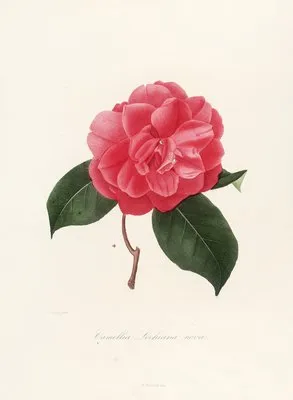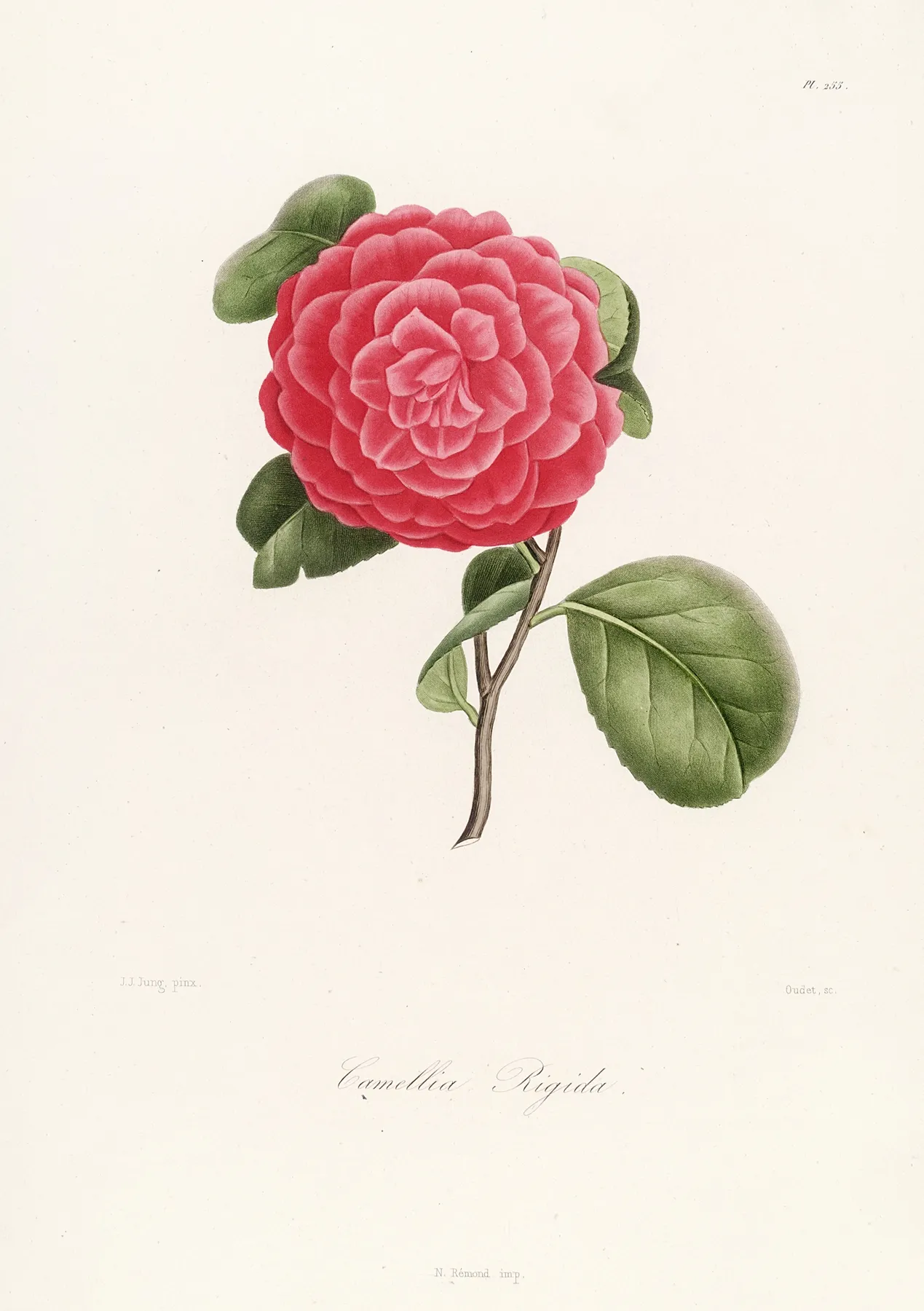
Iconographie du genre Camellia Pl.055
xutd Suns rr Oudet, sc Caellia Kigidu N. Rémond imp.
Iconographie du genre Camellia Pl.055
Ten ways of seeing
- measured cast red
- upright 1.42 : 1
First Look
搜尽奇峰打草稿。
—— 清·石涛《苦瓜和尚画语录》
Exhaust the strange peaks, and then make the sketch.
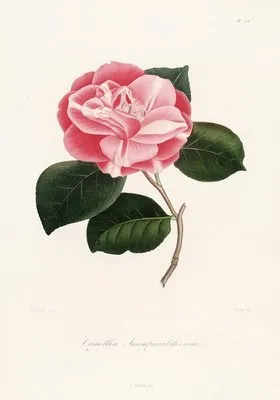
The sheet is vertical: the eye climbs and settles in the upper half. Let the plant stand before you look for detail. Then step in close: watch where colour meets line, and whether the line ever breaks. Third, find the darkest small patch: the whole tonal order is measured from there. The pose leans left: the upper half carries 20 points further left than the lower — a living thing, not a diagram.
Name and Thing
Only the genus Camellia is given; species-level names came later. No established Chinese name exists, so it is cited by its binomial alone.
Form and Colour
Measured on this plate: flower colour covers 9.3% of the sheet, foliage 5.1%, the cast red. No other plate shares exactly this measure. Camellias are evergreen shrubs with thick, waxen, serrate leaves; the double flowers overlap like roof tiles and fall whole, petals still attached.No colour group is recorded. A single plant, laid out with nothing hidden.
Composition
The sheet is tall. No details are appended: a plate for looking, not for keying out. The plant covers only 15% of the sheet, centred above centre; the emptiness is where the eye rests.
Line and Colour
The first half of the nineteenth century moved from copper to steel to lithography; stipple could render the softest transition. Take a loupe to three places: petal edge, leaf vein, caption. An unbroken line means engraving; colour crossing the outline means a hand. If you mean to copy it: take its skeleton, its margins and the order of its colours; the burin's hatching is the language of copper — suggest it with pencil density, do not imitate it stroke for stroke.
Poetic Resonance
落红不是无情物,化作春泥更护花。
—— 清·龚自珍《己亥杂诗》
Fallen petals are not heartless things; turned to spring mud, they shelter the flowers still to come.
The poem gives the mood first and the picture supplies the form; set the line beside the plate and the corolla becomes its resting point.
Symbolism
In China the camellia is the friend that endures; in Europe it became Eastern beauty and unattainability, and after La Dame aux Camélias, a token of brief life. In a flora it is a species first and a symbol second; the order is worth keeping.
Season and Place
Late winter into early spring, blooming in the cold of the first lunar month. Southwest China and Japan, with Yunnan the centre of diversity. The year 1841 on the plate is that of publication, not of flowering — the gathering came a year or two earlier. Read the locality and the flowering season both with a discount: one is hearsay, the other a ten-day peak.
The Book and the Hand
“Iconographie du genre Camellia” carries only Lorenzo Berlese's name. From drawing to plate the sheet passed through several hands — the engraver aimed at accuracy, the colourist at speed, and between them lies each plate's unevenness.
What to Take Away
Appreciation is not knowledge but habit — one more look each time. The flower of that year is dust, yet its image on paper has outlived every living cousin.
About this plate
Iconographie du genre Camellia Pl.055 is plate 55, from Iconographie du genre Camellia, drawn by Lorenzo Berlese. This public-domain plate is reproduced at high resolution, free to view and download. Publication: Paris, H. Cousin, 1841-1843.