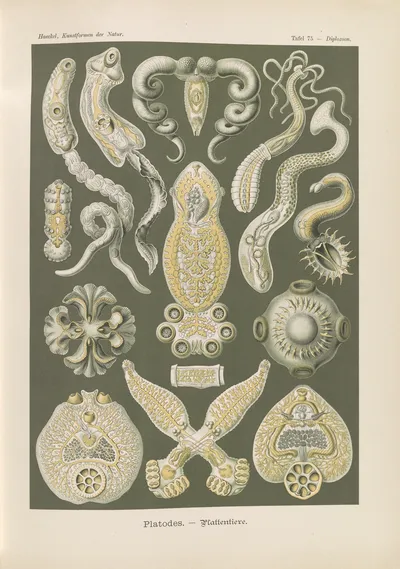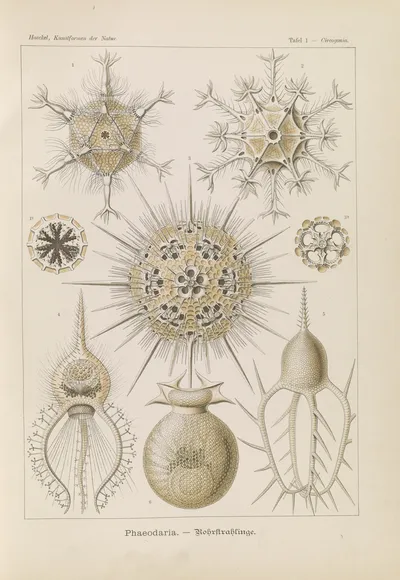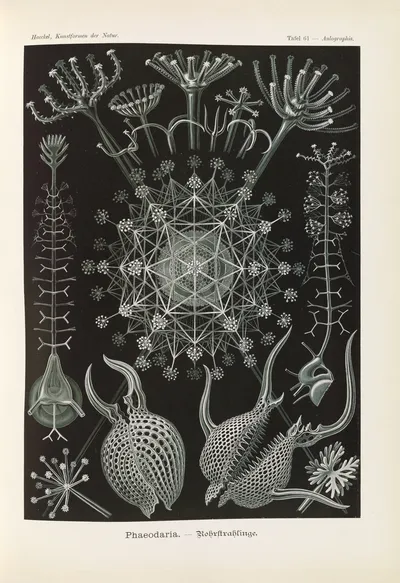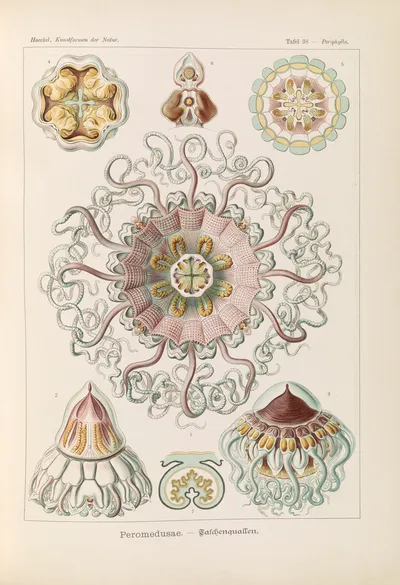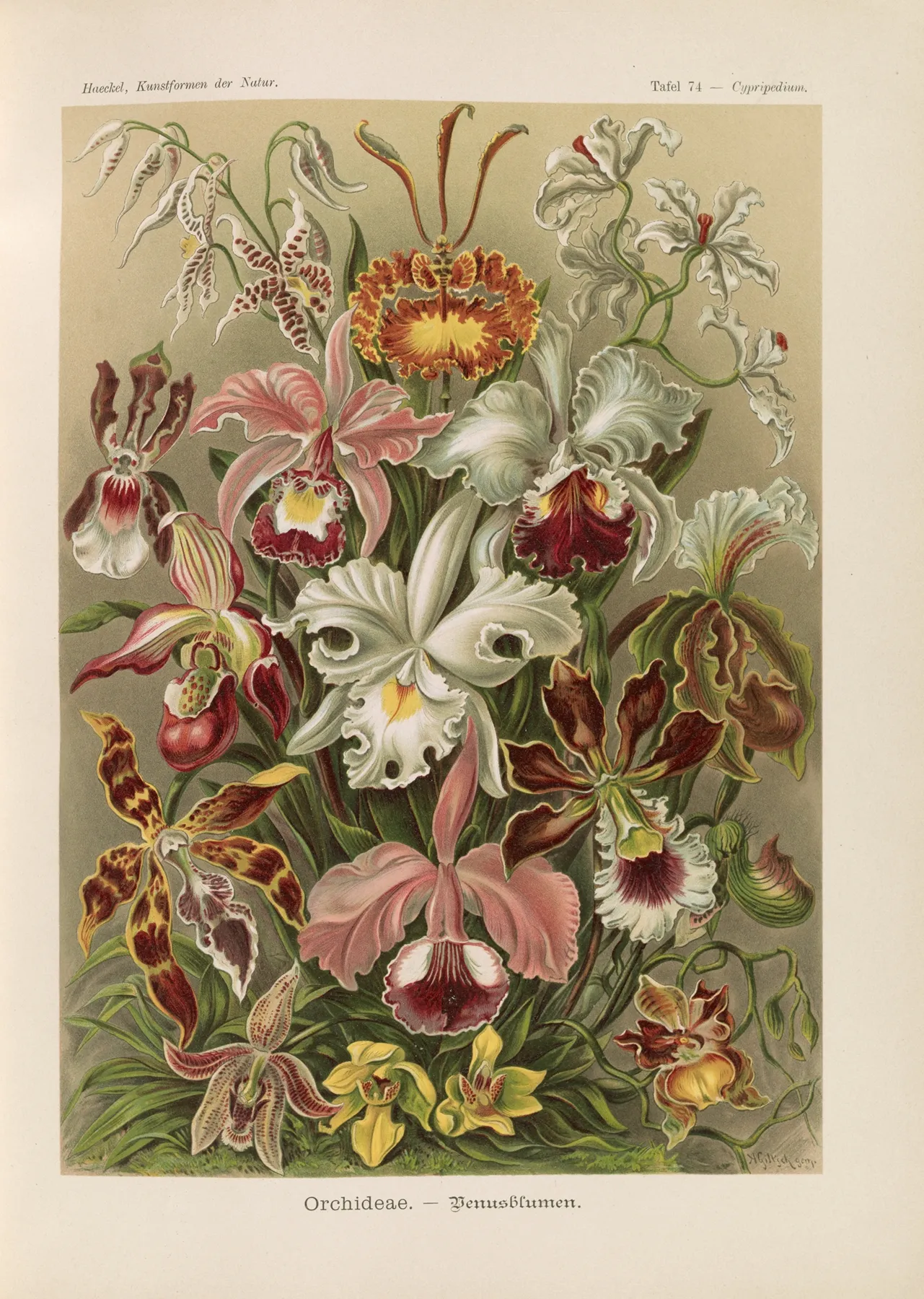
Orchideae. – Denusblumen (1904)
Ten ways of seeing
- upright 1.41 : 1
First Look
搜尽奇峰打草稿。
—— 清·石涛《苦瓜和尚画语录》
Exhaust the strange peaks, and then make the sketch.
The sheet is vertical: the eye climbs and settles in the upper half. Let the plant stand before you look for detail. Then step in close: watch where colour meets line, and whether the line ever breaks. Third, find the darkest small patch: the whole tonal order is measured from there.
Name and Thing
No reliable binomial survives, so the printed title must serve. Neither name nor binomial survives: the printed title must do.
Form and Colour
Orchids carry pseudobulbs or fleshy roots; six tepals, one modified into a lip that serves as a landing stage, and a column uniting stamens and pistil — a structure unique to the family.No colour group is recorded. Read the outline, then the colour layers, then the brush.
Composition
Tall and narrow, the plant rising in one movement with generous margins — the upright format of most floras. No details are appended: a plate for looking, not for keying out. Old plates set the plant slightly off centre, with unequal margins — that small imbalance is what keeps it alive.
Line and Colour
After 1900 photography and colour reproduction ran alongside watercolour: accuracy rose, the cut of the burin disappeared. There is evidence on the back too: the plate mark pressed into the paper, the slight relief of the pigment, lines worn shallow in a later printing. If you mean to copy it: this is a photomechanical record — match the colours directly, do not imitate the printing grain.
Poetic Resonance
绿蕙不香饶桂酒,红樱无色让花钿。
—— 唐·白居易《宴周皓大夫光福宅》
The poem gives the mood first and the picture supplies the form; set the line beside the plate and the corolla becomes its resting point.
Symbolism
In China the orchid is the gentleman who blooms unseen; in Victorian Europe it was luxury and obsession, a single new species worth a fortune. Flower language was added later; the flower knows nothing of it, and that innocence is part of its power.
Season and Place
Varies by genus: temperate terrestrials flower in spring and summer, tropical epiphytes almost year-round. the orchids drawn for European portfolios came largely from the cloud forests of Central America and Southeast Asia. The year 1904 on the plate is that of publication, not of flowering — the gathering came a year or two earlier. The bud and the ripe fruit on one branch tell the season; the name in the title often tells the journey.
The Book and the Hand
“Kunstformen der Natur” carries only Ernst Haeckel's name. A plate is collective work: drawer, engraver and colourist were different hands, and the unnamed ones decided how good it looks.
What to Take Away
Carry three rules away: whole before detail; line before colour; picture before book. Two centuries on, the plant may still flower in some garden; the one on this sheet stopped in the season of 1904.