Abutilon vexillarium
苘麻属·Abutilon vexillarinm|苘麻属
Abutilon vexillarium
About this plate
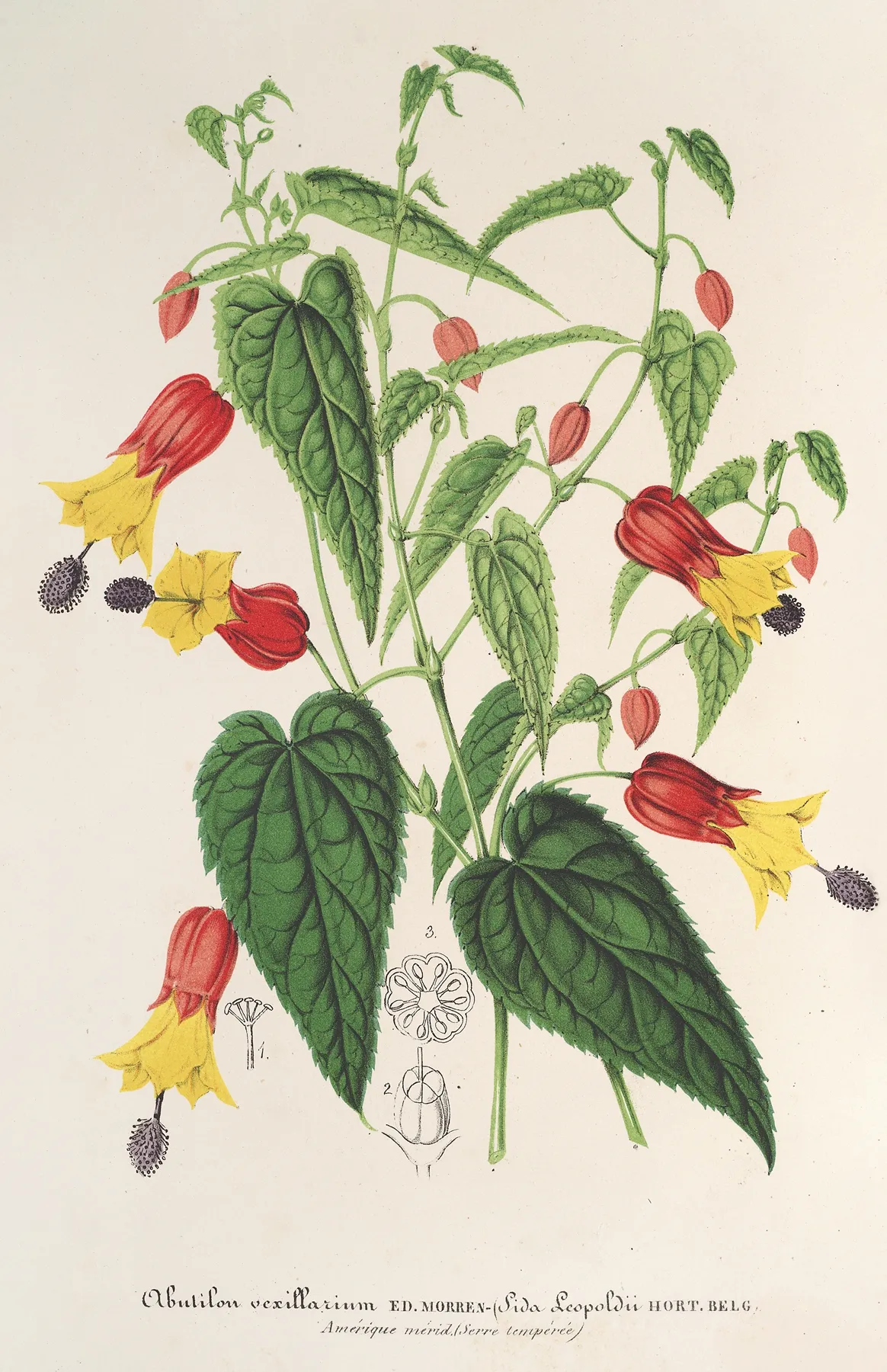
Abutilon vexillarium is plate 430, from L'Illustration horticole, drawn by Charles Antoine Lemaire. This public-domain plate is reproduced at high resolution, free to view and download. Publication: Gand, Belgium, Imprimerie et lithographie de F. et E. Gyselnyck,1854-1896.
Ten ways of seeing
- measured cast red
- upright 1.55 : 1
- published 1854
- Plate 430
Not a catalogue entry but a way of looking: how to stand, what to notice, how the line was cut — then, halfway, a line of Chinese poetry: how the ancients saw this same flower. After it, the flower's language, its season and homeland, its book; and at the end one line of classical prose — and a pair of eyes to take away.
-
First Look
凡画山水,意在笔先。
—— 唐·王维《山水论》
In painting, the intention precedes the brush.
The sheet is vertical: the eye climbs and settles in the upper half. Let the plant stand before you look for detail. Then step in close: watch where colour meets line, and whether the line ever breaks. Third, find where the green is deepest: the whole tonal order is measured from that patch.
-
Name and Thing
The binomial is Abutilon vexillarium: the first word is the genus it belongs among, the second the epithet that sets it apart. Two words carry a whole provenance. The Chinese name 苘麻属 is a modern rendering of the Latin, not an old garden name.
-
Form and Colour
Measured on this plate: flower colour covers 7.0% of the sheet, foliage 19.6%, the cast red with a second note of yellow-green. No other plate shares exactly this measure. Flowering trees and shrubs put out branches first; blossoms open before or with the leaves, usually five thin, translucent petals around a cluster of fine stamens. Filed under green — a moss green, a colour that comes mostly from leaf and stem. Three things fix the habit: leaf arrangement, tepal count, and how the flower is borne.
-
Composition
Tall and narrow, the plant rising in one movement with generous margins — the upright format of most floras. (about 1.55 : 1) No details are appended: a plate for looking, not for keying out. The plant takes about 30% of the sheet, centred near the centre — the easy measure most florists kept to. Old plates set the plant slightly off centre, with unequal margins — that small imbalance is what keeps it alive.
-
Line and Colour
In the later nineteenth century chromolithography took over: colour printed rather than painted, line demoted. There is evidence on the back too: the plate mark pressed into the paper, the slight relief of the pigment, lines worn shallow in a later printing. If you mean to copy it: block in the broad shapes and colours first, detail last; lithographic softness comes from thin washes — two or three pale layers will get you close.
-
Poetic Resonance
莫听声声催去櫂,桃溪浅处不胜舟。
—— 唐·王之涣《宴词》
The poem gives the mood first and the picture supplies the form; set the line beside the plate and the green the corolla becomes its resting point.
-
Symbolism
Plum is solitude, peach is marriage, apricot is spring itself, crabapple is a fragile fate; the hibiscus, opening at dawn and falling at dusk, is impermanence. Meanings change their tune: the same flower can say opposite things within a century.
-
Season and Place
Mid spring: plum first, then peach and apricot, cherry last — the season keeps its order. East Asia and temperate Eurasia. Plum, peach and apricot are Chinese in origin, grown for three thousand years. The year 1854 on the plate is that of publication, not of flowering — the gathering came a year or two earlier. Read the locality and the flowering season both with a discount: one is hearsay, the other a ten-day peak.
-
The Book and the Hand
“L'Illustration horticole” was drawn by Charles Antoine Lemaire and published 1854-1896. This plate is Plate 430. The image is public domain; the hand-colouring is still one person's hand.
-
The Written Tradition
桃之夭夭,灼灼其华。之子于归,宜其室家。
—— 《诗经·周南·桃夭》
The peach tree young and lovely, its blossoms blazing; this girl goes to her new home, and it will be well with her house.
Lin Bu of Hangzhou famously took the plum as his wife and the crane as his son; the Book of Songs already used peach blossom to open a wedding song. The difference is not of quality but of question: Europe asks what it is, China asks whom it resembles.
What to Take Away
Appreciation is not knowledge but habit — one more look each time. The flower of that year is dust, yet its image on paper has outlived every living cousin.