Amaryllis (Hippeastrum) Alberti
Amaryllis (Hippeastrum) Alberti
Amaryllis (Hippeastrum) Alberti
Ten ways of seeing
- orange key
- upright 1.53 : 1
First Look
搜尽奇峰打草稿。
—— 清·石涛《苦瓜和尚画语录》
Exhaust the strange peaks, and then make the sketch.
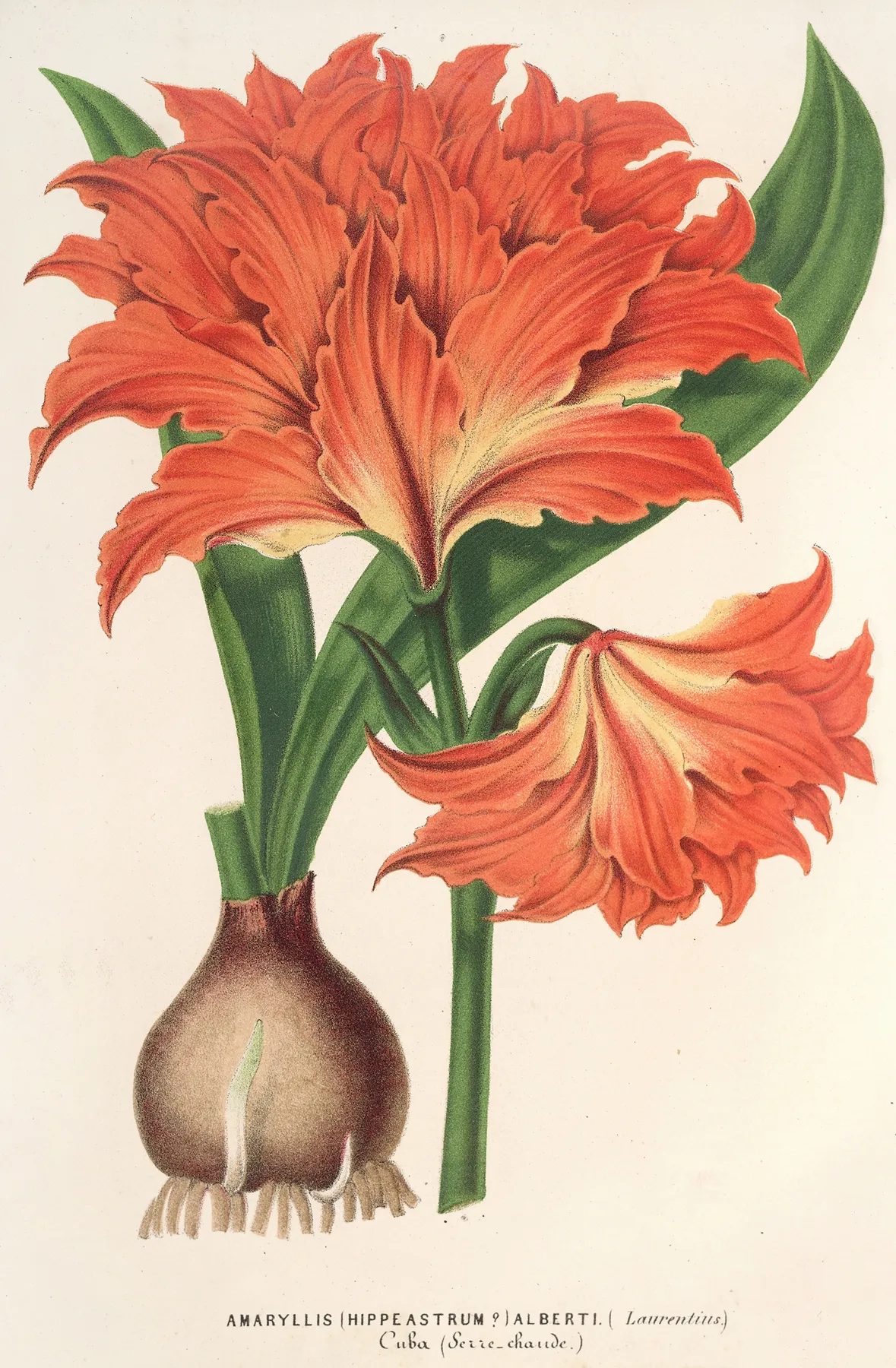
The sheet is vertical: the eye climbs and settles in the upper half. Let the plant stand before you look for detail. Then step in close: watch where colour meets line, and whether the line ever breaks. Third, find where the orange is deepest: the whole tonal order is measured from that patch.
Name and Thing
Only the genus Amaryllis is given; species-level names came later. No established Chinese name exists, so it is cited by its binomial alone.
Form and Colour
Bulbous plants store the year underground — bulb, corm or tuber — then send up a few thick leaves and a single scape, with six tepals in cup, funnel or star. Filed under orange — an amber orange, built in washes from a pale ground. Read the outline, then the colour layers, then the brush.
Composition
Tall and narrow, the plant rising in one movement with generous margins — the upright format of most floras. No details are appended: a plate for looking, not for keying out. Cover the margins with your thumb and the plate suffocates; uncover them and the flower breathes again.
Line and Colour
In the later nineteenth century chromolithography took over: colour printed rather than painted, line demoted. Craft leaves franker evidence than inscriptions. If you mean to copy it: block in the broad shapes and colours first, detail last; lithographic softness comes from thin washes — two or three pale layers will get you close.
Poetic Resonance
燕麦青青游子悲,河堤弱柳郁金枝。
—— 唐·李白《春日獨坐寄鄭明府》
The poem gives the mood first and the picture supplies the form; set the line beside the plate and the orange the corolla becomes its resting point.
Symbolism
The tulip was an imperial emblem in Istanbul and a speculative bubble in Amsterdam; the hyacinth sprang from a boy's blood in Greek myth. What bulbs share is concealment: next year kept underground. This plate leans orange, which in flower language adds one more degree of feeling. In a flora it is a species first and a symbol second; the order is worth keeping.
Season and Place
Early spring to early summer, genus by genus: tulips and hyacinths first, gladiolus and amaryllis later. Three homelands: the Mediterranean, Central Asia and South Africa. The tulip came from Ottoman gardens and became a Dutch mania. The year 1854 on the plate is that of publication, not of flowering — the gathering came a year or two earlier. The bud and the ripe fruit on one branch tell the season; the name in the title often tells the journey.
The Book and the Hand
“L'Illustration horticole” carries only Charles Antoine Lemaire's name. From drawing to plate the sheet passed through several hands — the engraver aimed at accuracy, the colourist at speed, and between them lies each plate's unevenness.
What to Take Away
Next time you stand before a flowering plant, give it three minutes: leaf arrangement, direction of the flower, the darkest patch. The flower of that year is dust, yet its image on paper has outlived every living cousin.
About this plate
Amaryllis (Hippeastrum) Alberti is plate 46, from L'Illustration horticole, drawn by Charles Antoine Lemaire. This public-domain plate is reproduced at high resolution, free to view and download. Publication: Gand, Belgium, Imprimerie et lithographie de F. et E. Gyselnyck,1854-1896.