Azalea indica
Serre froide|皋月杜鹃
Azalea indica
About this plate
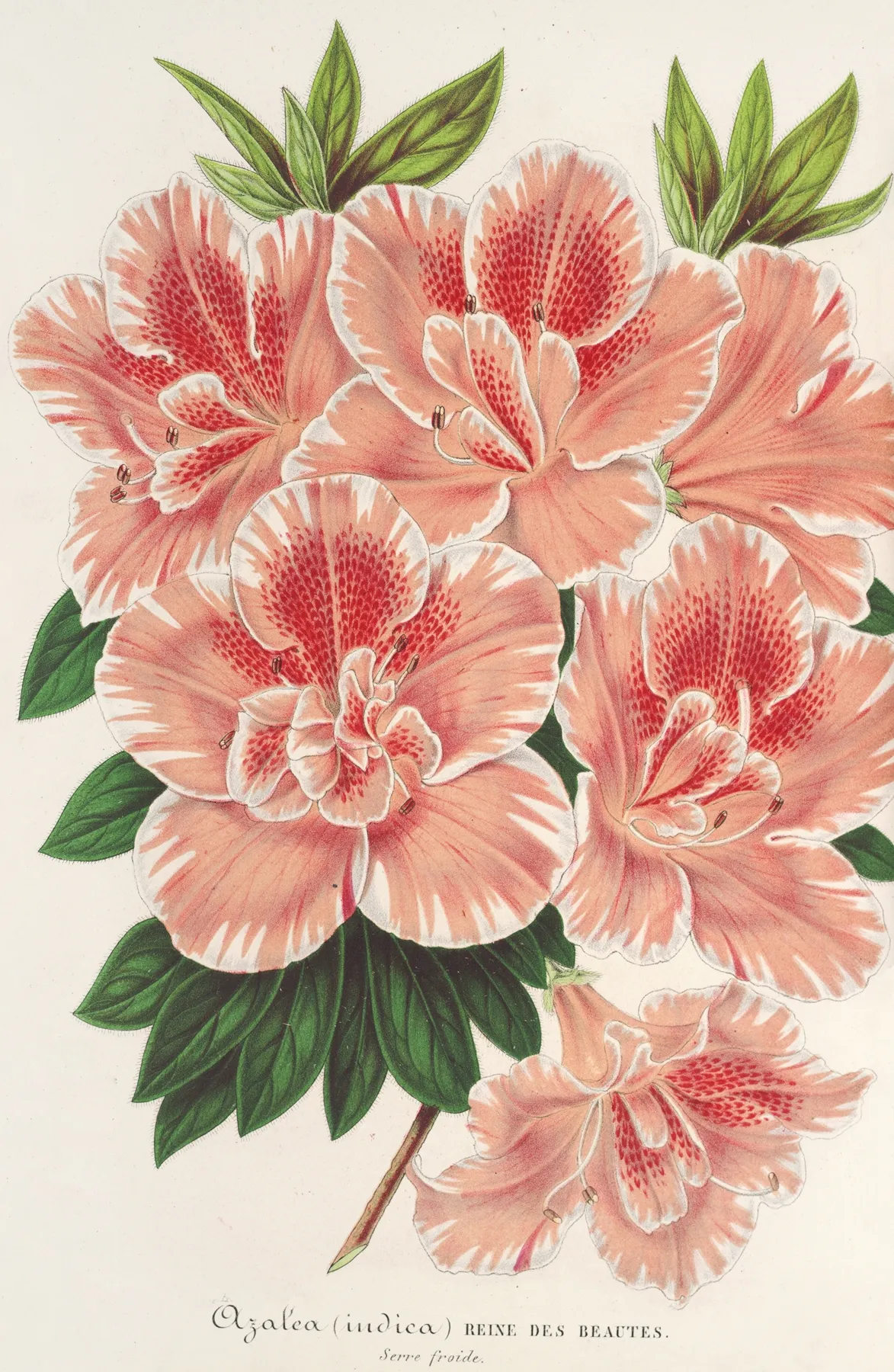
Azalea indica is plate 409, from L'Illustration horticole, drawn by Charles Antoine Lemaire. This public-domain plate is reproduced at high resolution, free to view and download. Publication: Gand, Belgium, Imprimerie et lithographie de F. et E. Gyselnyck,1854-1896.
Twelve ways of seeing
- measured cast amber
- upright 1.53 : 1
- published 1854
- Plate 409
Not a catalogue entry but a way of looking: how to stand, what to notice, how the line was cut, when it flowers, where it came from, who made it — and then the poems and the classics that taught China to see the same flower. Read the twelve in order and the plate opens.
-
First Look
真山水之川谷,远望之以取其势,近看之以取其质。
—— 宋·郭熙《林泉高致·山水训》
Mountains and valleys: from afar take their momentum, up close take their texture — the two distances from which any picture is read.
The sheet is vertical: the eye climbs and settles in the upper half. Let the plant stand before you look for detail. Then step in close: watch where colour meets line, and whether the line ever breaks. Third, find where the orange is deepest: the whole tonal order is measured from that patch.
-
Name and Thing
The binomial is Azalea indica: the first word is the genus it belongs among, the second the epithet that sets it apart. Here the epithet indica means “of India” — the name records the feature the namer noticed first. The Chinese name 皋月杜鹃 is a modern rendering of the Latin, not an old garden name.
-
Form and Colour
Measured on this plate: flower colour covers 46.4% of the sheet, foliage 8.3%, the cast amber with a second note of red. No other plate shares exactly this measure. Garden annuals and low perennials: many small, brilliantly coloured flowers to a stem, with leaves palmately lobed, pinnate or entire — the mainstay of the Victorian bedding scheme. Filed under orange — an amber orange, built in washes from a pale ground. Read the outline, then the colour layers, then the brush.
-
Composition
Tall and narrow, the plant rising in one movement with generous margins — the upright format of most floras. (about 1.53 : 1) No details are appended: a plate for looking, not for keying out. The plant fills 59% of the sheet, centred near the centre — the herbarium way, drawn to be read whole. Cover the margins with your thumb and the plate suffocates; uncover them and the flower breathes again.
-
Line and Colour
In the later nineteenth century chromolithography took over: colour printed rather than painted, line demoted. Craft leaves franker evidence than inscriptions.
-
Season
Late spring to early autumn, June through September; under glass they could be had from March. The year 1854 on the plate is that of publication, not of flowering — the gathering came a year or two earlier. Note the season. Phenology is the most practical tool of appreciation.
-
Provenance
Gathered from everywhere by plant hunters and the glasshouse trade: pelargoniums from South Africa, campanulas from European mountains, lobelias from North America, fuchsias from Chile. In the same volume the kin are shelved together; set several plates side by side.
-
The Book and the Hand
“L'Illustration horticole” was drawn by Charles Antoine Lemaire and published 1854-1896. This plate is Plate 409. The image is public domain; the hand-colouring is still one person's hand.
-
Poetic Resonance
适情处处皆安乐,大抵园林胜市朝。
—— 唐·白居易《諭親友》
The poem gives the mood first and the picture supplies the form; set the line beside the plate and the orange the corolla becomes its resting point.
-
The Written Tradition
会心处不必在远,翳然林水,便自有濠濮间想也。
—— 南朝宋·刘义庆《世说新语·言语》
Where the heart understands, distance is not needed: a screen of trees and a little water, and the mind is already by the River Hao.
China had its own gardening literature — Chen Haozi's Hua Jing on courtyard planting — which, like European bedding, brought wild plants down to human scale. The difference is not of quality but of question: Europe asks what it is, China asks whom it resembles.
-
Symbolism
Bedding plants carry no imperial weight; they mean the everyday — window sill, border, festival, gift. Victorian floriography grew up among exactly these flowers. This plate leans orange, which in flower language adds one more degree of feeling. Meanings change their tune: the same flower can say opposite things within a century.
-
What to Take Away
Carry three rules away: whole before detail; line before colour; picture before book. A flora exists to be consulted; look long enough and you forget to consult — someone in 1854 gave a whole day to a single flower.