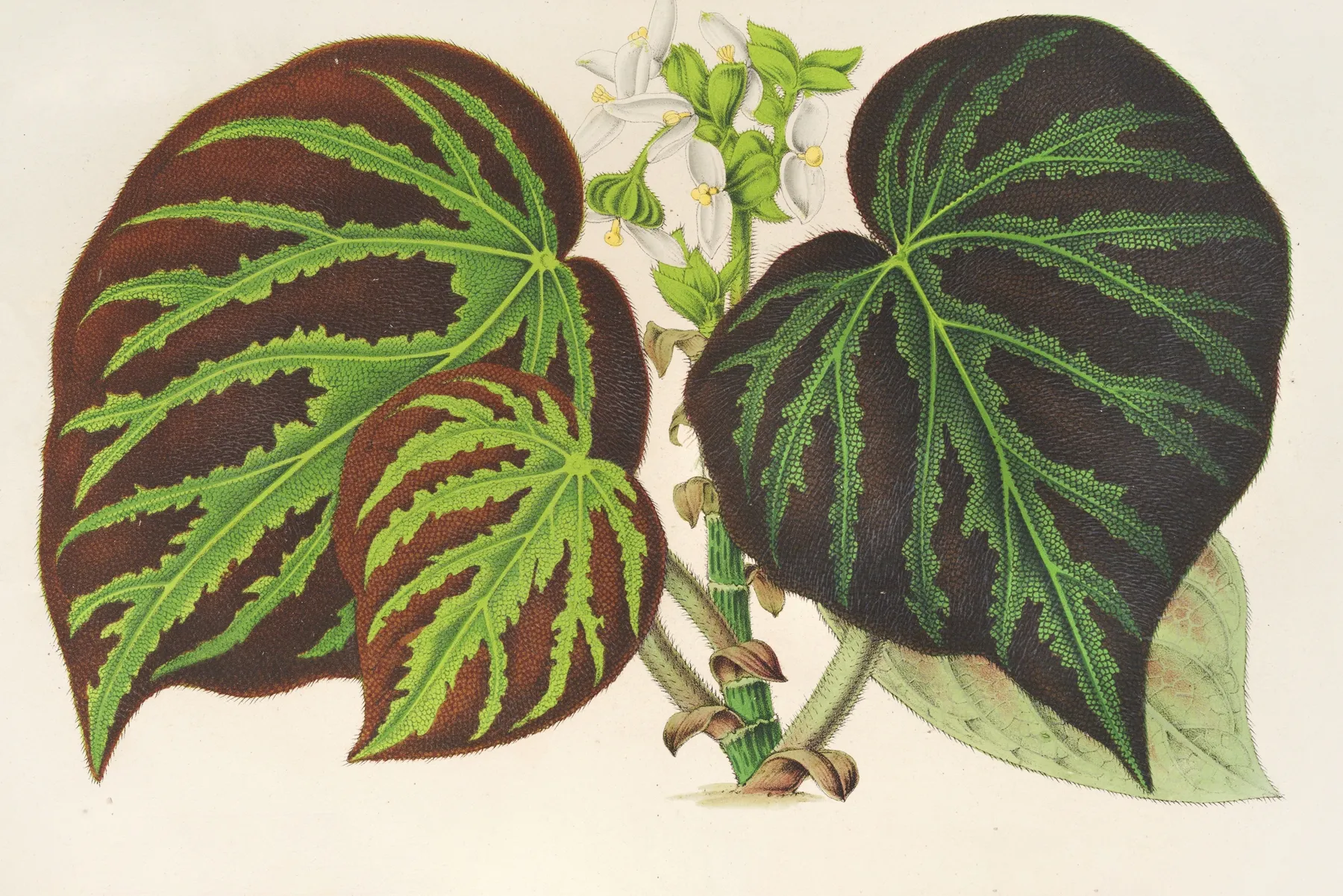
Bégonia imperialis (type}
Bégonia imperialis (type}
Ten ways of seeing
- measured cast amber
- broad 0.67 : 1
- published 1854
- Plate 268
First Look
真山水之川谷,远望之以取其势,近看之以取其质。
—— 宋·郭熙《林泉高致·山水训》
Mountains and valleys: from afar take their momentum, up close take their texture — the two distances from which any picture is read.
Broad and horizontal: the eye travels side to side. Find where it stops. Then step in close: watch where colour meets line, and whether the line ever breaks. Third, find where the green is deepest: the whole tonal order is measured from that patch.
Name and Thing
No reliable binomial survives, so the printed title must serve. Neither name nor binomial survives: the printed title must do.
Form and Colour
Measured on this plate: flower colour covers 26.0% of the sheet, foliage 25.2%, the cast amber with a second note of yellow-green. No other plate shares exactly this measure. A bulb of overlapping fleshy scales gives the lily its Chinese name, 'hundred-fold'; six tepals reflex as the flower opens, around six stamens with long, T-shaped anthers. Filed under green — a moss green, a colour that comes mostly from leaf and stem. A single plant, laid out with nothing hidden.
Composition
Broad and horizontal — the format for groups or a whole plant with its roots. (about 0.67 : 1) No details are appended: a plate for looking, not for keying out. The plant fills 64% of the sheet, centred near the centre — the herbarium way, drawn to be read whole. Cover the margins with your thumb and the plate suffocates; uncover them and the flower breathes again.
Line and Colour
In the later nineteenth century chromolithography took over: colour printed rather than painted, line demoted. Decide first whether it was printed or painted; only then discuss whether it is beautiful. If you mean to copy it: block in the broad shapes and colours first, detail last; lithographic softness comes from thin washes — two or three pale layers will get you close.
Poetic Resonance
更乞两丛香百合,老翁七十尚童心。
—— 宋·陆游《窗前作小土山蓻兰及玉簪最后得香百合并种之戏作》
The poem gives the mood first and the picture supplies the form; set the line beside the plate and the green the corolla becomes its resting point.
Symbolism
In the West the white lily is Marian purity, held by the angel of the Annunciation; in China the name sounds like 'a hundred years in harmony', a wedding wish. Meanings change their tune: the same flower can say opposite things within a century.
Season and Place
the flowers last only days, so artists drew them just as they opened. Temperate north — China, Japan, Europe. Long used in Chinese medicine, lilies were hunted in East Asia by nineteenth-century collectors and transformed European gardens. The year 1854 on the plate is that of publication, not of flowering — the gathering came a year or two earlier. The volume was made in 1854-1896, when most of this knowledge came from living plants under glass.
The Book and the Hand
“L'Illustration horticole” was drawn by Charles Antoine Lemaire and published 1854-1896. This plate is Plate 268. The image is public domain; the hand-colouring is still one person's hand.
What to Take Away
Next time you stand before a flowering plant, give it three minutes: leaf arrangement, direction of the flower, the darkest patch. Two centuries on, the plant may still flower in some garden; the one on this sheet stopped in the season of 1854.
About this plate
Bégonia imperialis (type} is plate 268, from L'Illustration horticole, drawn by Charles Antoine Lemaire. This public-domain plate is reproduced at high resolution, free to view and download. Publication: Gand, Belgium, Imprimerie et lithographie de F. et E. Gyselnyck,1854-1896.