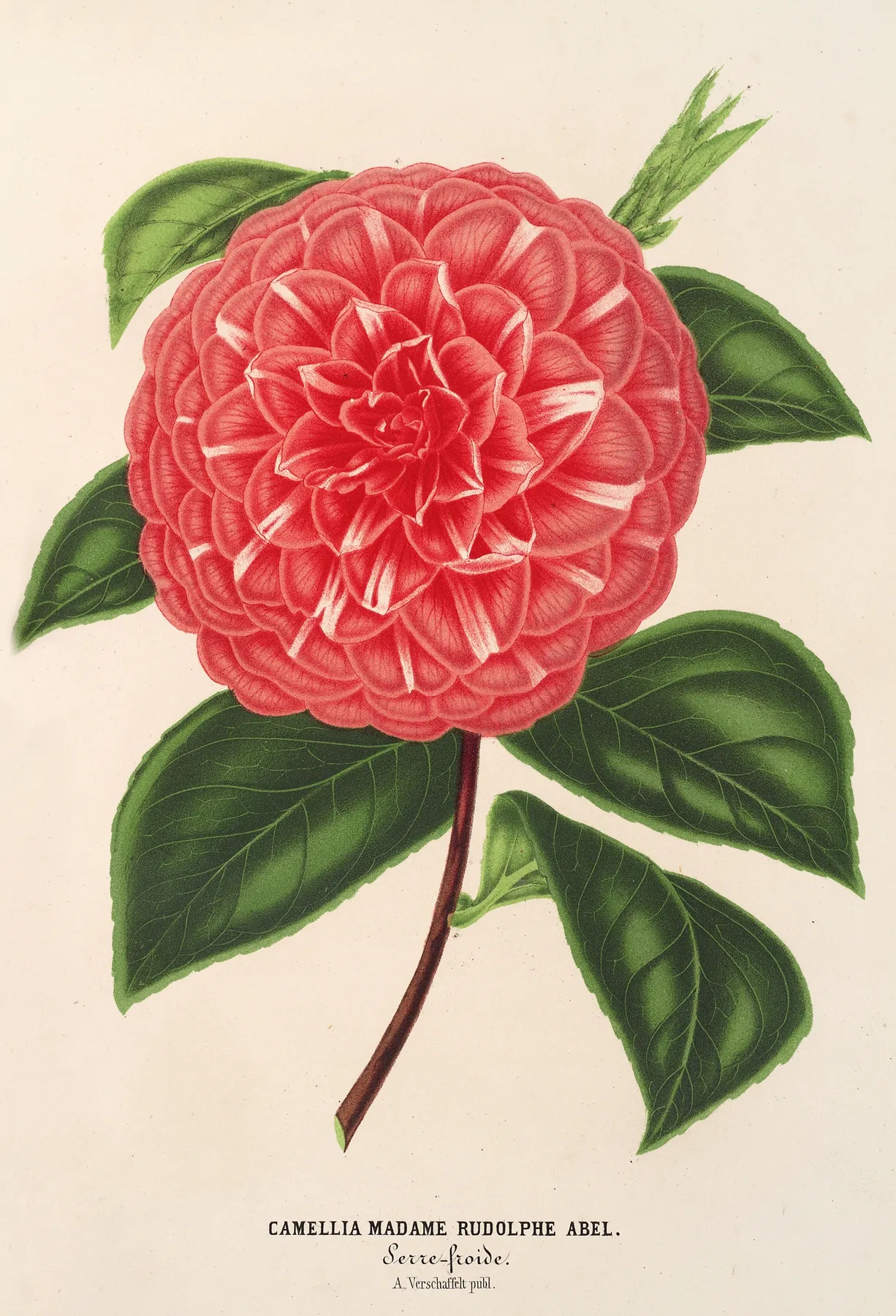
Camellia Madame Rudolph Abel
Verschaffelt publ|Camellia Madame Rudolph Abel
Camellia Madame Rudolph Abel
Ten ways of seeing
- measured cast red
- upright 1.47 : 1
First Look
凡画山水,意在笔先。
—— 唐·王维《山水论》
In painting, the intention precedes the brush.
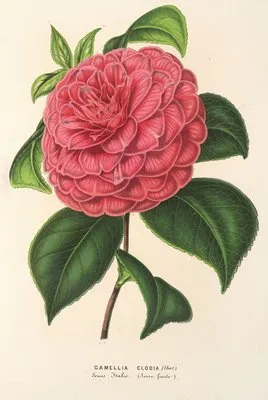
The sheet is vertical: the eye climbs and settles in the upper half. Let the plant stand before you look for detail. Then step in close: watch where colour meets line, and whether the line ever breaks. Third, find where the red is deepest: the whole tonal order is measured from that patch. The pose leans left: the upper half carries 8 points further left than the lower — a living thing, not a diagram.
Name and Thing
Only the genus Camellia is given; species-level names came later. No established Chinese name exists, so it is cited by its binomial alone.
Form and Colour
Measured on this plate: flower colour covers 23.1% of the sheet, foliage 20.8%, the cast red. No other plate shares exactly this measure. Camellias are evergreen shrubs with thick, waxen, serrate leaves; the double flowers overlap like roof tiles and fall whole, petals still attached. Filed under red — a red close to carmine, built in washes from a pale ground. A single plant, laid out with nothing hidden.
Composition
The sheet is tall. No details are appended: a plate for looking, not for keying out. The plant fills 44% of the sheet, centred near the centre — the herbarium way, drawn to be read whole.
Line and Colour
In the later nineteenth century chromolithography took over: colour printed rather than painted, line demoted. Decide first whether it was printed or painted; only then discuss whether it is beautiful. If you mean to copy it: block in the broad shapes and colours first, detail last; lithographic softness comes from thin washes — two or three pale layers will get you close.
Poetic Resonance
夜饮海棠月,朝漱山茶露。
—— 宋·范成大《壬辰三月十八日石湖花下作》
The poem gives the mood first and the picture supplies the form; set the line beside the plate and the red the corolla becomes its resting point.
Symbolism
In China the camellia is the friend that endures; in Europe it became Eastern beauty and unattainability, and after La Dame aux Camélias, a token of brief life. This plate leans red, which in flower language adds one more degree of feeling. Meanings change their tune: the same flower can say opposite things within a century.
Season and Place
a single flower may last a fortnight. Southwest China and Japan, with Yunnan the centre of diversity. The year 1854 on the plate is that of publication, not of flowering — the gathering came a year or two earlier. The bud and the ripe fruit on one branch tell the season; the name in the title often tells the journey.
The Book and the Hand
“L'Illustration horticole” carries only Charles Antoine Lemaire's name. From drawing to plate the sheet passed through several hands — the engraver aimed at accuracy, the colourist at speed, and between them lies each plate's unevenness.
What to Take Away
Appreciation is not knowledge but habit — one more look each time. The flower of that year is dust, yet its image on paper has outlived every living cousin.
About this plate
Camellia Madame Rudolph Abel is plate 272, from L'Illustration horticole, drawn by Charles Antoine Lemaire. This public-domain plate is reproduced at high resolution, free to view and download. Publication: Gand, Belgium, Imprimerie et lithographie de F. et E. Gyselnyck,1854-1896.