Camellia Petazzi
Verschaffelt pribl|Camellia Petazzi
Camellia Petazzi
About this plate
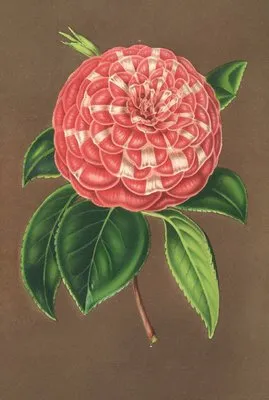
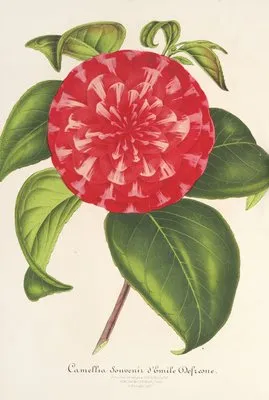
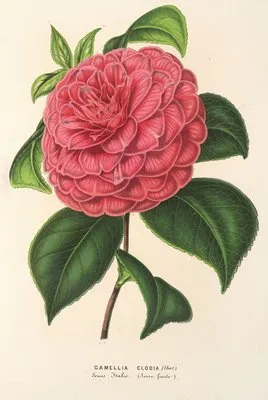
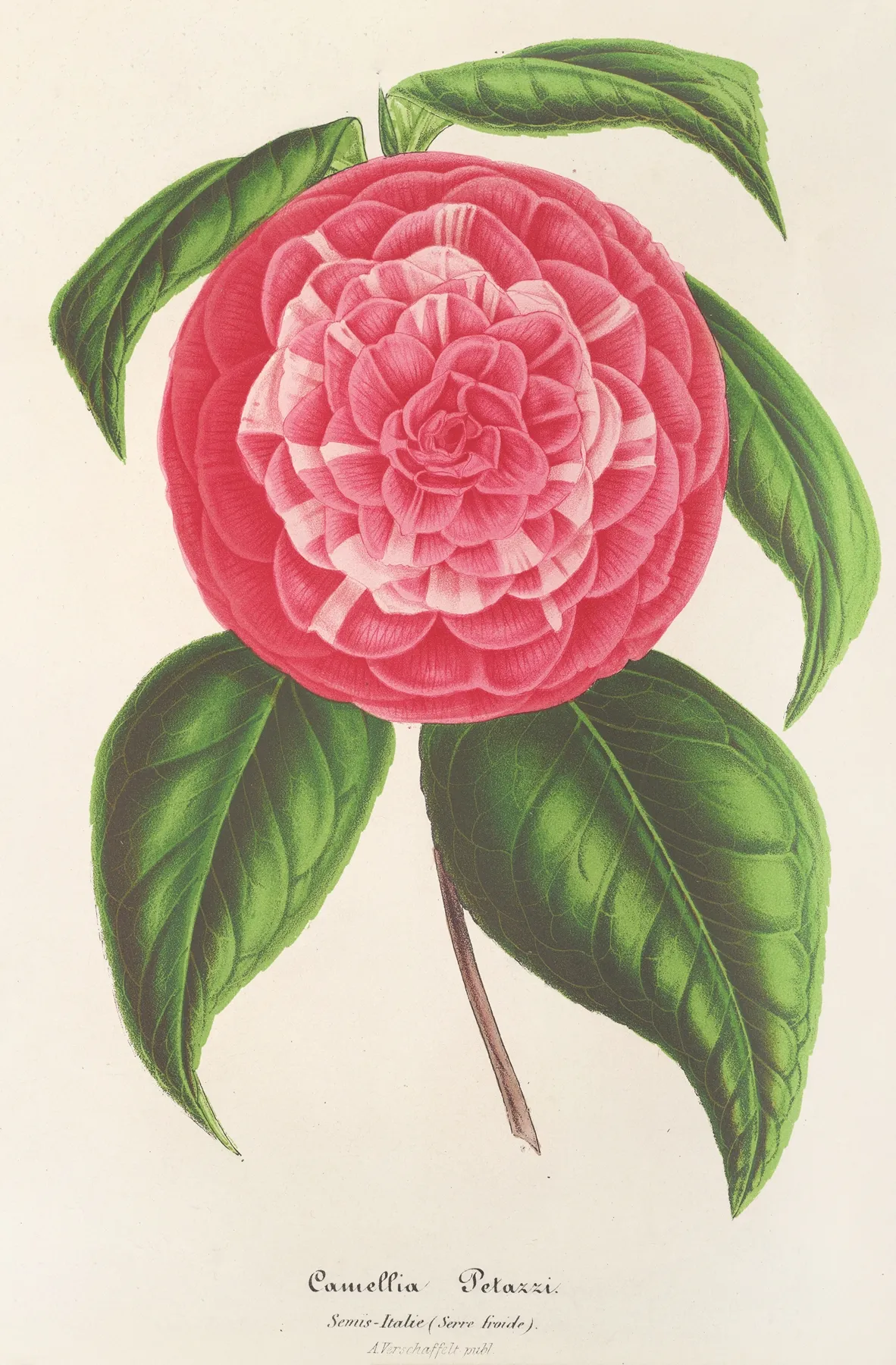
Camellia Petazzi is plate 230, from L'Illustration horticole, drawn by Charles Antoine Lemaire. This public-domain plate is reproduced at high resolution, free to view and download. Publication: Gand, Belgium, Imprimerie et lithographie de F. et E. Gyselnyck,1854-1896.
Twelve ways of seeing
- measured cast red
- upright 1.52 : 1
- published 1854
- Plate 230
Not a catalogue entry but a way of looking: how to stand, what to notice, how the line was cut, when it flowers, where it came from, who made it — and then the poems and the classics that taught China to see the same flower. Read the twelve in order and the plate opens.
-
First Look
竖划三寸,当千仞之高;横墨数尺,体百里之迥。
—— 南朝宋·宗炳《画山水序》
A vertical stroke of three inches stands for a cliff of a thousand fathoms; a few feet of ink holds a hundred li.
The sheet is vertical: the eye climbs and settles in the upper half. Let the plant stand before you look for detail. Then step in close: watch where colour meets line, and whether the line ever breaks. Third, find where the red is deepest: the whole tonal order is measured from that patch.
-
Name and Thing
The binomial is Camellia petazzi: the first word is the genus it belongs among, the second the epithet that sets it apart. The genus name Camellia: Camellia honours Georg Kamel, the Moravian Jesuit who first described the plant in the Philippines. No established Chinese name exists, so it is cited by its binomial alone.
-
Form and Colour
Measured on this plate: flower colour covers 23.3% of the sheet, foliage 19.1%, the cast red. No other plate shares exactly this measure. Camellias are evergreen shrubs with thick, waxen, serrate leaves; the double flowers overlap like roof tiles and fall whole, petals still attached. Filed under red — a red close to carmine, built in washes from a pale ground. Read the outline, then the colour layers, then the brush.
-
Composition
Tall and narrow, the plant rising in one movement with generous margins — the upright format of most floras. (about 1.52 : 1) No details are appended: a plate for looking, not for keying out. The plant fills 47% of the sheet, centred above centre — the herbarium way, drawn to be read whole. Cover the margins with your thumb and the plate suffocates; uncover them and the flower breathes again.
-
Line and Colour
In the later nineteenth century chromolithography took over: colour printed rather than painted, line demoted. There is evidence on the back too: the plate mark pressed into the paper, the slight relief of the pigment, lines worn shallow in a later printing.
-
Season
Late winter into early spring, blooming in the cold of the first lunar month; a single flower may last a fortnight. The year 1854 on the plate is that of publication, not of flowering — the gathering came a year or two earlier. The best time to read such a plate is its flowering season: three minutes under the tree explains what no text can.
-
Provenance
Southwest China and Japan, with Yunnan the centre of diversity; when it reached Europe in the nineteenth century it was hailed as 'the rose of the East'. In the same volume the kin are shelved together; set several plates side by side.
-
The Book and the Hand
“L'Illustration horticole” was drawn by Charles Antoine Lemaire and published 1854-1896. This plate is Plate 230. The image is public domain; the hand-colouring is still one person's hand.
-
Poetic Resonance
东园三日雨兼风,桃李飘零扫地空。惟有山茶偏耐久,绿丛又放数枝红。
—— 宋·陆游《山茶》
Three days of wind and rain in the east garden: peach and plum are swept away. Only the camellia endures, putting out a few more red sprays from the green.
The poem gives the mood first and the picture supplies the form; set the line beside the plate and the red the corolla becomes its resting point.
-
The Written Tradition
茗赏者上也,谭赏者次也,酒赏者下也。
—— 明·袁宏道《瓶史·清赏》
To enjoy flowers with tea is best, with talk second, with wine the least — what is ranked is the viewer's mind, not the flower.
Ming flower manuals list dozens of camellia varieties; the Bencao Gangmu presses oil from the seeds and brews the leaves — the plant belongs to both flower lore and pharmacy. Keep the line; it will surface the next time you meet the same plant.
-
Symbolism
In China the camellia is the friend that endures; in Europe it became Eastern beauty and unattainability, and after La Dame aux Camélias, a token of brief life. This plate leans red, which in flower language adds one more degree of feeling. Flower language was added later; the flower knows nothing of it, and that innocence is part of its power.
-
What to Take Away
Carry three rules away: whole before detail; line before colour; picture before book. A flora exists to be consulted; look long enough and you forget to consult — someone in 1854 gave a whole day to a single flower.