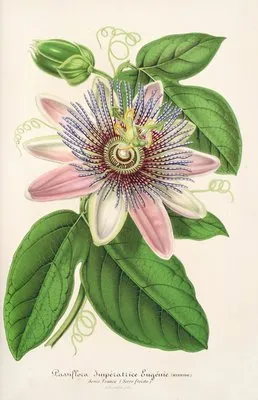
Passiflora Baraquiniana
Baiaquimima sor|Passiflora Baraquiniana
Passiflora Baraquiniana
About this plate
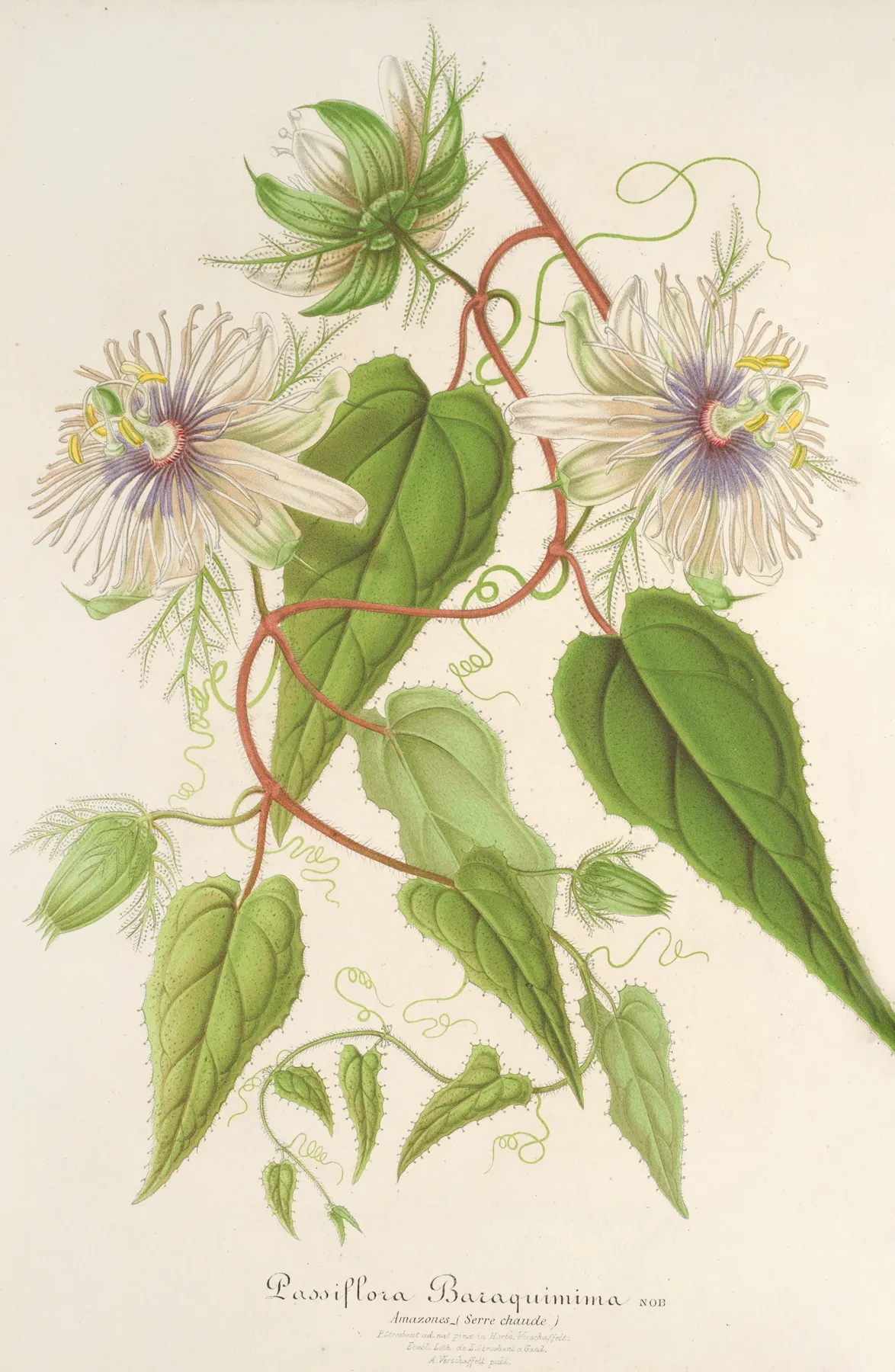
Passiflora Baraquiniana is plate 247, from L'Illustration horticole, drawn by Charles Antoine Lemaire. This public-domain plate is reproduced at high resolution, free to view and download. Publication: Gand, Belgium, Imprimerie et lithographie de F. et E. Gyselnyck,1854-1896.
Twelve ways of seeing
- measured cast yellow-green
- upright 1.53 : 1
- published 1854
- Plate 247
Not a catalogue entry but a way of looking: how to stand, what to notice, how the line was cut, when it flowers, where it came from, who made it — and then the poems and the classics that taught China to see the same flower. Read the twelve in order and the plate opens.
-
First Look
搜尽奇峰打草稿。
—— 清·石涛《苦瓜和尚画语录》
Exhaust the strange peaks, and then make the sketch.
The sheet is vertical: the eye climbs and settles in the upper half. Let the plant stand before you look for detail. Then step in close: watch where colour meets line, and whether the line ever breaks. Third, find where the yellow is deepest: the whole tonal order is measured from that patch.
-
Name and Thing
The binomial is Passiflora baraquiniana: the first word is the genus it belongs among, the second the epithet that sets it apart. Two words carry a whole provenance. No established Chinese name exists, so it is cited by its binomial alone.
-
Form and Colour
Measured on this plate: flower colour covers 12.1% of the sheet, foliage 15.6%, the cast yellow-green with a second note of amber. No other plate shares exactly this measure. Tropical plants defy temperate habits: heavy, saturated flowers with strong scent, leathery or dissected leaves, stems that climb, swell, or reduce to spines. Filed under yellow — a honey-yellow, built in washes from a pale ground. Read the outline, then the colour layers, then the brush.
-
Composition
Tall and narrow, the plant rising in one movement with generous margins — the upright format of most floras. (about 1.53 : 1) No details are appended: a plate for looking, not for keying out. The plant takes about 31% of the sheet, centred near the centre — the easy measure most florists kept to. Old plates set the plant slightly off centre, with unequal margins — that small imbalance is what keeps it alive.
-
Line and Colour
In the later nineteenth century chromolithography took over: colour printed rather than painted, line demoted. Take a loupe to three places: petal edge, leaf vein, caption. An unbroken line means engraving; colour crossing the outline means a hand.
-
Season
The tropics have no four seasons, only wet and dry; flowering follows the first rains, so a month on the plate often means 'after the rain'. The year 1854 on the plate is that of publication, not of flowering — the gathering came a year or two earlier. Note the season. Phenology is the most practical tool of appreciation.
-
Provenance
Central and South America, Southeast Asia, India, Ceylon. Eighteenth- and nineteenth-century artists either sailed with the ships or drew from living specimens under glass. The volume was made in 1854-1896, when most of this knowledge came from living plants under glass.
-
The Book and the Hand
“L'Illustration horticole” was drawn by Charles Antoine Lemaire and published 1854-1896. This plate is Plate 247. The image is public domain; the hand-colouring is still one person's hand.
-
Poetic Resonance
日啖荔枝三百颗,不辞长作岭南人。
—— 宋·苏轼《食荔枝》
Three hundred lychees a day — I would not mind being a southerner all my life.
The poem gives the mood first and the picture supplies the form; set the line beside the plate and the yellow the corolla becomes its resting point.
-
The Written Tradition
投我以木瓜,报之以琼琚。匪报也,永以为好也。
—— 《诗经·卫风·木瓜》
You toss me a quince, I return a jade pendant — not as payment, but so that we may be friends for ever.
Ji Han's fourth-century Records of the Plants of the South is China's earliest regional flora; Europe's counterpart was the exotic flora brought home by voyages — both by-products of empire and trade. You need not parse every word: take the line, and the flower acquires a second face.
-
Symbolism
In China these plants carry no classical symbolism; their meaning is newness — new worlds, new species, new trade routes. They show natural history's expanding edge. This plate leans yellow, which in flower language adds one more degree of feeling. Flower language was added later; the flower knows nothing of it, and that innocence is part of its power.
-
What to Take Away
Carry three rules away: whole before detail; line before colour; picture before book. The flower of that year is dust, yet its image on paper has outlived every living cousin.