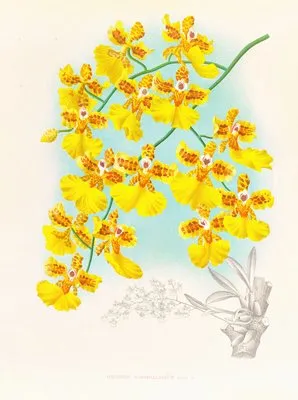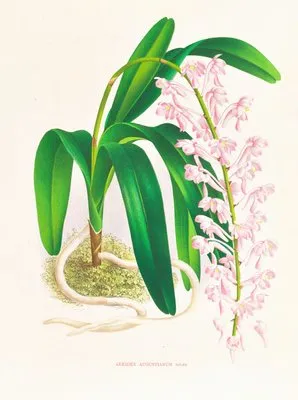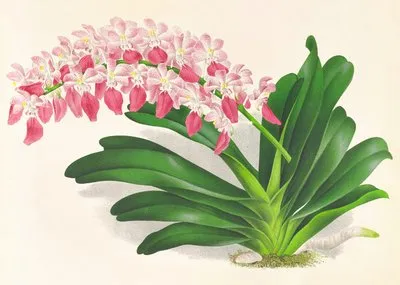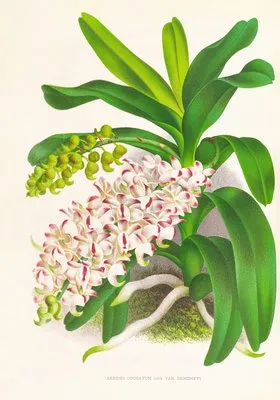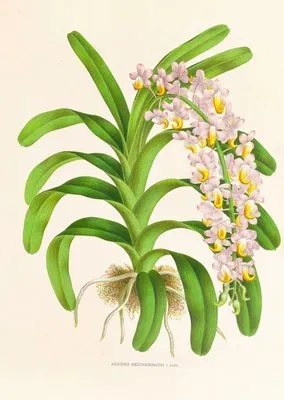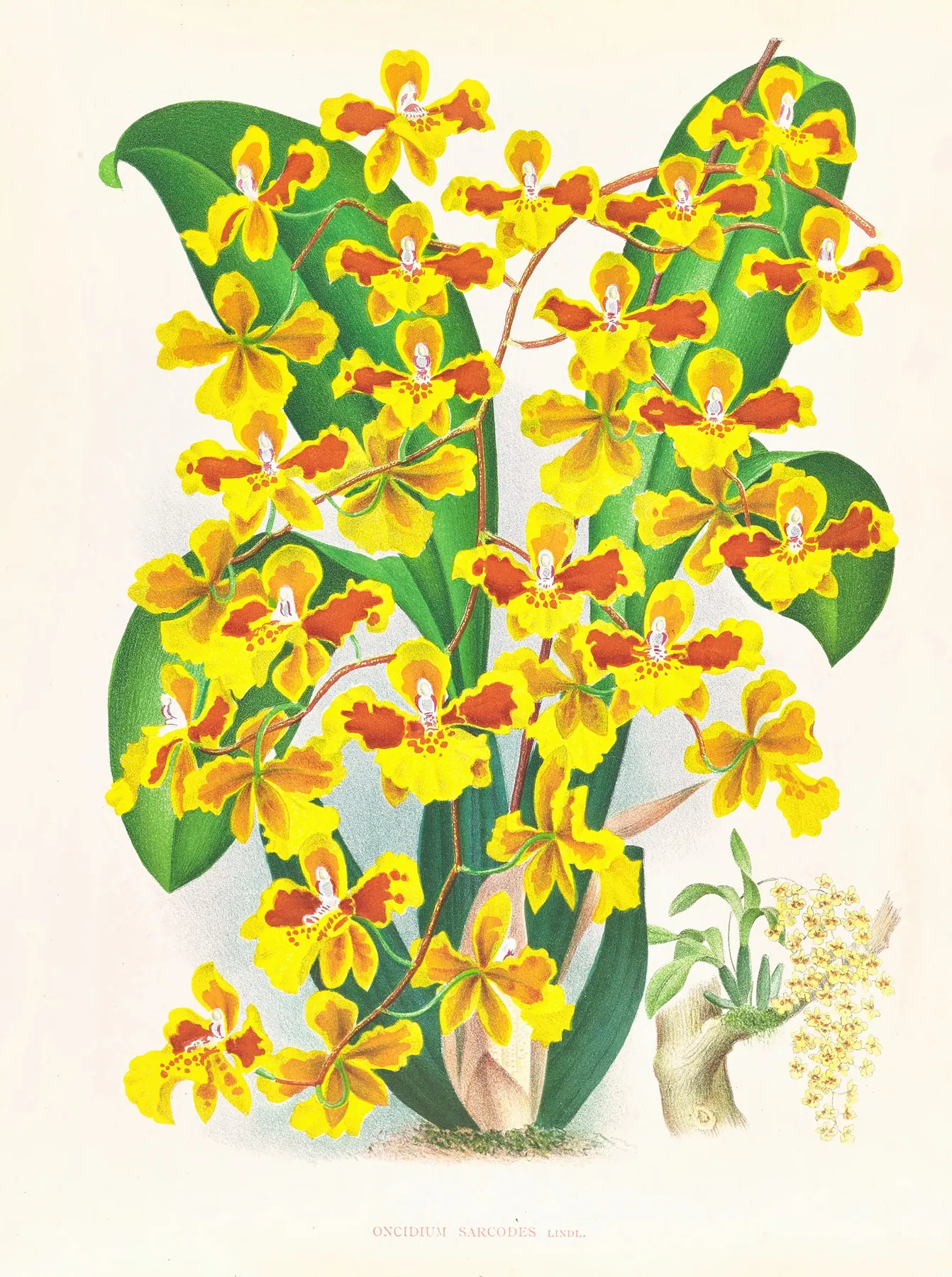
Oncidium sarcodes
肉色宫美兰
Oncidium sarcodes
About this plate
Oncidium sarcodes is plate 131, from Lindenia: Iconography of the Orchids, drawn by Jean Jules Linden. This public-domain plate is reproduced at high resolution, free to view and download. Publication: Gand [Belgium] :Impr. F. Meyer-van Loo,1885-1906.
Twelve ways of seeing
- measured cast yellow-green
- upright 1.34 : 1
- published 1885
- Plate 131
Not a catalogue entry but a way of looking: how to stand, what to notice, how the line was cut, when it flowers, where it came from, who made it — and then the poems and the classics that taught China to see the same flower. Read the twelve in order and the plate opens.
-
First Look
搜尽奇峰打草稿。
—— 清·石涛《苦瓜和尚画语录》
Exhaust the strange peaks, and then make the sketch.
The sheet is vertical: the eye climbs and settles in the upper half. Let the plant stand before you look for detail. Then step in close: watch where colour meets line, and whether the line ever breaks. Third, find where the yellow is deepest: the whole tonal order is measured from that patch.
-
Name and Thing
The binomial is Oncidium sarcodes: the first word is the genus it belongs among, the second the epithet that sets it apart. Two words carry a whole provenance. The Chinese name 肉色宫美兰 is a modern rendering of the Latin, not an old garden name.
-
Form and Colour
Measured on this plate: flower colour covers 31.8% of the sheet, foliage 14.7%, the cast yellow-green with a second note of amber. No other plate shares exactly this measure. Orchids carry pseudobulbs or fleshy roots; six tepals, one modified into a lip that serves as a landing stage, and a column uniting stamens and pistil — a structure unique to the family. Filed under yellow — a honey-yellow, built in washes from a pale ground. Read the outline, then the colour layers, then the brush.
-
Composition
Tall and narrow, the plant rising in one movement with generous margins — the upright format of most floras. (about 1.34 : 1) No details are appended: a plate for looking, not for keying out. The plant fills 49% of the sheet, centred near the centre — the herbarium way, drawn to be read whole. Blank paper is not unfinished work: it is where the eye rests.
-
Line and Colour
In the later nineteenth century chromolithography took over: colour printed rather than painted, line demoted. Craft leaves franker evidence than inscriptions.
-
Season
Varies by genus: temperate terrestrials flower in spring and summer, tropical epiphytes almost year-round. The year 1885 on the plate is that of publication, not of flowering — the gathering came a year or two earlier. The plate records ten days of peak; the other three hundred are leaf, fruit and rest.
-
Provenance
Worldwide, richest on tropical mountains. Chinese cymbidiums come from the hills of the south; the orchids drawn for European portfolios came largely from the cloud forests of Central America and Southeast Asia. In the same volume the kin are shelved together; set several plates side by side.
-
The Book and the Hand
“Lindenia: Iconography of the Orchids” was drawn by Jean Jules Linden and published 1885-1906. This plate is Plate 131. The image is public domain; the hand-colouring is still one person's hand.
-
Poetic Resonance
兰叶春葳蕤,桂华秋皎洁。
—— 唐·张九龄《感遇》
Orchid leaves luxuriate in spring; cassia flowers are bright and pure in autumn.
The poem gives the mood first and the picture supplies the form; set the line beside the plate and the yellow the corolla becomes its resting point.
-
The Written Tradition
释名(闲)、木香、香水兰、女兰、香草、燕尾香、大泽兰、兰泽草、煎泽草、省头草、都梁香、孩儿菊、千金草。气味(叶)辛、平、无毒。
—— 本草纲目·兰草第九十三
Confucius, finding an orchid flowering alone in a valley, is said to have composed the 'Lament for the Orchid'; in the Li Sao, orchids are worn as a girdle of virtue. You need not parse every word: take the line, and the flower acquires a second face.
-
Symbolism
In China the orchid is the gentleman who blooms unseen; in Victorian Europe it was luxury and obsession, a single new species worth a fortune. This plate leans yellow, which in flower language adds one more degree of feeling. Flower language was added later; the flower knows nothing of it, and that innocence is part of its power.
-
What to Take Away
If you keep one line, keep Guo Xi's: from afar its momentum, up close its texture. A flora exists to be consulted; look long enough and you forget to consult — someone in 1885 gave a whole day to a single flower.