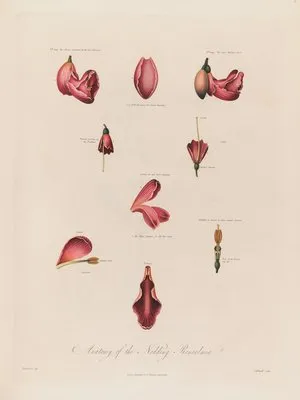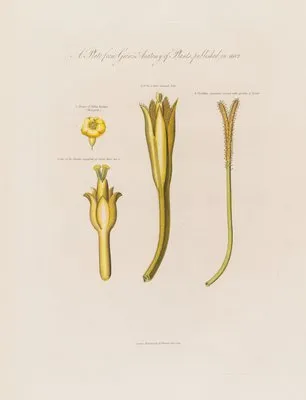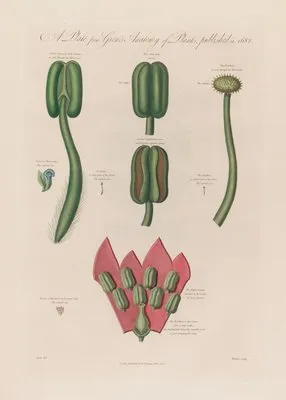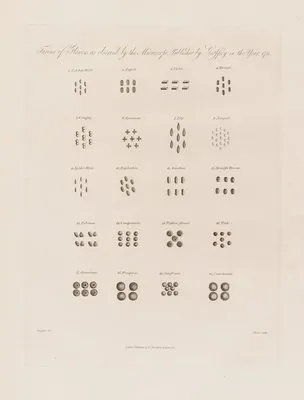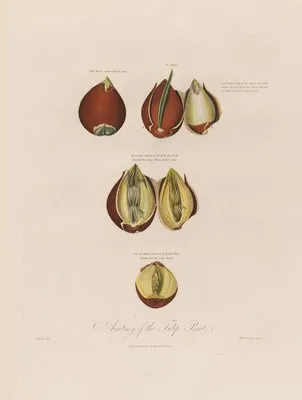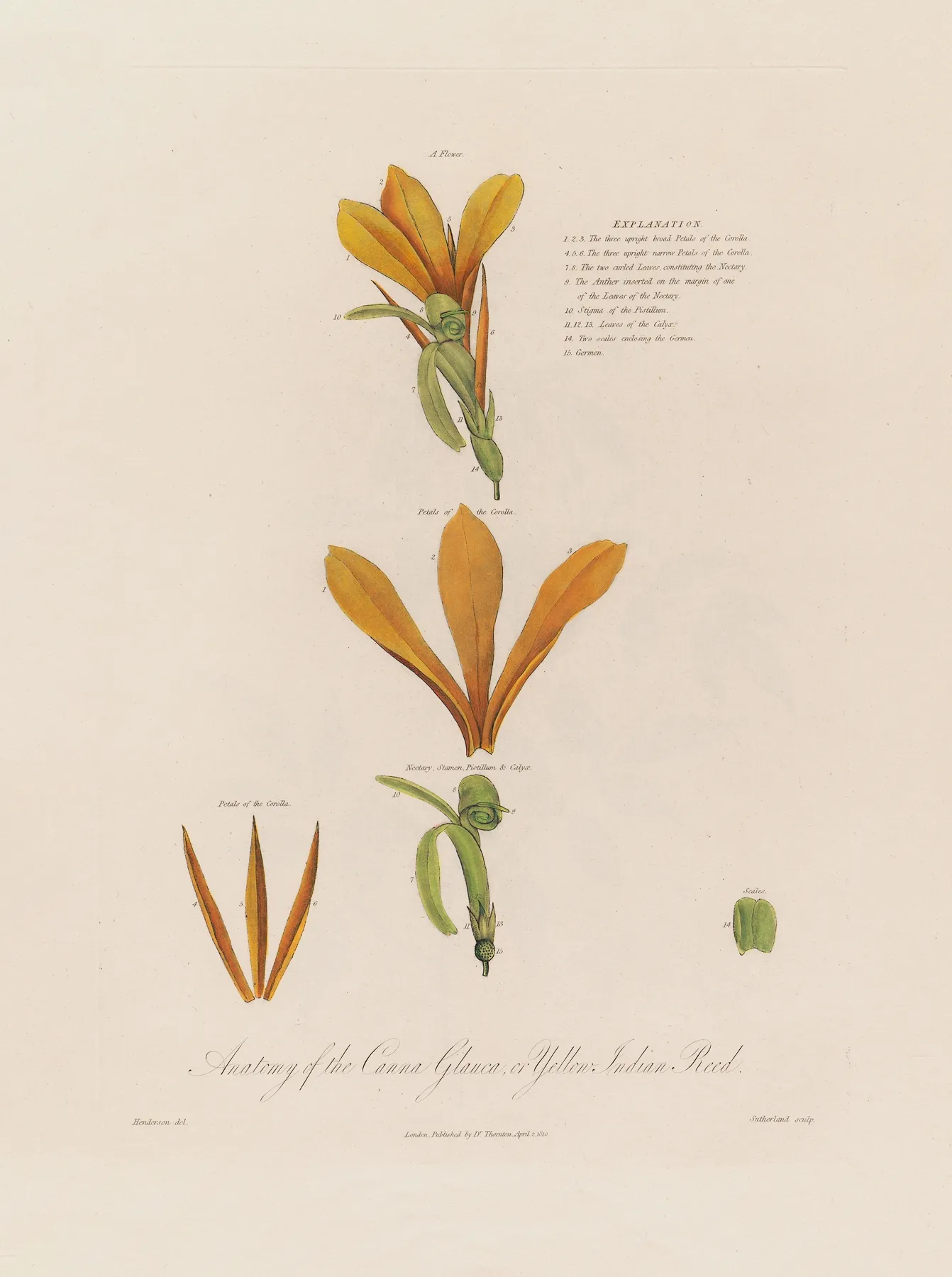
Anatomy of the Canna Glauca, or Yellow Indian Reed
A Flowr EXPLANATION. 1.2. 3. The three upright broad Pctals of the Corola 4.6.6. The thre upright narrow Petals of the Corolla 1.8. The two curlcd Leaves, constituting the Nectary. 9. The Anther
Anatomy of the Canna Glauca, or Yellow Indian Reed
Ten ways of seeing
- measured cast amber
- upright 1.34 : 1
First Look
江馆清秋,晨起看竹,烟光日影露气,皆浮动于疏枝密叶之间。
—— 清·郑板桥《题画竹》
On an autumn morning at the river lodge I looked at the bamboo: mist, sunlight, dew, all drifting among the sparse and dense leaves.
The sheet is vertical: the eye climbs and settles in the upper half. Let the plant stand before you look for detail. Then step in close: watch where colour meets line, and whether the line ever breaks. Third, find the darkest small patch: the whole tonal order is measured from there.
Name and Thing
Only the genus Canna is given; species-level names came later. No established Chinese name exists, so it is cited by its binomial alone.
Form and Colour
Measured on this plate: flower colour covers 5.7% of the sheet, foliage 0.2%, the cast amber with a second note of yellow-green. No other plate shares exactly this measure. Garden annuals and low perennials: many small, brilliantly coloured flowers to a stem, with leaves palmately lobed, pinnate or entire — the mainstay of the Victorian bedding scheme.No colour group is recorded. A single plant, laid out with nothing hidden.
Composition
The sheet is tall. No details are appended: a plate for looking, not for keying out. The plant covers only 6% of the sheet, centred near the centre; the emptiness is where the eye rests.
Line and Colour
Eighteenth-century plates are mostly copper engraving: hatched lines for shadow, then hand-colouring by another hand. Decide first whether it was printed or painted; only then discuss whether it is beautiful. If you mean to copy it: take its skeleton, its margins and the order of its colours; the burin's hatching is the language of copper — suggest it with pencil density, do not imitate it stroke for stroke.
Poetic Resonance
余既滋兰之九畹兮,又树蕙之百亩。
—— 战国·屈原《离骚》
I have planted nine acres of orchids and set out a hundred acres of sweet flag.
The poem gives the mood first and the picture supplies the form; set the line beside the plate and the corolla becomes its resting point.
Symbolism
Bedding plants carry no imperial weight; they mean the everyday — window sill, border, festival, gift. Victorian floriography grew up among exactly these flowers. Meanings change their tune: the same flower can say opposite things within a century.
Season and Place
under glass they could be had from March. Gathered from everywhere by plant hunters and the glasshouse trade: pelargoniums from South Africa, campanulas from European mountains, lobelias from North America, fuchsias from Chile. The year 1799 on the plate is that of publication, not of flowering — the gathering came a year or two earlier. See this kind of plate in the flowering season if you can: once you have met the living flower, you stop reading only colour.
The Book and the Hand
“New illustration of the sexual system of Carolus von Linnaeus” carries only Robert John Thornton, Carl von Linné's name. A plate is collective work: drawer, engraver and colourist were different hands, and the unnamed ones decided how good it looks.
What to Take Away
Carry three rules away: whole before detail; line before colour; picture before book. The flower of that year is dust, yet its image on paper has outlived every living cousin.
About this plate
Anatomy of the Canna Glauca, or Yellow Indian Reed is plate 24, from New illustration of the sexual system of Carolus von Linnaeus, drawn by Robert John Thornton, Carl von Linné. This public-domain plate is reproduced at high resolution, free to view and download. Publication: London, T. Bensley, 1799–1810.