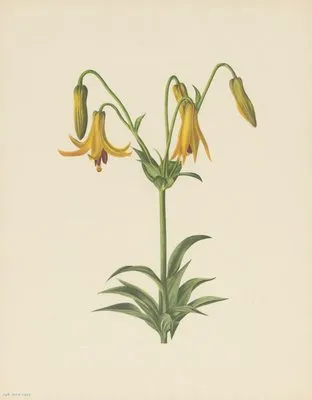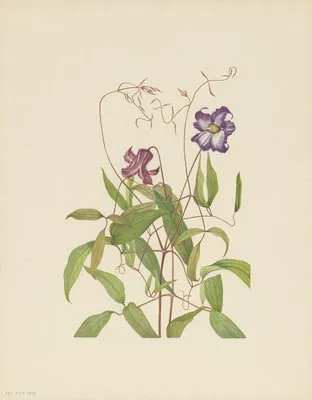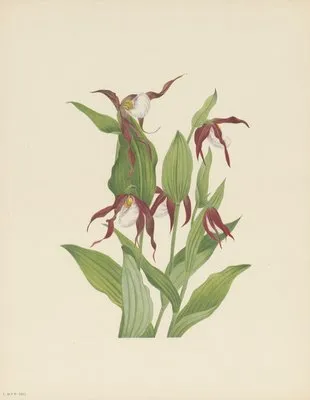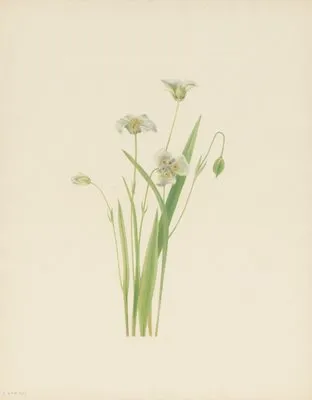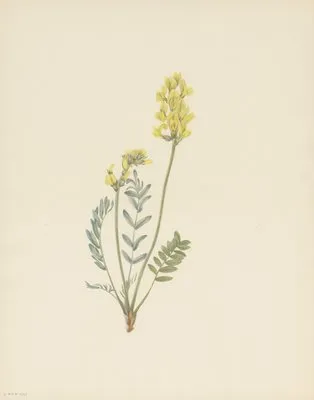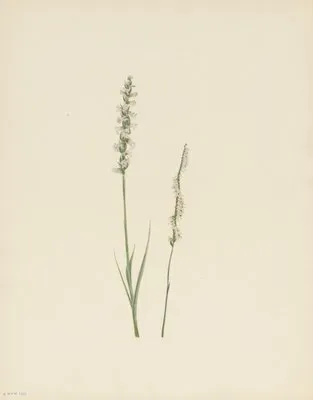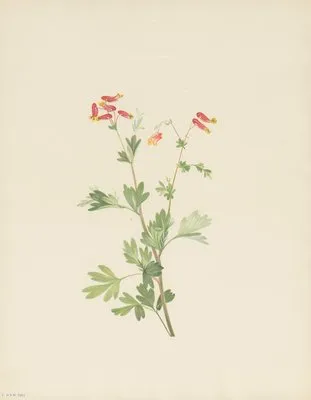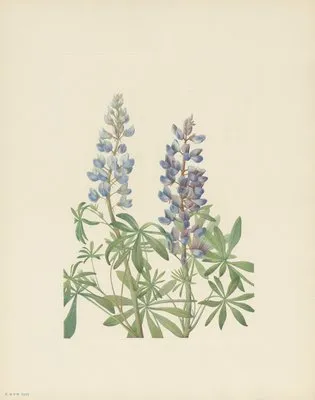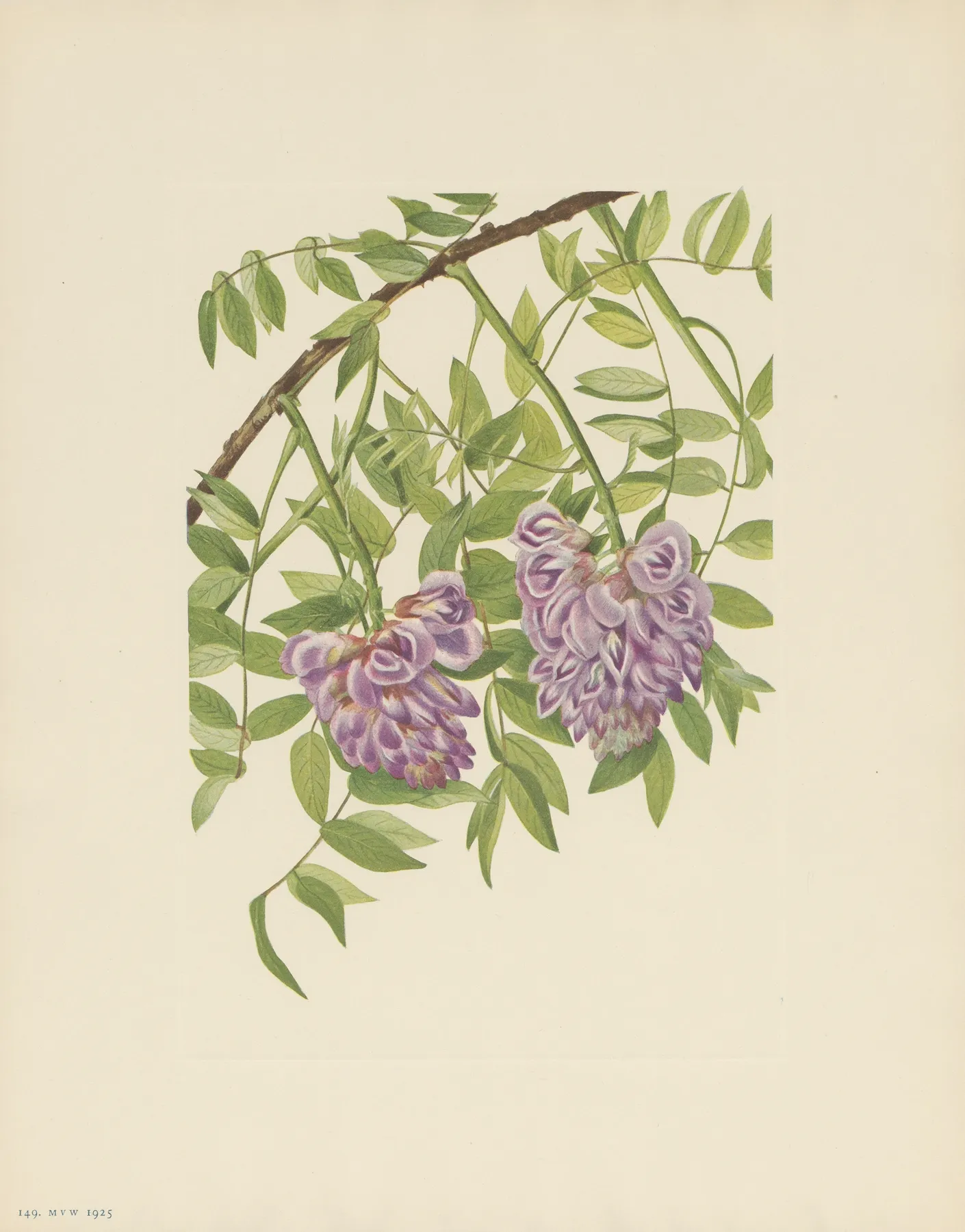
American Wistaria (Kraunhia frutescens) (1925)
American Wistaria (Kraunhia frutescens) (1925)
American Wistaria (Kraunhia frutescens) (1925)
Ten ways of seeing
- measured cast yellow-green
- slightly upright 1.28 : 1
First Look
夫象物必在于形似,形似须全其骨气。
—— 唐·张彦远《历代名画记》
Likeness is the threshold; bone-and-breath is the point.
Slightly taller than wide; the eye lands above centre. Then step in close: watch where colour meets line, and whether the line ever breaks. Third, find the darkest small patch: the whole tonal order is measured from there.
Name and Thing
Only the genus Wistaria is given; species-level names came later. No established Chinese name exists, so it is cited by its binomial alone.
Form and Colour
Measured on this plate: flower colour covers 9.3% of the sheet, foliage 6.4%, the cast yellow-green. No other plate shares exactly this measure. Flowering trees and shrubs put out branches first; blossoms open before or with the leaves, usually five thin, translucent petals around a cluster of fine stamens.No colour group is recorded. Three things fix the habit: leaf arrangement, tepal count, and how the flower is borne.
Composition
The sheet is slightly tall. No details are appended: a plate for looking, not for keying out. The plant covers only 19% of the sheet, centred near the centre; the emptiness is where the eye rests.
Line and Colour
After 1900 photography and colour reproduction ran alongside watercolour: accuracy rose, the cut of the burin disappeared. Take a loupe to three places: petal edge, leaf vein, caption. An unbroken line means engraving; colour crossing the outline means a hand. If you mean to copy it: this is a photomechanical record — match the colours directly, do not imitate the printing grain.
Poetic Resonance
桃之夭夭,灼灼其华。
—— 《诗经·周南·桃夭》
The peach tree, young and graceful, its blossoms blazing bright.
The poem gives the mood first and the picture supplies the form; set the line beside the plate and the corolla becomes its resting point.
Symbolism
Plum is solitude, peach is marriage, apricot is spring itself, crabapple is a fragile fate; the hibiscus, opening at dawn and falling at dusk, is impermanence. Flower language was added later; the flower knows nothing of it, and that innocence is part of its power.
Season and Place
Mid spring: plum first, then peach and apricot, cherry last — the season keeps its order. cherry and crabapple went east to Japan and west to Europe. The year 1925 on the plate is that of publication, not of flowering — the gathering came a year or two earlier. Read the locality and the flowering season both with a discount: one is hearsay, the other a ten-day peak.
The Book and the Hand
“North American wild flowers” carries only Mary Vaux Walcott's name. The image is public domain; the hand-colouring is still one person's hand.
What to Take Away
Appreciation is not knowledge but habit — one more look each time. A flora exists to be consulted; look long enough and you forget to consult — someone in 1925 gave a whole day to a single flower.
About this plate
American Wistaria (Kraunhia frutescens) (1925) is plate 149, from North American wild flowers, drawn by Mary Vaux Walcott. This public-domain plate is reproduced at high resolution, free to view and download. Publication: Washington, D.C., The Smithsonian Institution, 1925.