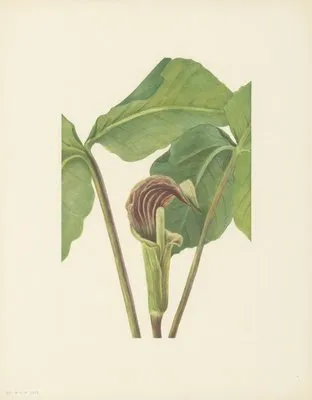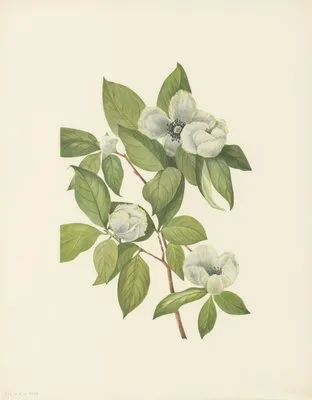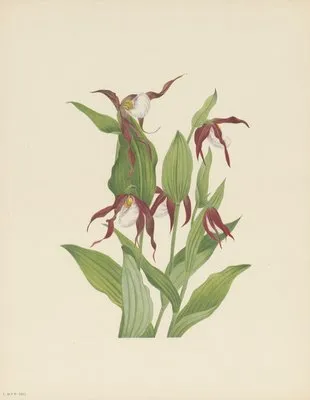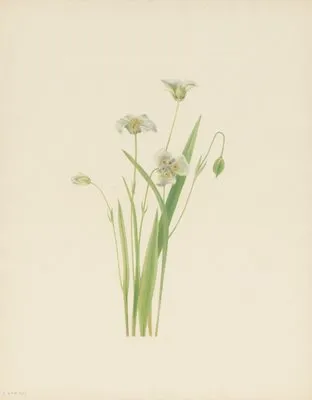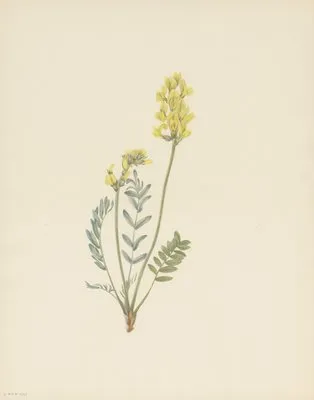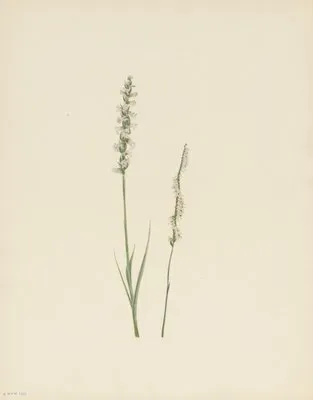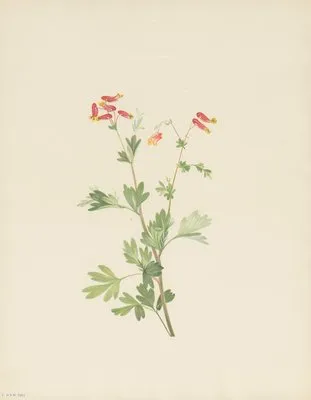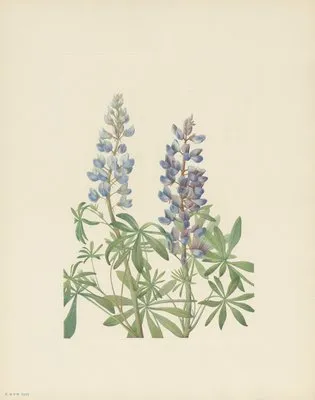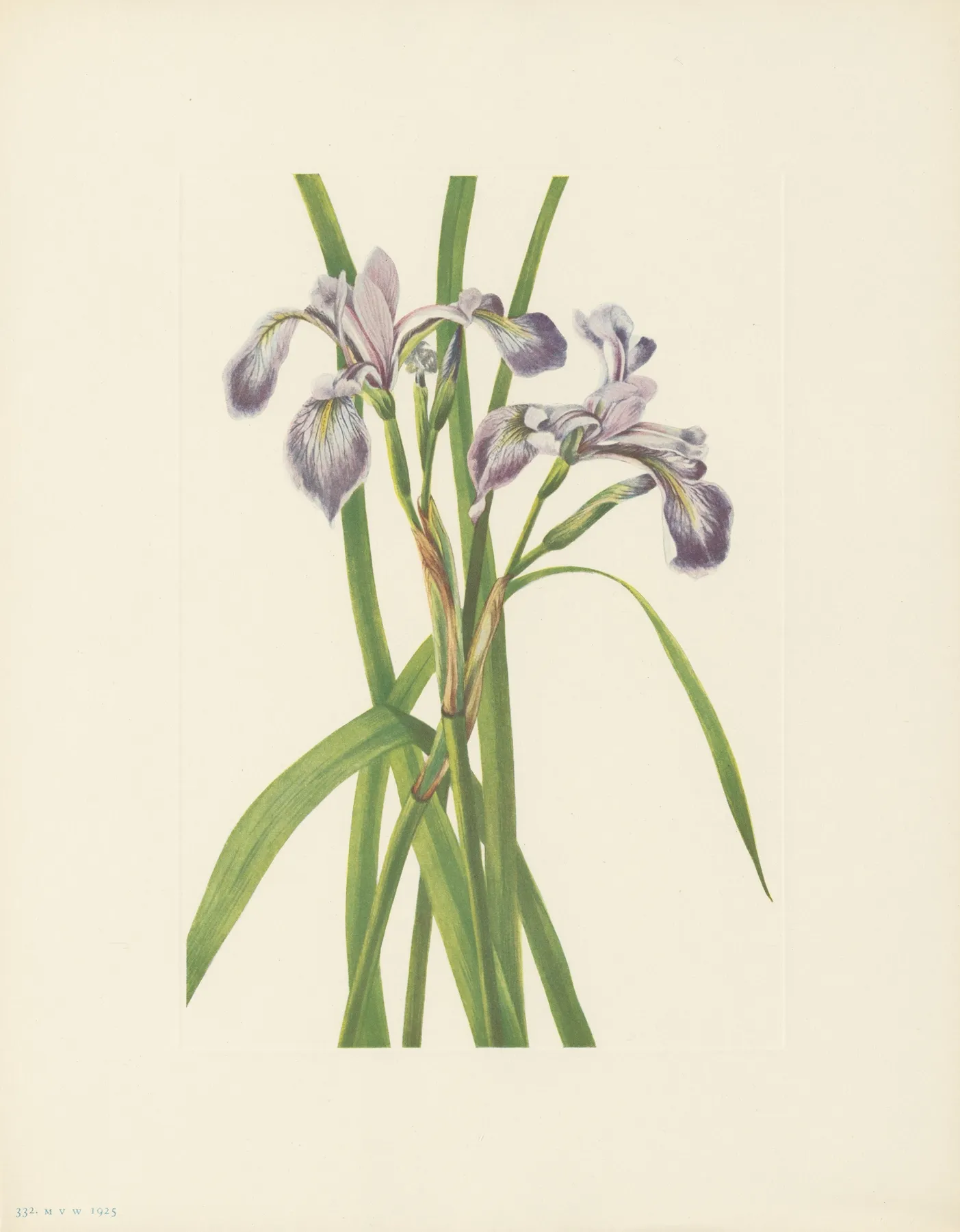
Blueflag Iris (Iris versicolor) (1925)
变色鸢尾
Blueflag Iris (Iris versicolor) (1925)
About this plate
Blueflag Iris (Iris versicolor) (1925) is plate 332, from North American wild flowers, drawn by Mary Vaux Walcott. This public-domain plate is reproduced at high resolution, free to view and download. Publication: Washington, D.C., The Smithsonian Institution, 1925.
Ten ways of seeing
- measured cast yellow-green
- slightly upright 1.28 : 1
- published 1925
- Plate 332
Not a catalogue entry but a way of looking: how to stand, what to notice, how the line was cut — then, halfway, a line of Chinese poetry: how the ancients saw this same flower. After it, the flower's language, its season and homeland, its book; and at the end one line of classical prose — and a pair of eyes to take away.
-
First Look
六法者何?一、气韵生动是也;二、骨法用笔是也;三、应物象形是也;四、随类赋彩是也;五、经营位置是也;六、传移模写是也。
—— 南齐·谢赫《古画品录》
The six laws: spirit resonance alive; bone-method in the brush; matching form; colour by kind; planning the placing; copying the masters.
Slightly taller than wide; the eye lands above centre. Then step in close: watch where colour meets line, and whether the line ever breaks. Third, find the darkest small patch: the whole tonal order is measured from there.
-
Name and Thing
The binomial is Blueflag iris: the first word is the genus it belongs among, the second the epithet that sets it apart. Two words carry a whole provenance. The Chinese name 变色鸢尾 is a modern rendering of the Latin, not an old garden name.
-
Form and Colour
Measured on this plate: flower colour covers 1.9% of the sheet, foliage 7.8%, the cast yellow-green with a second note of amber. No other plate shares exactly this measure. Irises carry rhizomes or bulbs, sword-shaped leaves in two ranks, and six tepals — three falls drooping, often bearded or speckled, three standards erect.No colour group is recorded. A single plant, laid out with nothing hidden.
-
Composition
Slightly taller than wide, the plant set a little above centre. (about 1.28 : 1) No details are appended: a plate for looking, not for keying out. The plant covers only 13% of the sheet, centred near the centre; the emptiness is where the eye rests. Old plates set the plant slightly off centre, with unequal margins — that small imbalance is what keeps it alive.
-
Line and Colour
After 1900 photography and colour reproduction ran alongside watercolour: accuracy rose, the cut of the burin disappeared. Take a loupe to three places: petal edge, leaf vein, caption. An unbroken line means engraving; colour crossing the outline means a hand. If you mean to copy it: this is a photomechanical record — match the colours directly, do not imitate the printing grain.
-
Poetic Resonance
蓝田日暖玉生烟。
—— 唐·李商隐《锦瑟》
In warm sun over Lantian, the jade gives off smoke.
The poem gives the mood first and the picture supplies the form; set the line beside the plate and the corolla becomes its resting point.
-
Symbolism
In China sweet flag hung at the door wards off evil at midsummer; in Europe the iris is the messenger, since Iris was the rainbow goddess who carried divine words. Meanings change their tune: the same flower can say opposite things within a century.
-
Season and Place
Late spring to early summer, peaking in April and May, before the summer rains. Temperate north. In China iris and sweet flag belong to the Dragon Boat festival. The year 1925 on the plate is that of publication, not of flowering — the gathering came a year or two earlier. The volume was made in 1925, when most of this knowledge came from living plants under glass.
-
The Book and the Hand
“North American wild flowers” was drawn by Mary Vaux Walcott and published 1925. This plate is Plate 332. The image is public domain; the hand-colouring is still one person's hand.
-
The Written Tradition
五月五日,采艾以为人,悬门户上,以禳毒气。
—— 南朝梁·宗懔《荆楚岁时记》
On the fifth of the fifth month they gather mugwort, shape it into a figure and hang it on the door to drive off fever — plant as medicine and as charm.
The Bencao Gangmu lists iris and sweet flag among herbs; the Jingchu seasonal records describe hanging mugwort and flag at the door at midsummer — a custom unbroken for a thousand years. The difference is not of quality but of question: Europe asks what it is, China asks whom it resembles.
What to Take Away
Appreciation is not knowledge but habit — one more look each time. Two centuries on, the plant may still flower in some garden; the one on this sheet stopped in the season of 1925.