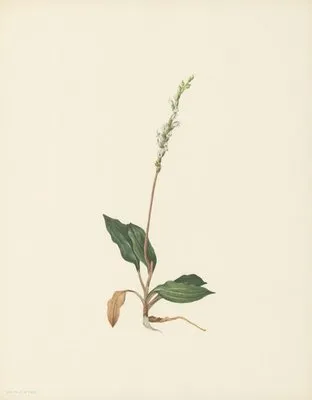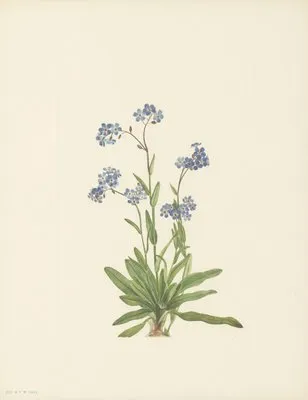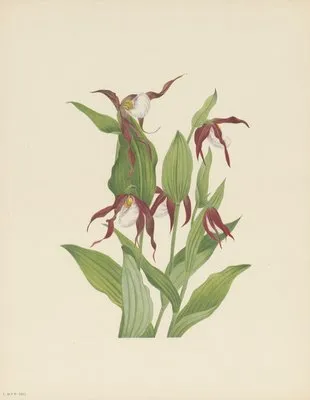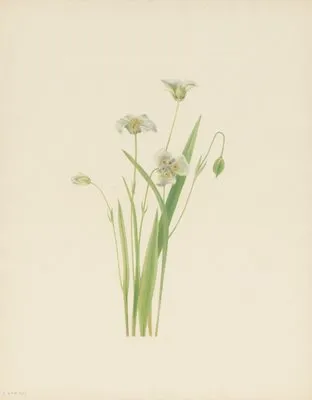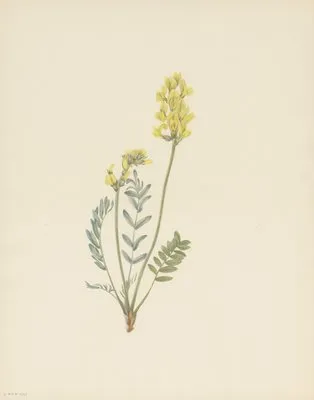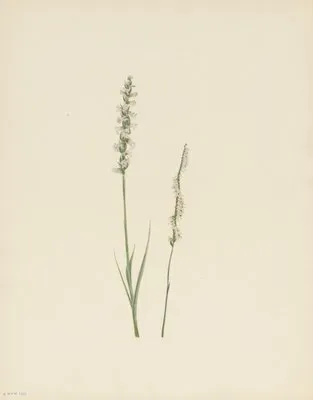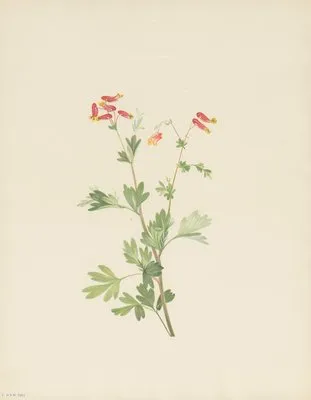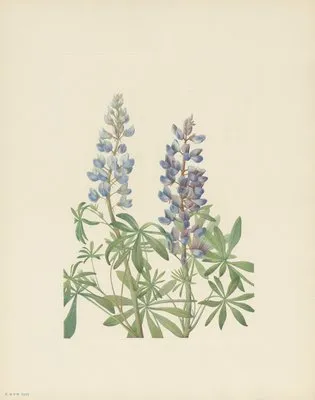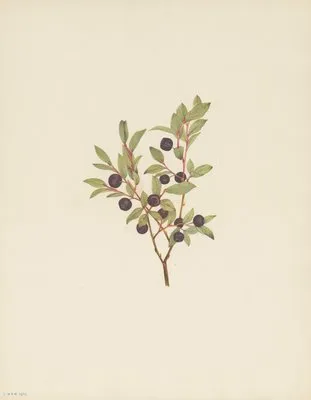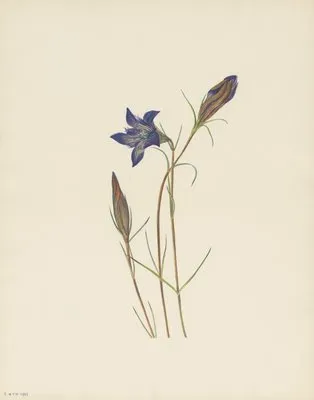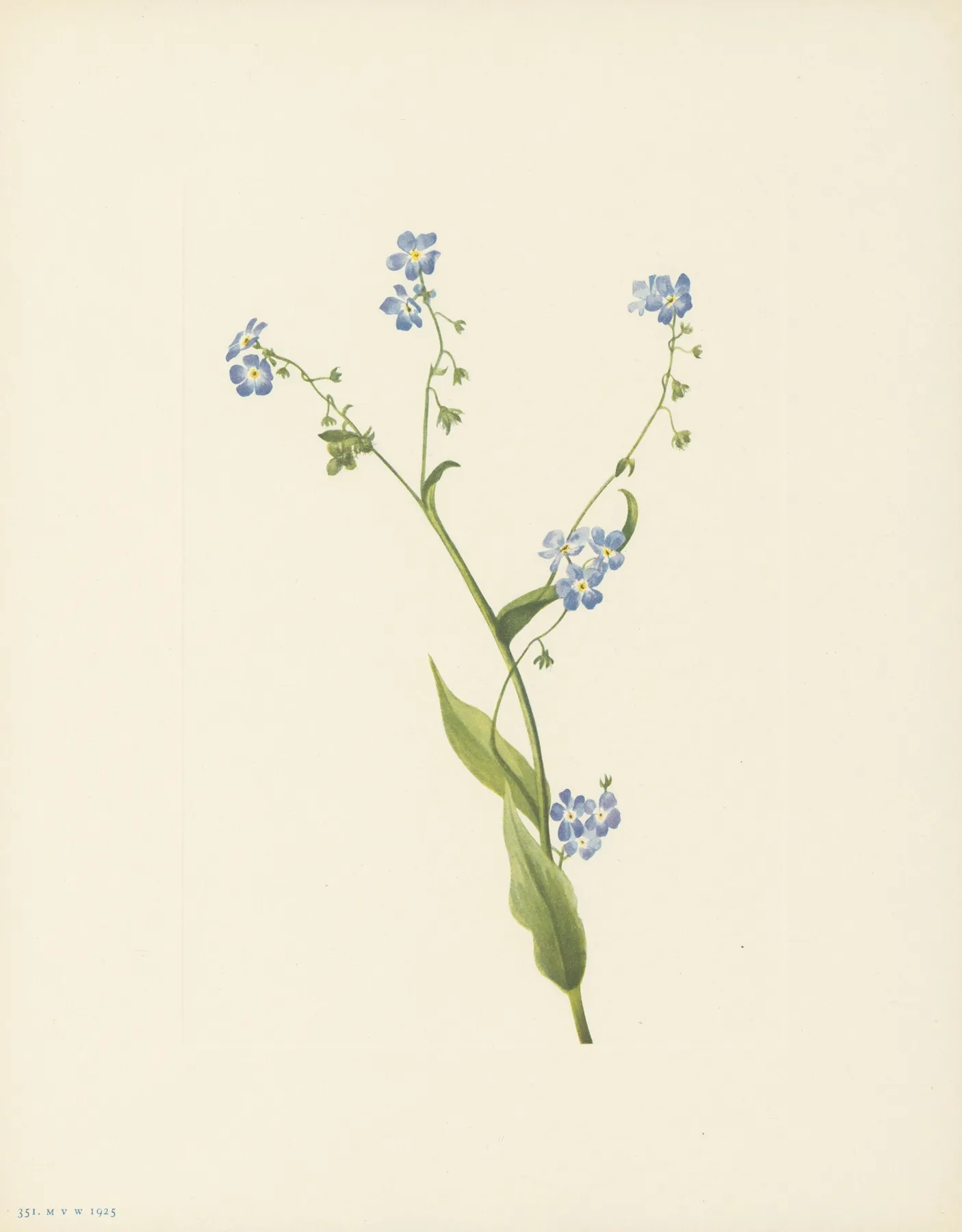
Bur-forget-me-not (Lappula diffusa) (1925)
弗吉尼亚假鹤虱
Bur-forget-me-not (Lappula diffusa) (1925)
Ten ways of seeing
- measured cast yellow-green
- slightly upright 1.28 : 1
First Look
论画以形似,见与儿童邻。
—— 宋·苏轼《书鄢陵王主簿所画折枝》
To judge painting by likeness alone is the view of a child.
Slightly taller than wide; the eye lands above centre. Then step in close: watch where colour meets line, and whether the line ever breaks. Third, find the darkest small patch: the whole tonal order is measured from there.
Name and Thing
No reliable binomial survives, so the printed title must serve. The Chinese name 弗吉尼亚假鹤虱 is a modern rendering of the Latin, not an old garden name.
Form and Colour
Measured on this plate: flower colour covers 1.3% of the sheet, foliage 1.1%, the cast yellow-green. No other plate shares exactly this measure. Wildflowers are rarely tidy: small blooms, slender stems, leaves imperfect and often chewed. That untidiness is exactly what records wind, light and soil.No colour group is recorded. Three things fix the habit: leaf arrangement, tepal count, and how the flower is borne.
Composition
The sheet is slightly tall. No details are appended: a plate for looking, not for keying out. The plant covers only 3% of the sheet, centred near the centre; the emptiness is where the eye rests.
Line and Colour
After 1900 photography and colour reproduction ran alongside watercolour: accuracy rose, the cut of the burin disappeared. Craft leaves franker evidence than inscriptions. If you mean to copy it: this is a photomechanical record — match the colours directly, do not imitate the printing grain.
Poetic Resonance
爱客满堂尽豪翰,开筵上日思芳草。
—— 唐·杜甫《蘇端薛復筵簡薛華醉歌》
The poem gives the mood first and the picture supplies the form; set the line beside the plate and the corolla becomes its resting point.
Symbolism
In Chinese verse wildflowers bloom unseen, owing nothing to praise; in the West they mark a place — one species, one landscape's character. Meanings change their tune: the same flower can say opposite things within a century.
Season and Place
in the northeastern United States, April to August — each species for two or three weeks, so a wildflower book is arranged by month. Native plants of woodland floor, bog, roadside and rock crevice. The year 1925 on the plate is that of publication, not of flowering — the gathering came a year or two earlier. See this kind of plate in the flowering season if you can: once you have met the living flower, you stop reading only colour.
The Book and the Hand
“North American wild flowers” carries only Mary Vaux Walcott's name. The image is public domain; the hand-colouring is still one person's hand.
What to Take Away
Next time you stand before a flowering plant, give it three minutes: leaf arrangement, direction of the flower, the darkest patch. Two centuries on, the plant may still flower in some garden; the one on this sheet stopped in the season of 1925.
About this plate
Bur-forget-me-not (Lappula diffusa) (1925) is plate 351, from North American wild flowers, drawn by Mary Vaux Walcott. This public-domain plate is reproduced at high resolution, free to view and download. Publication: Washington, D.C., The Smithsonian Institution, 1925.