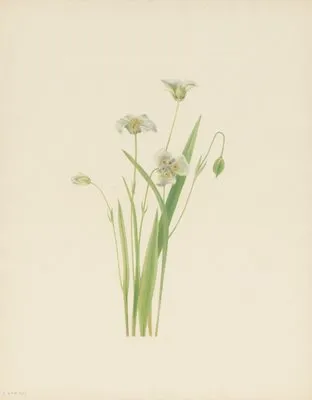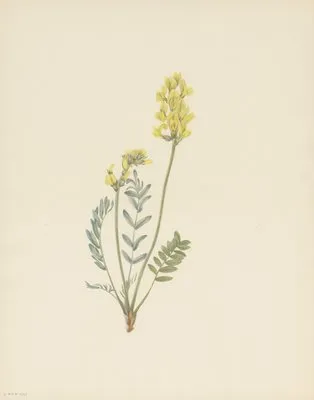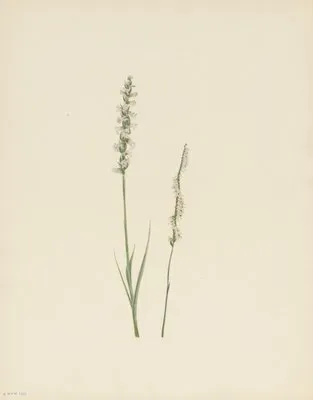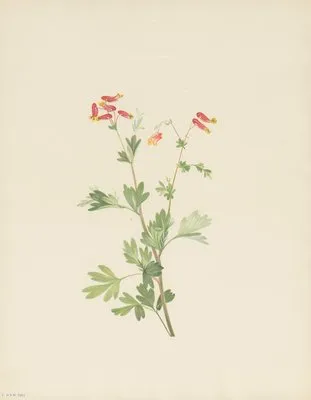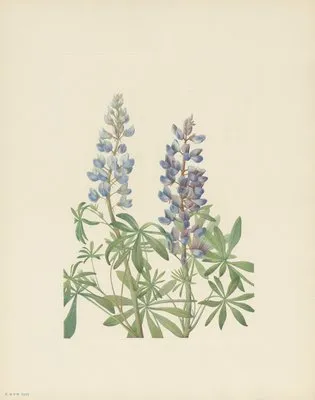
Clusterlily (Hookera pauciflora) (1925)
蓝壶韭
Clusterlily (Hookera pauciflora) (1925)
About this plate
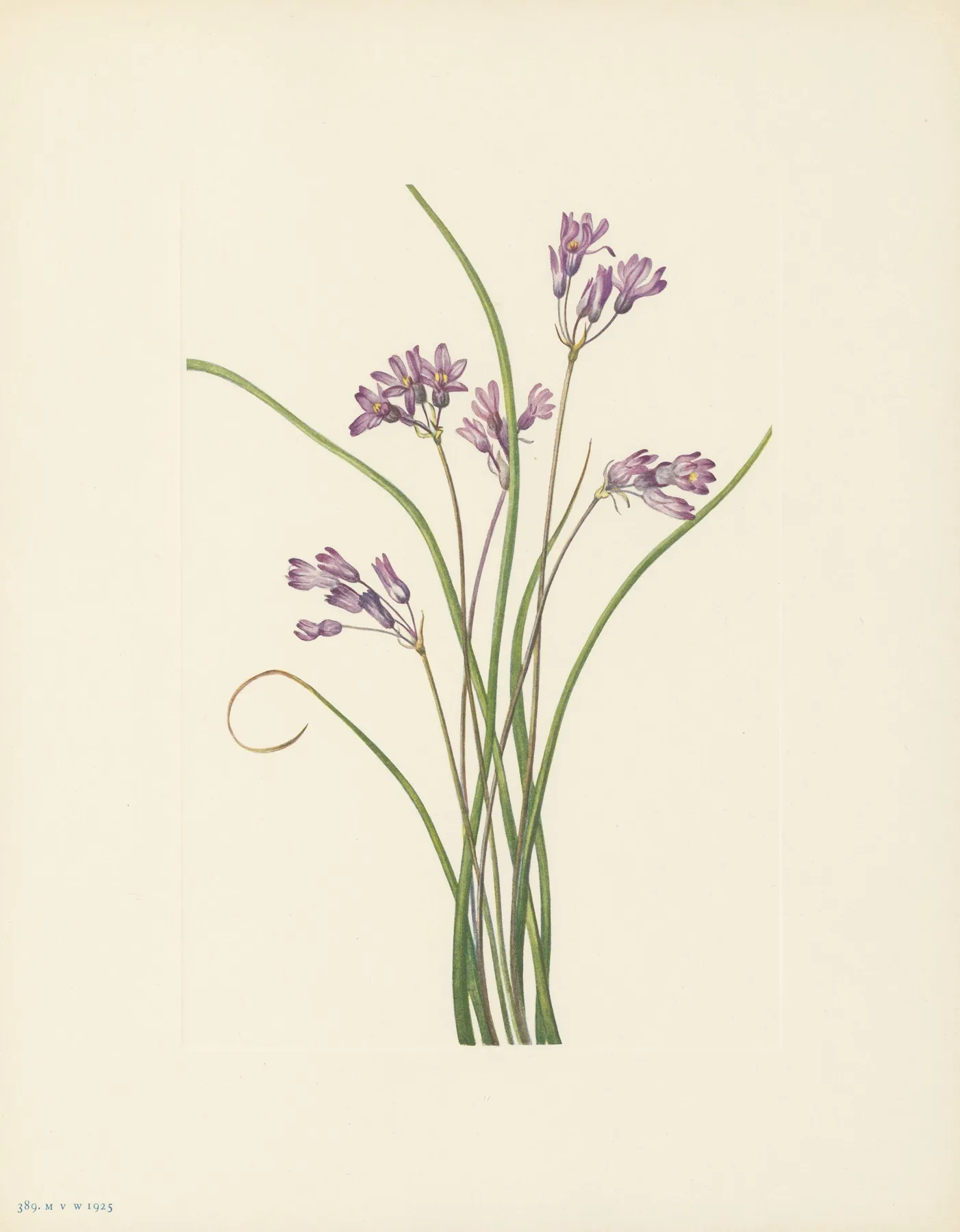
Clusterlily (Hookera pauciflora) (1925) is plate 389, from North American wild flowers, drawn by Mary Vaux Walcott. This public-domain plate is reproduced at high resolution, free to view and download. Publication: Washington, D.C., The Smithsonian Institution, 1925.
Twelve ways of seeing
- measured cast yellow-green
- slightly upright 1.28 : 1
- published 1925
- Plate 389
Not a catalogue entry but a way of looking: how to stand, what to notice, how the line was cut, when it flowers, where it came from, who made it — and then the poems and the classics that taught China to see the same flower. Read the twelve in order and the plate opens.
-
First Look
论画以形似,见与儿童邻。
—— 宋·苏轼《书鄢陵王主簿所画折枝》
To judge painting by likeness alone is the view of a child.
Slightly taller than wide; the eye lands above centre. Then step in close: watch where colour meets line, and whether the line ever breaks. Third, find the darkest small patch: the whole tonal order is measured from there.
-
Name and Thing
No reliable binomial survives, so the printed title must serve. The Chinese name 蓝壶韭 is a modern rendering of the Latin, not an old garden name.
-
Form and Colour
Measured on this plate: flower colour covers 1.8% of the sheet, foliage 1.9%, the cast yellow-green with a second note of amber. No other plate shares exactly this measure. A bulb of overlapping fleshy scales gives the lily its Chinese name, 'hundred-fold'; six tepals reflex as the flower opens, around six stamens with long, T-shaped anthers.No colour group is recorded. Read the outline, then the colour layers, then the brush.
-
Composition
Slightly taller than wide, the plant set a little above centre. (about 1.28 : 1) No details are appended: a plate for looking, not for keying out. The plant covers only 6% of the sheet, centred near the centre; the emptiness is where the eye rests. Old plates set the plant slightly off centre, with unequal margins — that small imbalance is what keeps it alive.
-
Line and Colour
After 1900 photography and colour reproduction ran alongside watercolour: accuracy rose, the cut of the burin disappeared. There is evidence on the back too: the plate mark pressed into the paper, the slight relief of the pigment, lines worn shallow in a later printing.
-
Season
Early to high summer, June and July; the flowers last only days, so artists drew them just as they opened. The year 1925 on the plate is that of publication, not of flowering — the gathering came a year or two earlier. The best time to read such a plate is its flowering season: three minutes under the tree explains what no text can.
-
Provenance
Temperate north — China, Japan, Europe. Long used in Chinese medicine, lilies were hunted in East Asia by nineteenth-century collectors and transformed European gardens. The volume was made in 1925, when most of this knowledge came from living plants under glass.
-
The Book and the Hand
“North American wild flowers” was drawn by Mary Vaux Walcott and published 1925. This plate is Plate 389. The image is public domain; the hand-colouring is still one person's hand.
-
Poetic Resonance
两丛香百合,一架粉长春。
—— 宋·陆游《北窗偶题四首 其一》
The poem gives the mood first and the picture supplies the form; set the line beside the plate and the corolla becomes its resting point.
-
The Written Tradition
生川谷。《吴普》曰:百合一名重迈,一名中庭,生冠朐及荆山。(艺文类聚引云:一名重匡)《名医》曰:一名重箱,一名摩罗,一名中逢花,一名强瞿,生荆州,二月八月,采根,暴干。
—— 神农本草经·百合第一百七十
The Bencao Gangmu describes the bulb as garlic-like, edible and medicinal; Song writers already noted that the leaves vary while the flowers stay white. You need not parse every word: take the line, and the flower acquires a second face.
-
Symbolism
In the West the white lily is Marian purity, held by the angel of the Annunciation; in China the name sounds like 'a hundred years in harmony', a wedding wish. Meanings change their tune: the same flower can say opposite things within a century.
-
What to Take Away
Carry three rules away: whole before detail; line before colour; picture before book. A flora exists to be consulted; look long enough and you forget to consult — someone in 1925 gave a whole day to a single flower.