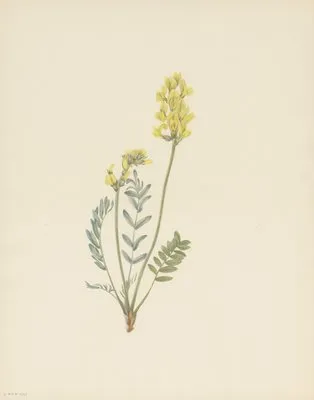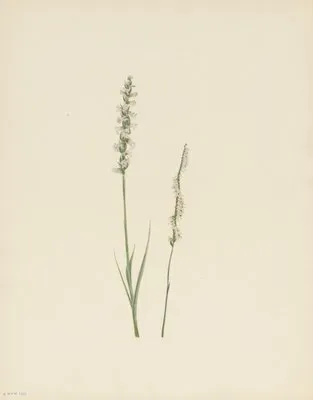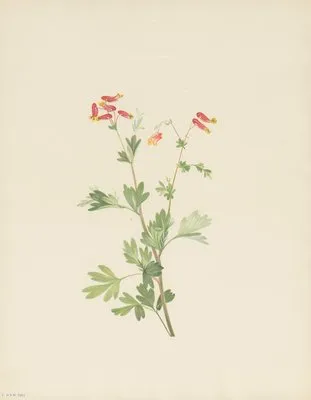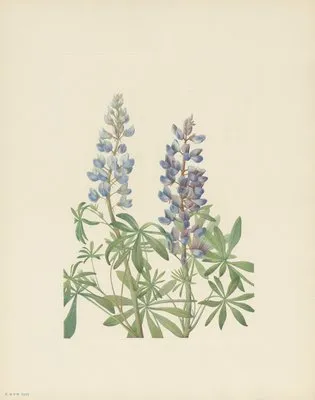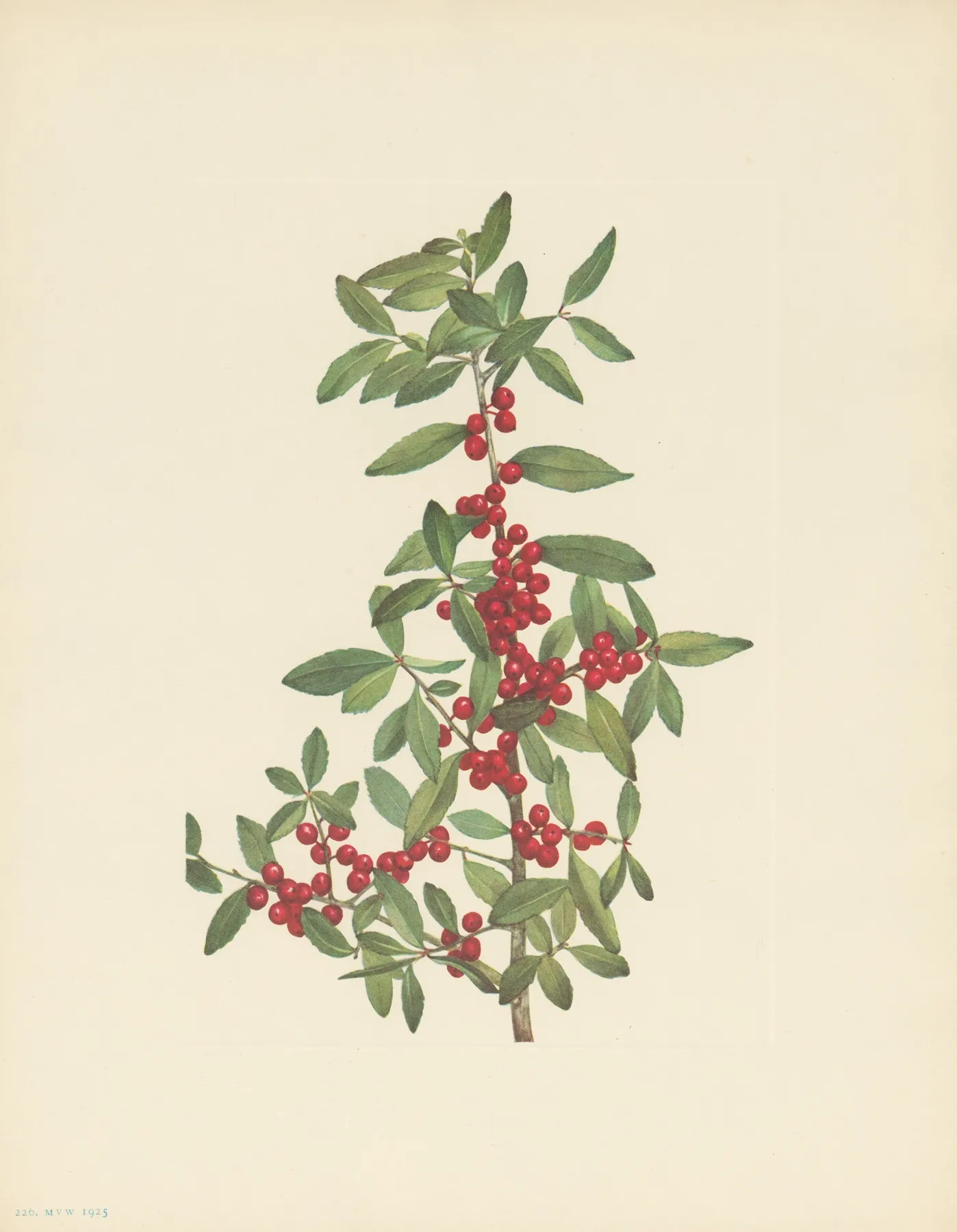
Yaupon (Ilex vomitoria) (1925)
催吐冬青
Yaupon (Ilex vomitoria) (1925)
Ten ways of seeing
- measured cast red
- slightly upright 1.29 : 1
First Look
真山水之川谷,远望之以取其势,近看之以取其质。
—— 宋·郭熙《林泉高致·山水训》
Mountains and valleys: from afar take their momentum, up close take their texture — the two distances from which any picture is read.
Slightly taller than wide; the eye lands above centre. Then step in close: watch where colour meets line, and whether the line ever breaks. Third, find the darkest small patch: the whole tonal order is measured from there.
Name and Thing
No reliable binomial survives, so the printed title must serve. The Chinese name 催吐冬青 is a modern rendering of the Latin, not an old garden name.
Form and Colour
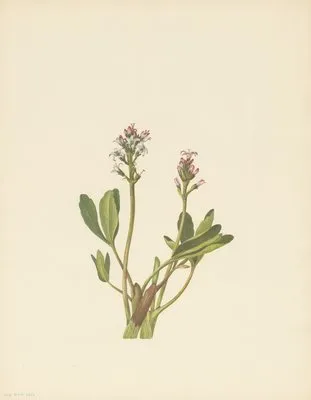
Measured on this plate: flower colour covers 4.7% of the sheet, foliage 7.3%, the cast red with a second note of yellow-green. No other plate shares exactly this measure. Wildflowers are rarely tidy: small blooms, slender stems, leaves imperfect and often chewed. That untidiness is exactly what records wind, light and soil.No colour group is recorded. Read the outline, then the colour layers, then the brush.
Composition
The sheet is slightly tall. No details are appended: a plate for looking, not for keying out. The plant covers only 13% of the sheet, centred near the centre; the emptiness is where the eye rests.
Line and Colour
After 1900 photography and colour reproduction ran alongside watercolour: accuracy rose, the cut of the burin disappeared. There is evidence on the back too: the plate mark pressed into the paper, the slight relief of the pigment, lines worn shallow in a later printing. If you mean to copy it: this is a photomechanical record — match the colours directly, do not imitate the printing grain.
Poetic Resonance
春风尔来为阿谁,胡蝶忽然满芳草。
—— 唐·李白《琴曲歌辭 山人勸酒》
The poem gives the mood first and the picture supplies the form; set the line beside the plate and the corolla becomes its resting point.
Symbolism
In Chinese verse wildflowers bloom unseen, owing nothing to praise; in the West they mark a place — one species, one landscape's character. Meanings change their tune: the same flower can say opposite things within a century.
Season and Place
By latitude and altitude. Native plants of woodland floor, bog, roadside and rock crevice. The year 1925 on the plate is that of publication, not of flowering — the gathering came a year or two earlier. See this kind of plate in the flowering season if you can: once you have met the living flower, you stop reading only colour.
The Book and the Hand
“North American wild flowers” carries only Mary Vaux Walcott's name. From drawing to plate the sheet passed through several hands — the engraver aimed at accuracy, the colourist at speed, and between them lies each plate's unevenness.
What to Take Away
Next time you stand before a flowering plant, give it three minutes: leaf arrangement, direction of the flower, the darkest patch. The flower of that year is dust, yet its image on paper has outlived every living cousin.
About this plate
Yaupon (Ilex vomitoria) (1925) is plate 226, from North American wild flowers, drawn by Mary Vaux Walcott. This public-domain plate is reproduced at high resolution, free to view and download. Publication: Washington, D.C., The Smithsonian Institution, 1925.