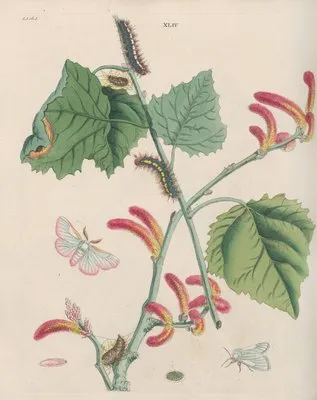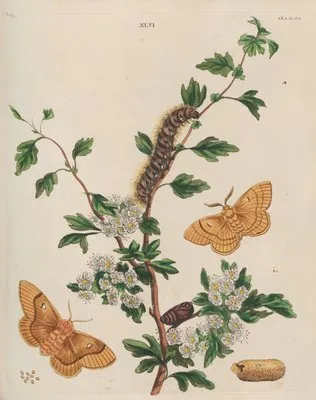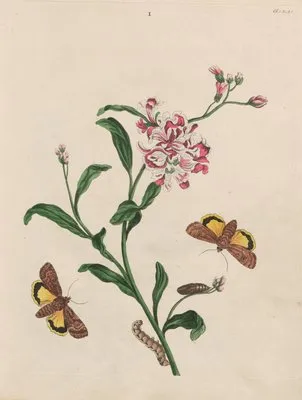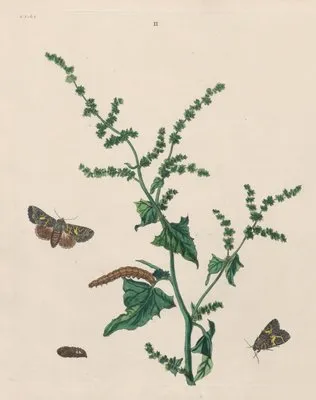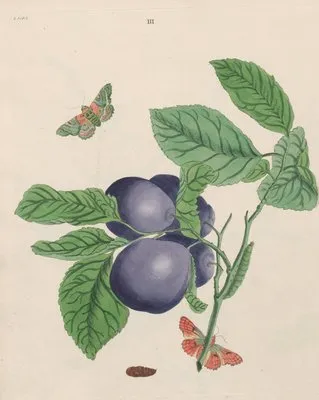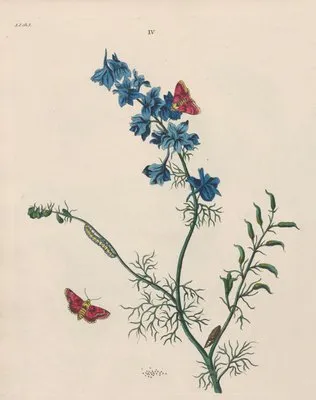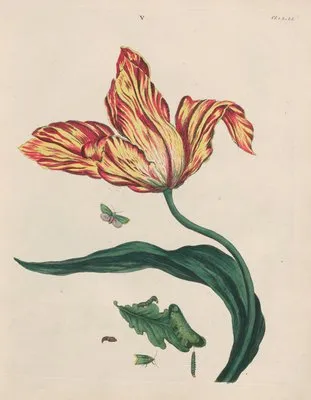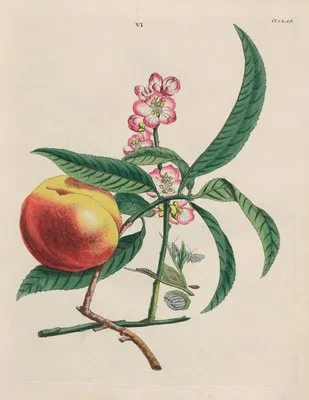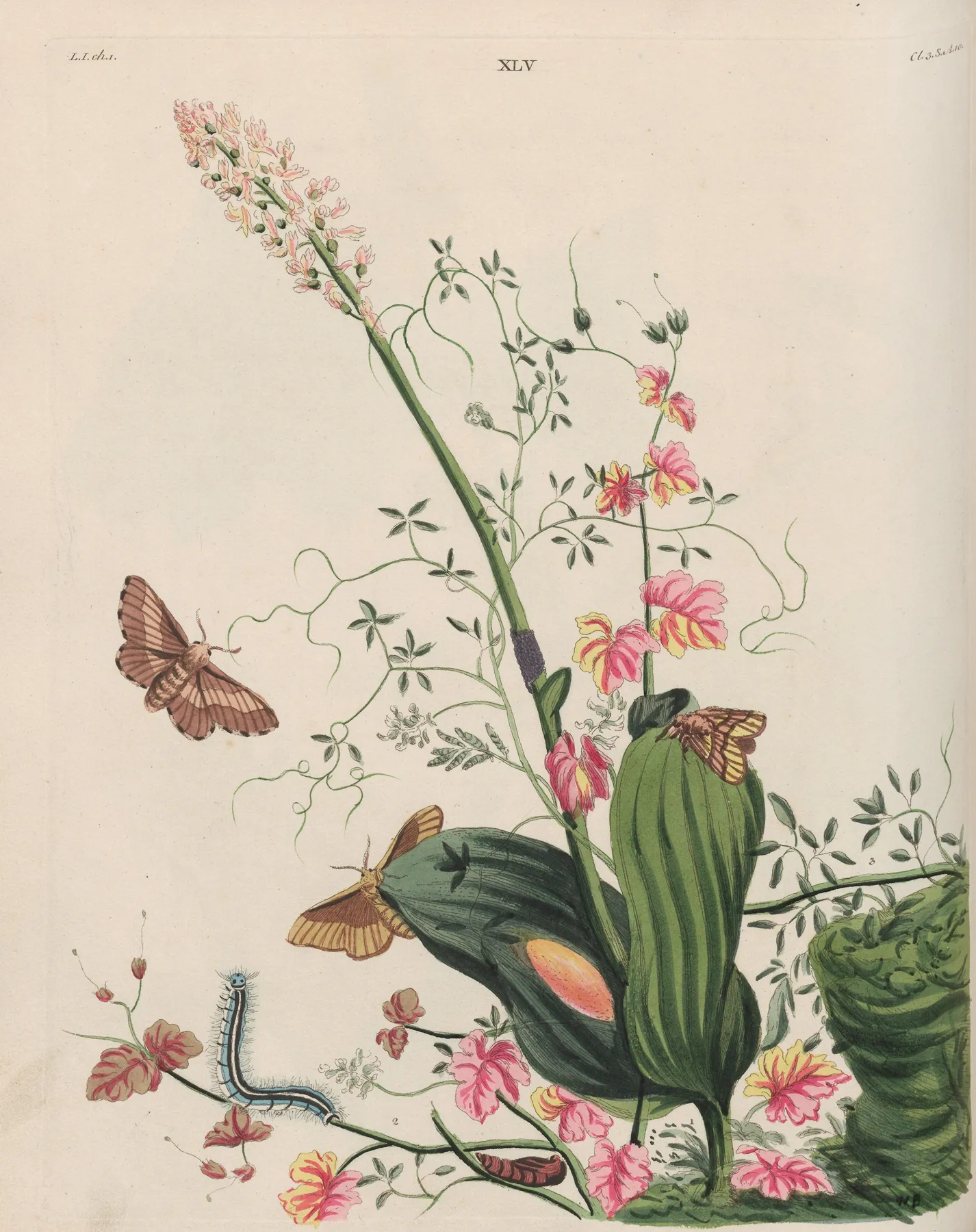
The Lacquey Moth (Phalæna Neustria), 1.Tway Blade (Ophrys ovata), 2.Shining Dovesfoot Cranesblll (Geranium lucidum), 3.Climbing Fumitory, or yellow Vetchling (Fumaria claviculata) (1773)
卵叶鸟巢兰、牻牛儿苗目、罂粟科
Ten ways of seeing
- measured cast amber
- slightly upright 1.26 : 1
First Look
论画以形似,见与儿童邻。
—— 宋·苏轼《书鄢陵王主簿所画折枝》
To judge painting by likeness alone is the view of a child.
Slightly taller than wide; the eye lands above centre. Then step in close: watch where colour meets line, and whether the line ever breaks. Third, find the darkest small patch: the whole tonal order is measured from there. The pose leans left: the upper half carries 15 points further left than the lower — a living thing, not a diagram.
Name and Thing
Only the genus Ophrys is given; species-level names came later. No established Chinese name exists, so it is cited by its binomial alone.
Form and Colour
Measured on this plate: flower colour covers 6.5% of the sheet, foliage 9.2%, the cast amber with a second note of red. No other plate shares exactly this measure. Orchids carry pseudobulbs or fleshy roots; six tepals, one modified into a lip that serves as a landing stage, and a column uniting stamens and pistil — a structure unique to the family.No colour group is recorded. Read the outline, then the colour layers, then the brush.
Composition
The sheet is slightly tall. No details are appended: a plate for looking, not for keying out. The plant covers only 23% of the sheet, centred below centre; the emptiness is where the eye rests.
Line and Colour
Eighteenth-century plates are mostly copper engraving: hatched lines for shadow, then hand-colouring by another hand. Take a loupe to three places: petal edge, leaf vein, caption. An unbroken line means engraving; colour crossing the outline means a hand. If you mean to copy it: take its skeleton, its margins and the order of its colours; the burin's hatching is the language of copper — suggest it with pencil density, do not imitate it stroke for stroke.
Poetic Resonance
谏院过时荣棣萼,谢庭归去踏芝兰。
—— 唐·刘禹锡《送国子令狐博士赴兴元觐省》
The poem gives the mood first and the picture supplies the form; set the line beside the plate and the corolla becomes its resting point.
Symbolism
In China the orchid is the gentleman who blooms unseen; in Victorian Europe it was luxury and obsession, a single new species worth a fortune. Meanings change their tune: the same flower can say opposite things within a century.
Season and Place
Varies by genus: temperate terrestrials flower in spring and summer, tropical epiphytes almost year-round. the orchids drawn for European portfolios came largely from the cloud forests of Central America and Southeast Asia. The year 1773 on the plate is that of publication, not of flowering — the gathering came a year or two earlier. See this kind of plate in the flowering season if you can: once you have met the living flower, you stop reading only colour.
The Book and the Hand
“One hundred and twenty copper-plates of English moths and butterflies” carries only Benjamin Wilkes's name. The image is public domain; the hand-colouring is still one person's hand.
What to Take Away
Appreciation is not knowledge but habit — one more look each time. A flora exists to be consulted; look long enough and you forget to consult — someone in 1773 gave a whole day to a single flower.
About this plate
The Lacquey Moth (Phalæna Neustria), 1.Tway Blade (Ophrys ovata), 2.Shining Dovesfoot Cranesblll (Geranium lucidum), 3.Climbing Fumitory, or yellow Vetchling (Fumaria claviculata) (1773) is plate 45, from One hundred and twenty copper-plates of English moths and butterflies, drawn by Benjamin Wilkes. This public-domain plate is reproduced at high resolution, free to view and download. Publication: London, Benjamin White at Horace's-Head, 1773.