Gladiolus Carneus
Glayeul Couleur de Chair
About this plate
Description
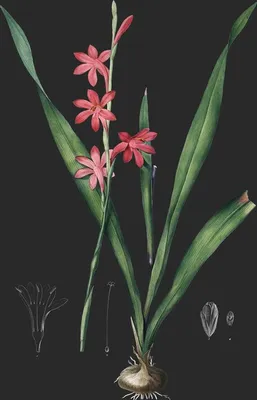
Le bean Glayeul dont nous donnons ici la figure parait n’être qu’une simple variété de celui que nous avons fait connaitre sous le même nom dans notre soixante-cinquième numéro: mais comme il en dillère à divers égards, nous allons en donner la description.
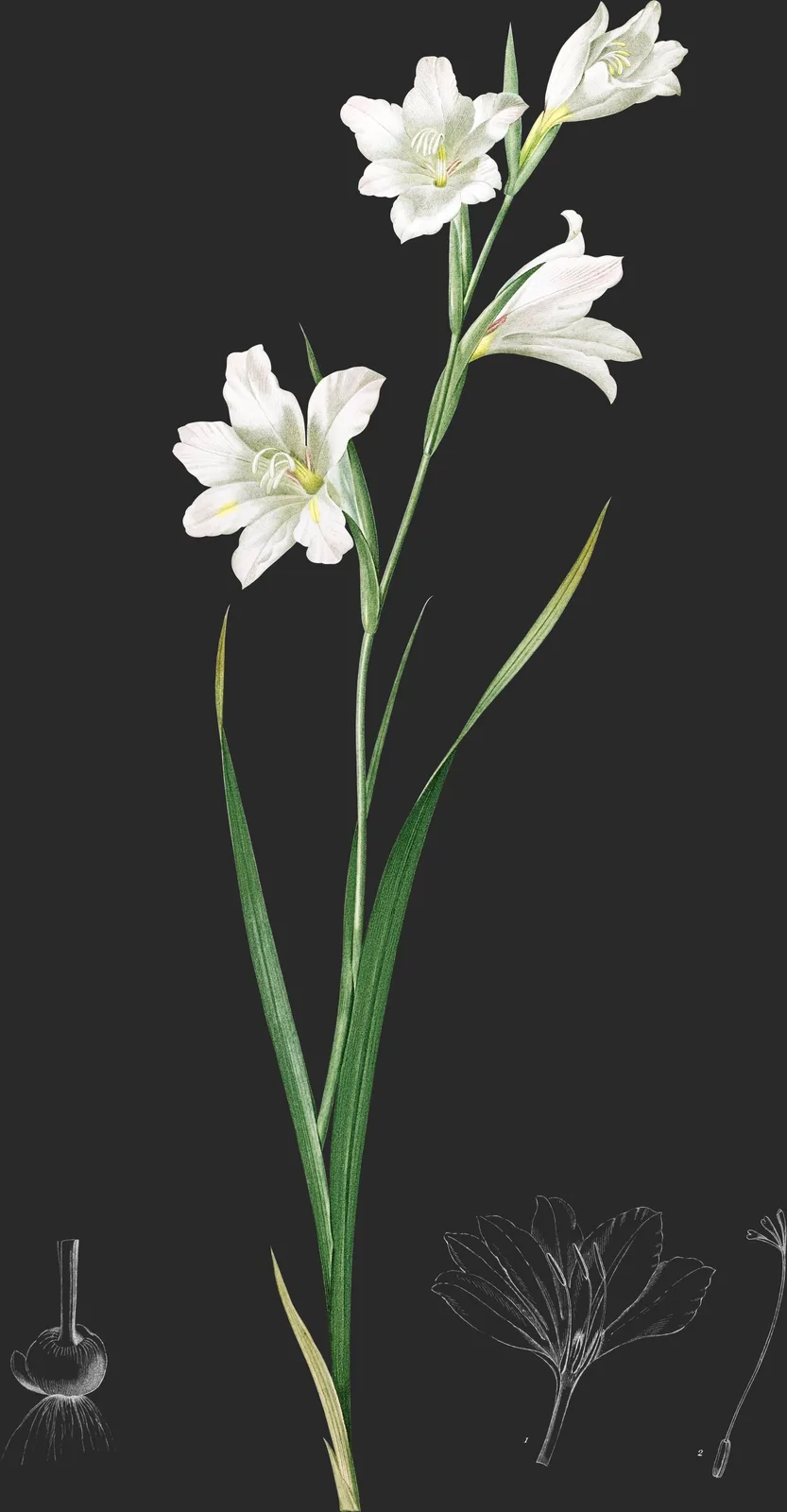
Sa racine est un tuberenle arrondi, un peu déprimé. Sa tige s’élève à quatre ou cinq décimètres. Droite dans le bas, elle se fléchit vers le milieu de sa hau-teur, et prend au-dessus une direction oblique. Elle est couverte par les feuilles dans sa moitié inférieure, et d’un vert glauque dans sa moitié supérieure. Les feuilles sont peu nombreuses, linéaires, dressées, plus courtes que la tige, marquées de nervures longitudinales, dont la moyenne seule est un peu saillante. Les fleurs sont an nombre de eing environ, disposées en épis sur deux rangs presque opposés. A la base de chacune d’elles sont deux bractées lancéolées, foliacées, dont l’extérieure, aigue et plus longue que le tube de la fleur, atteint presque l’extrémité des segments du périgone. l’intérieure est plus courte et terminée par deux petites pointes.
Le tube du périgone est caché entre les bractées. Sa longueur, en y compres nant l’ovaire, est de quatre centimètres. Sa couleur est un blane jaune. Il va en s’élargissant vers le haut, qui est un peu arqué. Le limbe est en forme de cloche un peu irrégulière. Les divisions sont ovales, lancéolées, égales en longueur, concaves, ondalées sur les bords dans leur partie supérieure. Les trois extérieures sont arrondies au sommet, qui porte une petite pointe. Les trois intérieures sont échancrées profondément. Les trois supérieures, et surtout la moyenne, sont plas larges et un peu redressées dans le haut. Lear couleur est blanche, avec une teinte rose dans la partie supérieure. Vers le lieu on la moyenne se réunit avec les latérales, est de chaque côté une tache pourpre en forme d’anneau. Les trois inférieures sont plus étroites, et entièrement blanches, à l’exception d’une tache d’un jaune très-pâle qu’elles présentent dans leur partie moyenne.
Les étamines sont de moitié plus courtes que les divisions du périgone. Leurs filaments sont en forme d’alene, blancs, arqués. Les anthères sont blanches, oblongues, linéaires.
Lovaire est oblong, vert, a six sillons. Le style est blanc, filiforme, aussi long que les étamines. Les stigmates sont blanes, très-dilatés dans le haut, et pliés en gouttière.
Histoire
Nous ignoronssi la variété que nous venons de décrire a été apportée du Cap, ou si elle a été créée dans les jardins d’Europe. C’est dans le jardin impérial de Sèvres que nous avons vu les individas qui ont servi à notre description et à notre figure. Ils étaient en fleurs à la fin de mai.
Explication de la planche
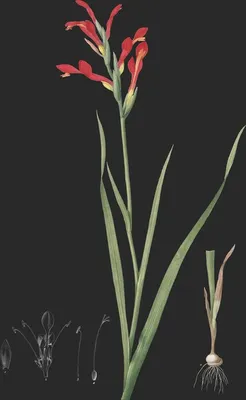
La Plante entière de grandeur naturelle.
- Une bulbe.
- Une fleur fendue latéralement et étalée.
- Lovaire, le style et les stigmates.
Fam. des Iris. Juss.—Triandrie monogynie. Lin.
- A. floribus carneis.
- Gladiolus carneus. G. caule simplicissimo, petalis superioribus divergentibus foliis ensiformibos. Liliac. № 65, exclus, synonymis Willdenowii et Jacquini Gladiolo caspidato referendis, in quoram loco sequentia subjicieda sunt.
- Gladiolas blandus. G. corollæ tubo spathâ breviore limbo campanulato-sobringente: laciniâ supremâ concavâ: tribus inferioribus angustioribus maculatis. Ait. Hort. Kew. ed. all. 1, p. 100.
- Gladiolas blandus. G. laciniis semi-campannlato-ringentibus subnatantibus, tubo subæqualibus, supremâ elliptico-concavâ, lateralibus oblongo-lanceolatis, infimis recto-patulis angustioribus, mediâ acutiore. Gawl. in Curt. bot. mag. 625.
- Gladiolus blandos, G. foliis lineari-lanceolatis nervosis glabris, floribus spicatis, laciniâ supremâ reflexâ, stigmatibus subbilobis. Ait. Hort. Kew. ed. 1. vol. 1. p. 64. Willd. sp. pl. 1. p. 220.
- Gladiolas campanulatos. G. foliis lanceolatis nervosis glabris, scapo subtrilloro, foliis longiore, corollâ sabcampanulatâ pallidè purpureâ, laciniis subæqualibas, stigmatibus bilidis. Andr. bot. rep. 188?
- GIndiolas albidas. G. corolla subringente, lacinis neutis, tribus superioribus undulatis, tribus inferioribas apice conniventibus foliis ensilormibus glabris, subobliquis. Jacq. collect. vol. 5. Ic. rar. 256.
- B. Floribus albis.
- Gladiolus blandas var. β. Gawl. in Cart. bot. mag. 648.
- Gladiolos blandas. γ. Andr. bot. rep. 99.
Ten ways of seeing
- measured cast yellow-green
- upright 1.92 : 1
- published 1812
- Plate 377
Not a catalogue entry but a way of looking: how to stand, what to notice, how the line was cut — then, halfway, a line of Chinese poetry: how the ancients saw this same flower. After it, the flower's language, its season and homeland, its book; and at the end one line of classical prose — and a pair of eyes to take away.
-
First Look
夫象物必在于形似,形似须全其骨气。
—— 唐·张彦远《历代名画记》
Likeness is the threshold; bone-and-breath is the point.
The sheet is vertical: the eye climbs and settles in the upper half. Let the plant stand before you look for detail. Then step in close: watch where colour meets line, and whether the line ever breaks. Third, find where the green is deepest: the whole tonal order is measured from that patch. The pose leans right: the upper half carries 10 points further right than the lower — a living thing, not a diagram.
-
Name and Thing
The binomial is Gladiolus carneus: the first word is the genus it belongs among, the second the epithet that sets it apart. Two words carry a whole provenance. The older system filed it under Iridaceæ by overall affinity; Linnaeus, counting stamens only, placed it in Triandria — two ways of asking what a plant is. No established Chinese name exists, so it is cited by its binomial alone.
-
Form and Colour
Measured on this plate: flower colour is sparing, 0.6% of the sheet against 3.2% of foliage, the cast tending yellow-green — as with pale or white blooms, outline and tone do the talking. Bulbous plants store the year underground — bulb, corm or tuber — then send up a few thick leaves and a single scape, with six tepals in cup, funnel or star. Filed under green — a moss green, a colour that comes mostly from leaf and stem. A single plant, laid out with nothing hidden.
-
Composition
Tall and narrow, the plant rising in one movement with generous margins — the upright format of most floras. (about 1.92 : 1) No details are appended: a plate for looking, not for keying out. The plant covers only 11% of the sheet, centred above centre; the emptiness is where the eye rests. Blank paper is not unfinished work: it is where the eye rests.
-
Line and Colour
The first half of the nineteenth century moved from copper to steel to lithography; stipple could render the softest transition. Take a loupe to three places: petal edge, leaf vein, caption. An unbroken line means engraving; colour crossing the outline means a hand. If you mean to copy it: take its skeleton, its margins and the order of its colours; the burin's hatching is the language of copper — suggest it with pencil density, do not imitate it stroke for stroke.
-
Poetic Resonance
卢家小妇郁金堂,海燕双栖玳瑁梁。
—— 唐·沈佺期《雜曲歌辭 獨不見》
The poem gives the mood first and the picture supplies the form; set the line beside the plate and the green the corolla becomes its resting point.
-
Symbolism
The tulip was an imperial emblem in Istanbul and a speculative bubble in Amsterdam; the hyacinth sprang from a boy's blood in Greek myth. What bulbs share is concealment: next year kept underground. In a flora it is a species first and a symbol second; the order is worth keeping.
-
Season and Place
Early spring to early summer, genus by genus: tulips and hyacinths first, gladiolus and amaryllis later. Three homelands: the Mediterranean, Central Asia and South Africa. The tulip came from Ottoman gardens and became a Dutch mania. The year 1812 on the plate is that of publication, not of flowering — the gathering came a year or two earlier. Read the locality and the flowering season both with a discount: one is hearsay, the other a ten-day peak.
-
The Book and the Hand
“The Liliaceae” was drawn by Pierre-Joseph Redouté and published 1802-1816. This plate is Plate 377, book page 377. The image is public domain; the hand-colouring is still one person's hand.
-
The Written Tradition
论画以形似,见与儿童邻。
—— 宋·苏轼《书鄢陵王主簿所画折枝》
To judge a painting by likeness alone is the view of a child.
Li Bai's 'orchid wine, fragrant with yujin' is often misread as tulips; the Tang yujin was a turmeric-like root used to scent wine — same name, different plant. The difference is not of quality but of question: Europe asks what it is, China asks whom it resembles.
What to Take Away
Appreciation is not knowledge but habit — one more look each time. A flora exists to be consulted; look long enough and you forget to consult — someone in 1812 gave a whole day to a single flower.