Ixia Filifolia
Ixia a Feuilles Filiformes
About this plate
Description
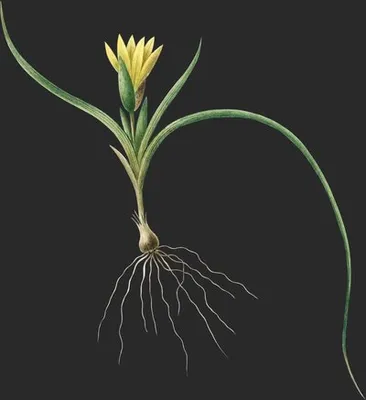
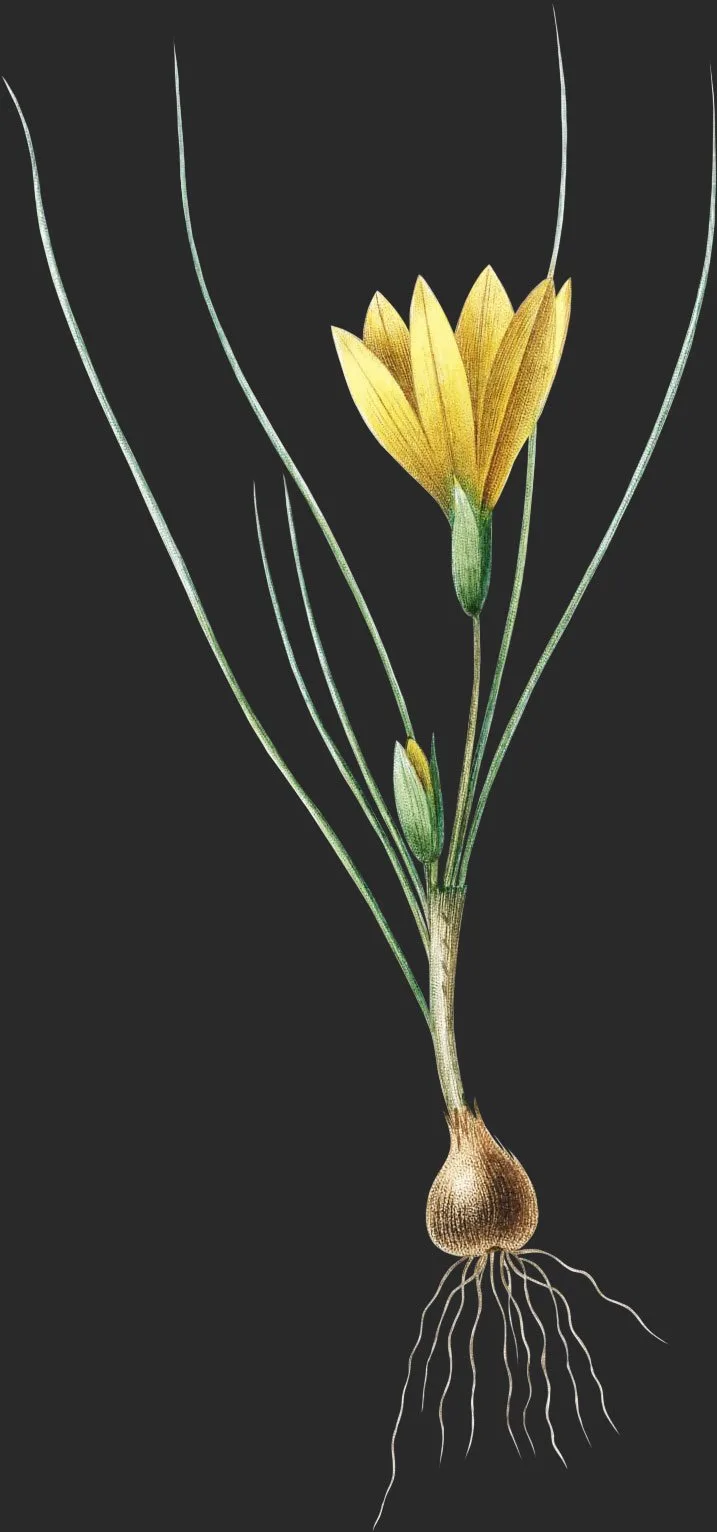
Cette jolie espèce d’Ixia appartient à la même section que la précédente. Elle se rapproche beaucoup de l’Ixia rosea, et n’en est peut-être qu’une variété. Cependant, comme elle en diffère par son port, par ses feuilles plus menues, et surtout plus courtes, ainsi que par ses spathes, dont la valve interne est presque entièrement foliacée; nous croyons qu’on peut la regarder comme une espèce distincte, jusqu’à ce que de nouvelles observations aient fait connaitre si les caractères que nous venons d’observer sont constants ou non.
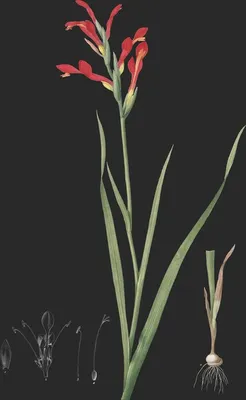
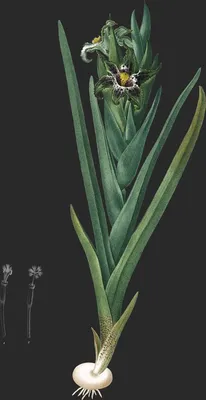
La bulbe qui lui donne naissance est arrondie, couverte d’une tunique brune un peu moins ferme que dans l’espèce précédente, ouverte dans le bas, et remplacée en ce lieu par un disque de la même substance, autour duquel sortent les fibrilles radicales. La tige est haute de six ou huit centimètres, grêle, demi-cylindrique, striée, feuillée dans le bas: quelquefois elle est simple; d’autres fois elle émet un ou plusieurs rameaux simples et nus. Les feuilles, les unes radi-cales, les autres caulinaires, sont filiformes, très-déliées, droites et aigues; elles dépassent un peu le sommet de la tige. Les fleurs sont terminales, solitaires, grandes, tantôt d’un jaune vif, tantôt d’une couleur rougeâtre. Elles sont entourées d’une spathe, dont les valves, toutes les deux foliacées, lancéolées, concaves et aiguës, n’atteignent pas la moitié de leur longueur. Les segments du périgone sont peu étalés, lancéolés, aigus et rétrécis inférieurement en un onglet étroit. Le tube est très-court. Les filaments des étamines sont capil-laires, velus à la base, plus longe que les anthères, qui sont grêles et linéaires. L’ovaire est ovoide, surmonté par un style filiforme qui dépasse un peu les étamines. Les stigmates sont arqués en dehors et partagés en deux lanières filiformes.
Histoire
Cette plante croit dans les mémes lieux que la précédente, et c’est également d’après des échantillons desséchés que nous la décrivons.
Fam. des Iris. Juss.—Triandrie monogynie. Lin.
- Ixia filifolia. I. foliis Gliformibus rectis, scapo tenui subramoso, paulo longio-ribus; utrique spathæ valvâ foliaceâ, floribus solitariis terminalibus.
- Var. A. floribus lateis.
- Var. B. floribus rubris.
Twelve ways of seeing
- measured cast yellow-green
- upright 2.14 : 1
- published 1809
- Plate 251
Not a catalogue entry but a way of looking: how to stand, what to notice, how the line was cut, when it flowers, where it came from, who made it — and then the poems and the classics that taught China to see the same flower. Read the twelve in order and the plate opens.
-
First Look
真山水之川谷,远望之以取其势,近看之以取其质。
—— 宋·郭熙《林泉高致·山水训》
Mountains and valleys: from afar take their momentum, up close take their texture — the two distances from which any picture is read.
The sheet is vertical: the eye climbs and settles in the upper half. Let the plant stand before you look for detail. Then step in close: watch where colour meets line, and whether the line ever breaks. Third, find where the yellow is deepest: the whole tonal order is measured from that patch.
-
Name and Thing
The binomial is Ixia filifolia: the first word is the genus it belongs among, the second the epithet that sets it apart. Two words carry a whole provenance. The older system filed it under Iridaceæ by overall affinity; Linnaeus, counting stamens only, placed it in Triandria — two ways of asking what a plant is. No established Chinese name exists, so it is cited by its binomial alone.
-
Form and Colour
Measured on this plate: flower colour covers 4.3% of the sheet, foliage 1.2%, the cast yellow-green with a second note of amber. No other plate shares exactly this measure. Bulbous plants store the year underground — bulb, corm or tuber — then send up a few thick leaves and a single scape, with six tepals in cup, funnel or star. Filed under yellow — a honey-yellow, built in washes from a pale ground. Three things fix the habit: leaf arrangement, tepal count, and how the flower is borne.
-
Composition
Tall and narrow, the plant rising in one movement with generous margins — the upright format of most floras. (about 2.14 : 1) No details are appended: a plate for looking, not for keying out. The plant covers only 9% of the sheet, centred a little right of centre; the emptiness is where the eye rests. Blank paper is not unfinished work: it is where the eye rests.
-
Line and Colour
The first half of the nineteenth century moved from copper to steel to lithography; stipple could render the softest transition. Take a loupe to three places: petal edge, leaf vein, caption. An unbroken line means engraving; colour crossing the outline means a hand.
-
Season
Early spring to early summer, genus by genus: tulips and hyacinths first, gladiolus and amaryllis later. The year 1809 on the plate is that of publication, not of flowering — the gathering came a year or two earlier. The plate records ten days of peak; the other three hundred are leaf, fruit and rest.
-
Provenance
Three homelands: the Mediterranean, Central Asia and South Africa. The tulip came from Ottoman gardens and became a Dutch mania; South African bulbs filled European glasshouses after 1800. The localities on the plate are those of a century ago; plants travel and places change their names.
-
The Book and the Hand
“The Liliaceae” was drawn by Pierre-Joseph Redouté and published 1802-1816. This plate is Plate 251, book page 251. The image is public domain; the hand-colouring is still one person's hand.
-
Poetic Resonance
仙衣才试郁金黄,便觉秋风满院芳。
—— 宋·朱熹《次劉彥集木犀韻三首 其二》
The poem gives the mood first and the picture supplies the form; set the line beside the plate and the yellow the corolla becomes its resting point.
-
The Written Tradition
气之动物,物之感人,故摇荡性情,形诸舞咏。
—— 南朝梁·钟嵘《诗品序》
The vital breath moves things, things move men, and the stirred heart takes shape in song.
Li Bai's 'orchid wine, fragrant with yujin' is often misread as tulips; the Tang yujin was a turmeric-like root used to scent wine — same name, different plant. The difference is not of quality but of question: Europe asks what it is, China asks whom it resembles.
-
Symbolism
The tulip was an imperial emblem in Istanbul and a speculative bubble in Amsterdam; the hyacinth sprang from a boy's blood in Greek myth. What bulbs share is concealment: next year kept underground. This plate leans yellow, which in flower language adds one more degree of feeling. In a flora it is a species first and a symbol second; the order is worth keeping.
-
What to Take Away
Carry three rules away: whole before detail; line before colour; picture before book. Two centuries on, the plant may still flower in some garden; the one on this sheet stopped in the season of 1809.