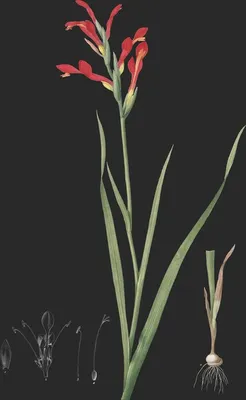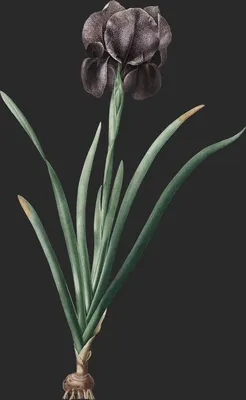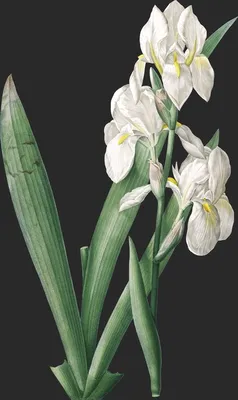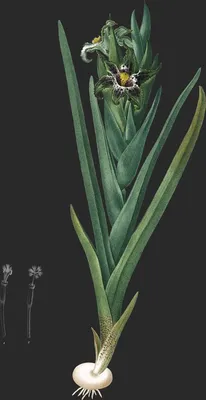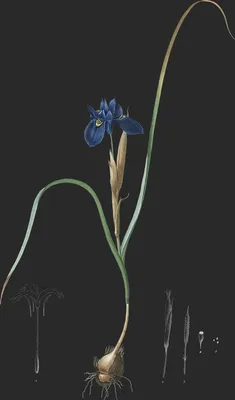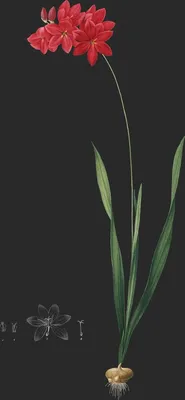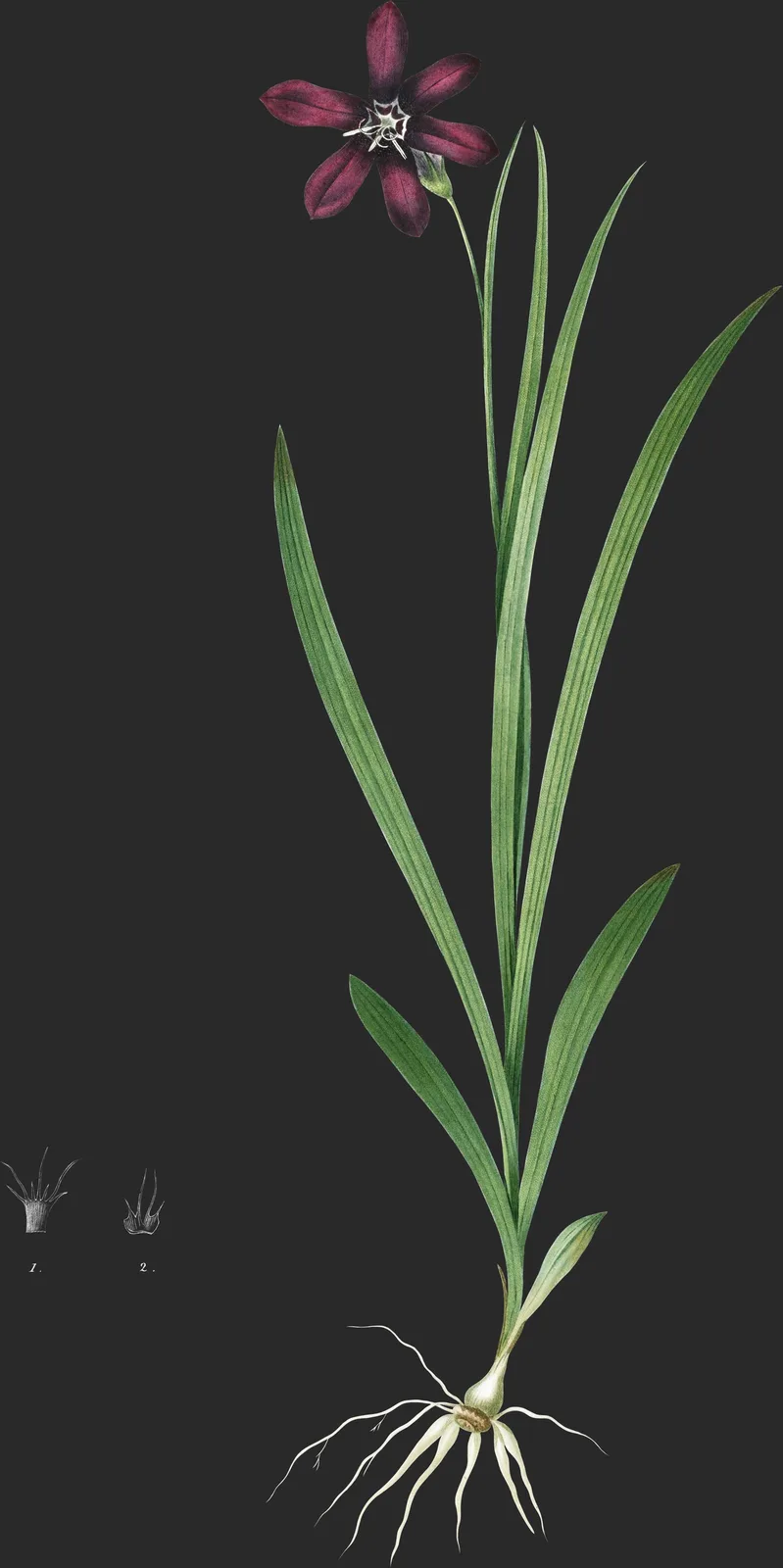
Ixia Grandiflora
Ixia a Grandes Fleurs
Ten ways of seeing
- measured cast crimson
- upright 2.00 : 1
First Look
真山水之川谷,远望之以取其势,近看之以取其质。
—— 宋·郭熙《林泉高致·山水训》
Mountains and valleys: from afar take their momentum, up close take their texture — the two distances from which any picture is read.
The sheet is vertical: the eye climbs and settles in the upper half. Let the plant stand before you look for detail. Then step in close: watch where colour meets line, and whether the line ever breaks. Third, find where the green is deepest: the whole tonal order is measured from that patch.
Name and Thing
The binomial is Ixia grandiflora: the first word is the genus it belongs among, the second the epithet that sets it apart. Here the epithet grandiflora means “large-flowered” — the name records the feature the namer noticed first. The older system filed it under Iridaceæ by overall affinity; Linnaeus, counting stamens only, placed it in Triandria — two ways of asking what a plant is. No established Chinese name exists, so it is cited by its binomial alone.
Form and Colour
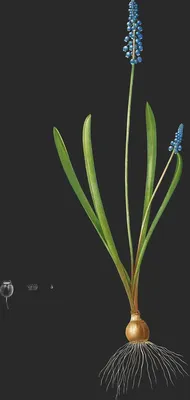
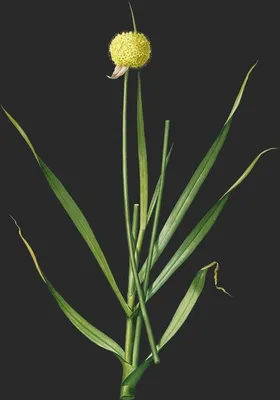
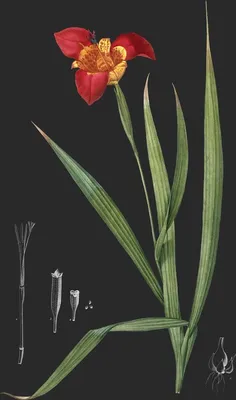
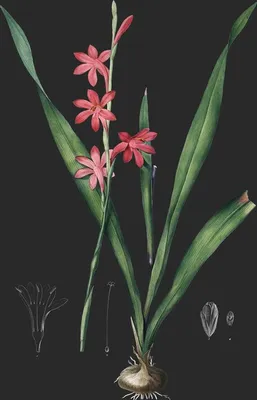
Measured on this plate: flower colour is sparing, 0.9% of the sheet against 6.8% of foliage, the cast tending crimson — as with pale or white blooms, outline and tone do the talking. Bulbous plants store the year underground — bulb, corm or tuber — then send up a few thick leaves and a single scape, with six tepals in cup, funnel or star. a moss green. A single plant, laid out with nothing hidden.
Composition
The sheet is tall. No details are appended: a plate for looking, not for keying out. The plant covers only 10% of the sheet, centred a little right of centre; the emptiness is where the eye rests.
Line and Colour
The first half of the nineteenth century moved from copper to steel to lithography; stipple could render the softest transition. Decide first whether it was printed or painted; only then discuss whether it is beautiful. If you mean to copy it: take its skeleton, its margins and the order of its colours; the burin's hatching is the language of copper — suggest it with pencil density, do not imitate it stroke for stroke.
Poetic Resonance
东风夜放花千树,更吹落、星如雨。
—— 宋·辛弃疾《青玉案·元夕》
East wind at night sets a thousand trees of flowers alight, then blows them down like rain of stars.
The poem gives the mood first and the picture supplies the form; set the line beside the plate and the green the corolla becomes its resting point.
Symbolism
The tulip was an imperial emblem in Istanbul and a speculative bubble in Amsterdam; the hyacinth sprang from a boy's blood in Greek myth. What bulbs share is concealment: next year kept underground. Flower language was added later; the flower knows nothing of it, and that innocence is part of its power.
Season and Place
Early spring to early summer, genus by genus: tulips and hyacinths first, gladiolus and amaryllis later. Three homelands: the Mediterranean, Central Asia and South Africa. The tulip came from Ottoman gardens and became a Dutch mania. The year 1812 on the plate is that of publication, not of flowering — the gathering came a year or two earlier. Read the locality and the flowering season both with a discount: one is hearsay, the other a ten-day peak.
The Book and the Hand
“The Liliaceae” carries only Pierre-Joseph Redouté's name. A plate is collective work: drawer, engraver and colourist were different hands, and the unnamed ones decided how good it looks.
What to Take Away
Next time you stand before a flowering plant, give it three minutes: leaf arrangement, direction of the flower, the darkest patch. The flower of that year is dust, yet its image on paper has outlived every living cousin.
About this plate
Observations
Quoique la plante dont nous donnons ici la figure nous paraisse une simple variété de celle que nous avons dejà décrite sous le même nom il y a quelques années, nous croyons utile de la faire connaitre, soit parce qu’elle offre des caractères assez prononcés, soit parce que cela nous donne occasion de faire quelques remarques sur les nombreuses variétés de l’espèce à laquelle elle appartient.
Elle est plus grele, dans toutes ses parties, que la variété multillore. Son tubercule radical n’est guère plus gros qu’un pois. Les feuilles supérieures sont linéaires étroites. La fleur est terminale. Outre les deux bractées membraneuses et profondément découpées qui embrassent son tube, il y en a une troisième latérale plus petite, foliacée, en forme d’alène, rétrécie à son sommet en un filament que termine un faisceau de cils. Les divisions du périgone sont très-étalées, oblongues, obtuses, un peu rétrécies dans le milieu de leur longueur, d’un beau violet uniforme, avee une tache irrégulière jaune à la base.
Cette variété, dont un individa a fleuri au mois d’avril dans les serres du Muséum d’Histoire naturelle, se rapproche, par sa tige uniflore, de celle que Miller a figurée, et dont Linné a fait son Ixia uniflora, mais elle en diffère par sa tige plus élancée, et par la forme plus rétrécie des divisions du périgone.
Nous avons observé dans le jardin impérial de Sevres trois autres variétés de la même espèce, qui toutes ont la tige chargée de deux ou trois fleurs moins ouvertes que celles de la variété dont nous donnons ici la figure.
L’une d’elles, dont la fleur est d’un beau violet, avec une tache blanche en forme de V à la base de chacune des divisions du périgone, a cela de parti-culier, que le style dépasse beaucoup les étamines.
Les fleurs de la seconde sont intérieurement d’un blanc jaunâtre. La partie moyenne de la face externe des divisions du périgone est rayée de violet: c’est celle dont M. Gawler a donné la figure dans le numéro 779 du Botanical Megazine.
Les fleurs de la troisième sont d’un blane lilas, du moins intérieurement. La face externe des divisions du périgone est plas ou moins violette. Les divisions sont terminées par ane petite pointe: à leur base est une tache violette en forme de V. Si l’on en excepte la forme de cette tache et le développement un peu plus grand de la petite pointe qui termine les divisions du périgone, cette variété ressemble en tout à celle que nous avons fait connaitre sous le nom d’Ixia liliogo, et que nous avons regardée dans le temps comme une espèce distincte de l’Ixia grandiflora: maintenant nous sommes presque certains que ce ne sont, ainsi que l’Ixia aristata de Thunberg, que de simples variétés d’une même espèce, qui doit conserver le nom d’Ixia grandiflora, plus exaet que celui d’Ixia uniflora donné par Linné, et plus ancien que celui d’Ixia aristata donné par Thunberg.
Fam. des Iris. Juss.—Triandrie monogynie. Lin.
- Ixia grandiflora. I. foliis subtiliter striatis, spathis aristato-laceris, tubo brevi, laciniis stellato patentibus oblongo-cuneatis apice rotundatis, staminibus lateralibus. Liliac. n. 139.
- Ixia aristata. I. foliis linearibus, spathis aristato-dentatis. Thunb. diss. n. 15.
- Ixia aristata. I. foliis ensiformibus, scapo subcompresso flexuoso, spathis mem-branaceis setaceo-laceris, corollæ tubo brevissimo. Vahl. enum. 2. p. 71.
- Ixia liliago. I. glabra, foliis ensiformi-linearibus planis scapo brevioribus, floribus magnis campanulatis, tubo brevissimo, laciniis oblongis basi maculatis. Liliac. n. 109.
- Sparaxis grandiflora. S. spathis lineatis, corollæ limbo regulari, laciniis obovato-oblongis. Ait. Kew. ed. alt. 1. p. 85.