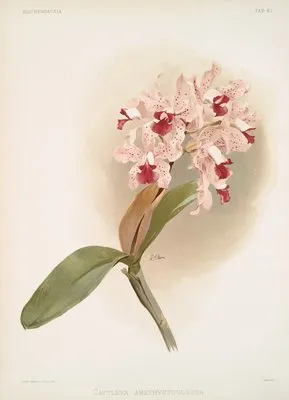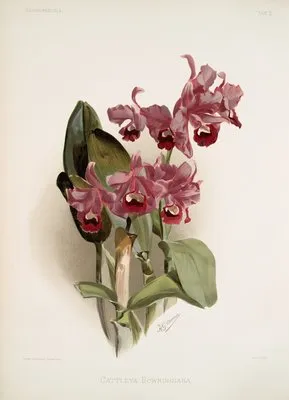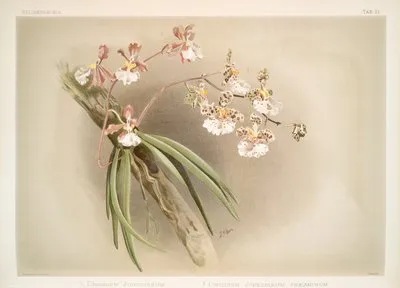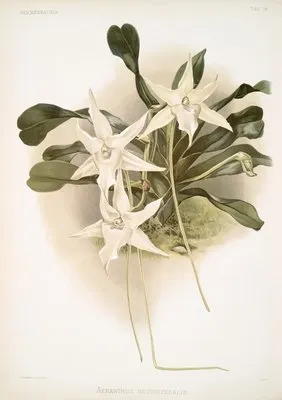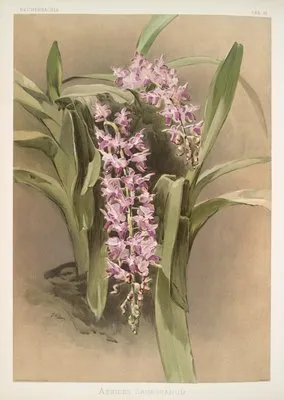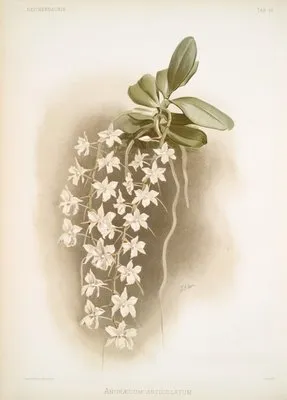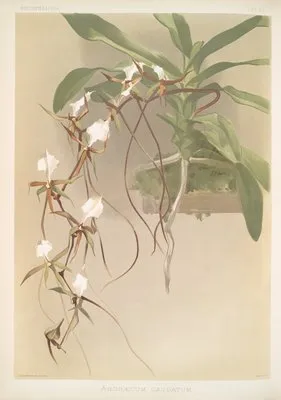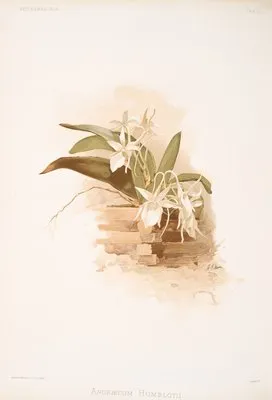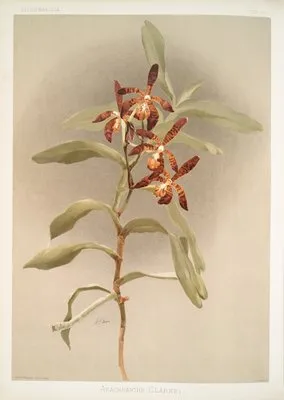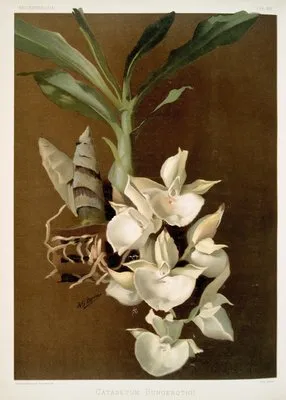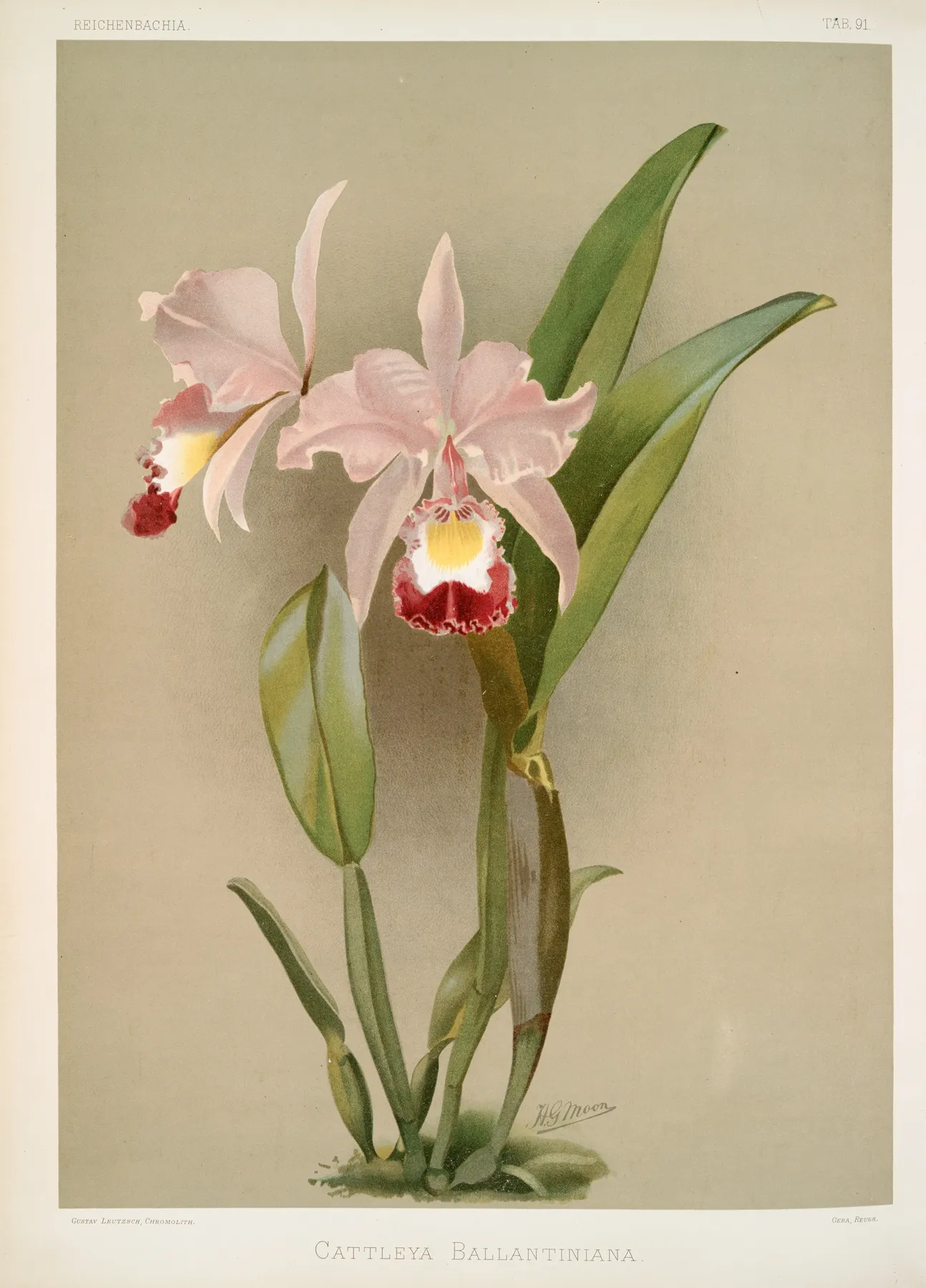
Cattleya ballantiniana.
蕾丽兰亚族
Cattleya ballantiniana.
About this plate
Cattleya ballantiniana. is plate 13, from Reichenbachia. Orchids, drawn by Frederick Sander. This public-domain plate is reproduced at high resolution, free to view and download. Publication: St. Albans, F. Sander & Co., 1888-1894.
Twelve ways of seeing
- measured cast amber
- upright 1.39 : 1
- published 1888
- Plate 13
Not a catalogue entry but a way of looking: how to stand, what to notice, how the line was cut, when it flowers, where it came from, who made it — and then the poems and the classics that taught China to see the same flower. Read the twelve in order and the plate opens.
-
First Look
真山水之川谷,远望之以取其势,近看之以取其质。
—— 宋·郭熙《林泉高致·山水训》
Mountains and valleys: from afar take their momentum, up close take their texture — the two distances from which any picture is read.
The sheet is vertical: the eye climbs and settles in the upper half. Let the plant stand before you look for detail. Then step in close: watch where colour meets line, and whether the line ever breaks. Third, find where the yellow is deepest: the whole tonal order is measured from that patch.
-
Name and Thing
The binomial is Cattleya ballantiniana: the first word is the genus it belongs among, the second the epithet that sets it apart. The genus name Cattleya: Cattleya honours William Cattley, who first flowered the plant in England. The Chinese name 蕾丽兰亚族 is a modern rendering of the Latin, not an old garden name.
-
Form and Colour
Measured on this plate: flower colour covers 66.9% of the sheet, foliage 2.5%, the cast amber with a second note of yellow-green. No other plate shares exactly this measure. Orchids carry pseudobulbs or fleshy roots; six tepals, one modified into a lip that serves as a landing stage, and a column uniting stamens and pistil — a structure unique to the family. Filed under yellow — a honey-yellow, built in washes from a pale ground. A single plant, laid out with nothing hidden.
-
Composition
Tall and narrow, the plant rising in one movement with generous margins — the upright format of most floras. (about 1.39 : 1) No details are appended: a plate for looking, not for keying out. The plant fills 77% of the sheet, centred near the centre — the herbarium way, drawn to be read whole. Old plates set the plant slightly off centre, with unequal margins — that small imbalance is what keeps it alive.
-
Line and Colour
In the later nineteenth century chromolithography took over: colour printed rather than painted, line demoted. There is evidence on the back too: the plate mark pressed into the paper, the slight relief of the pigment, lines worn shallow in a later printing.
-
Season
Varies by genus: temperate terrestrials flower in spring and summer, tropical epiphytes almost year-round. The year 1888 on the plate is that of publication, not of flowering — the gathering came a year or two earlier. The best time to read such a plate is its flowering season: three minutes under the tree explains what no text can.
-
Provenance
Worldwide, richest on tropical mountains. Chinese cymbidiums come from the hills of the south; the orchids drawn for European portfolios came largely from the cloud forests of Central America and Southeast Asia. In the same volume the kin are shelved together; set several plates side by side.
-
The Book and the Hand
“Reichenbachia. Orchids” was drawn by Frederick Sander and published 1888-1894. This plate is Plate 13. The image is public domain; the hand-colouring is still one person's hand.
-
Poetic Resonance
兰省花时锦帐下,庐山雨夜草庵中。
—— 唐·白居易《庐山草堂夜雨独宿寄牛二李七庾三十二员外》
The poem gives the mood first and the picture supplies the form; set the line beside the plate and the yellow the corolla becomes its resting point.
-
The Written Tradition
释名(闲)、木香、香水兰、女兰、香草、燕尾香、大泽兰、兰泽草、煎泽草、省头草、都梁香、孩儿菊、千金草。气味(叶)辛、平、无毒。
—— 本草纲目·兰草第九十三
Confucius, finding an orchid flowering alone in a valley, is said to have composed the 'Lament for the Orchid'; in the Li Sao, orchids are worn as a girdle of virtue. You need not parse every word: take the line, and the flower acquires a second face.
-
Symbolism
In China the orchid is the gentleman who blooms unseen; in Victorian Europe it was luxury and obsession, a single new species worth a fortune. This plate leans yellow, which in flower language adds one more degree of feeling. In a flora it is a species first and a symbol second; the order is worth keeping.
-
What to Take Away
Carry three rules away: whole before detail; line before colour; picture before book. A flora exists to be consulted; look long enough and you forget to consult — someone in 1888 gave a whole day to a single flower.