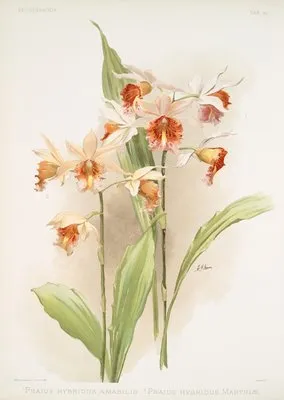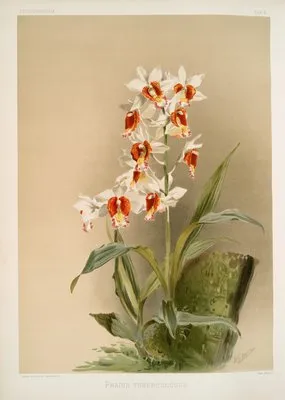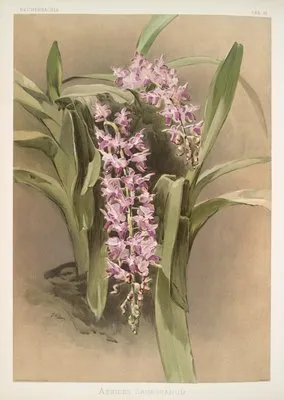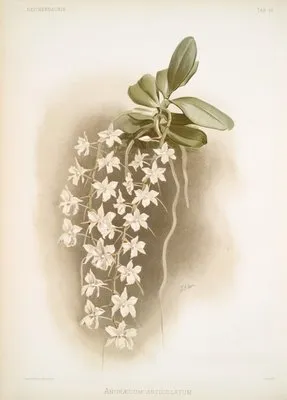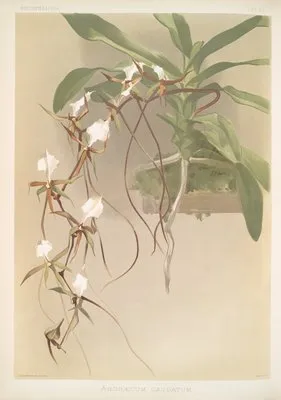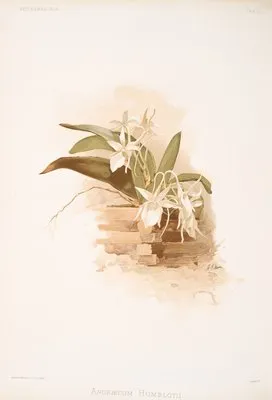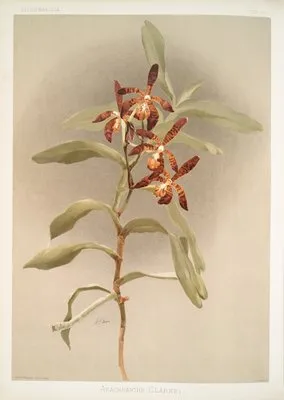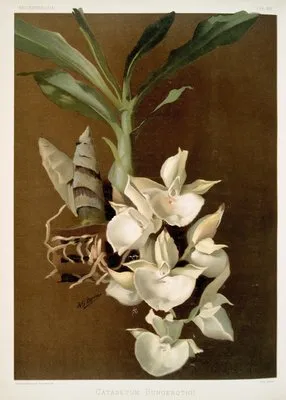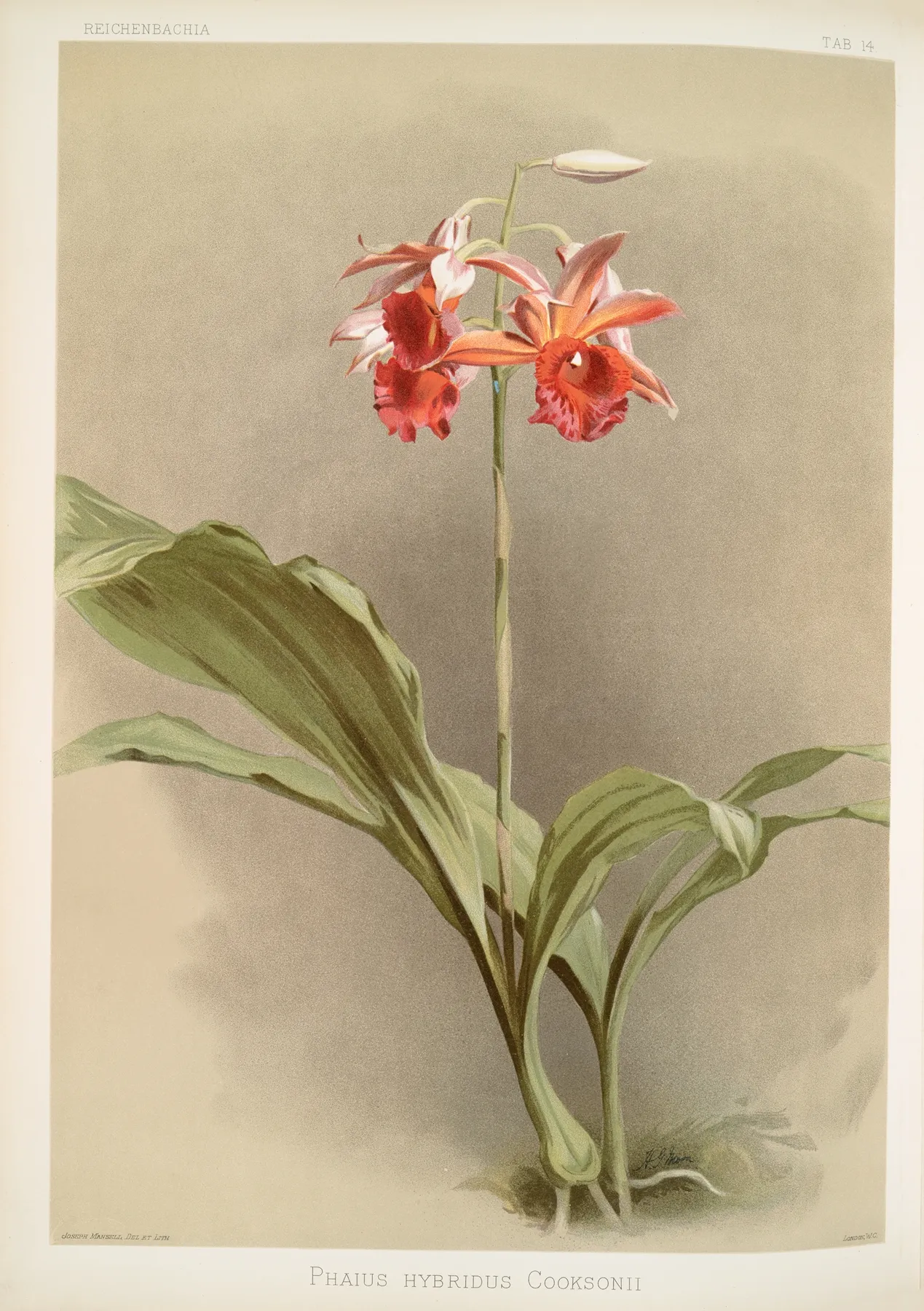
Phaius hybridus cooksonii.
虾脊兰属
Phaius hybridus cooksonii.
About this plate
Phaius hybridus cooksonii. is plate 162, from Reichenbachia. Orchids, drawn by Frederick Sander. This public-domain plate is reproduced at high resolution, free to view and download. Publication: St. Albans, F. Sander & Co., 1888-1894.
Twelve ways of seeing
One plate, read twelve times over: its name, its colour, the burin and the brush, the shape of the sheet, the season, the soil it came from, the book it belongs to, its language of flowers, the poem it answers to, the lore behind it, how to look, and what remains.
-
The Name
The plate is titled “Phaius hybridus cooksonii.”, numbered Plate 162. No reliable binomial survives on the plate, so it must be cited by its original title. The Chinese name 虾脊兰属 is a modern rendering of the Latin, not an old garden name — between a plant and its names there is always translation.
-
Form and Colour
Orchids carry pseudobulbs or fleshy roots; six tepals, one modified into a lip that serves as a landing stage, and a column uniting stamens and pistil — a structure unique to the family. Filed under yellow — a honey-yellow. The colour is built in washes: a pale ground first, then deepening at the petal base and in shadow. A single plant, laid out on the sheet with nothing hidden.
-
Line and Colour
In the later nineteenth century chromolithography took over: colour printed rather than painted, line demoted. Images grew more accurate and less personal. Look closely at the line and the colour: an unbroken line means engraving, colour crossing the outline by half a millimetre means hand-colouring. Craft leaves franker evidence than inscriptions.
-
Composition
Tall and narrow, the plant rising in one movement with generous margins above and below — the upright format of most floras. (about 1.42 : 1). No details are appended: this is a plate for looking, not for keying out.
-
Season
Varies by genus: temperate terrestrials flower in spring and summer, tropical epiphytes almost year-round. The year 1888 on the plate is the year of publication, not of flowering — the gathering came a year or two earlier.
-
Provenance
Worldwide, richest on tropical mountains. Chinese cymbidiums come from the hills of the south; the orchids drawn for European portfolios came largely from the cloud forests of Central America and Southeast Asia. The localities on the plate are those of a century ago; plants travel and places change their names.
-
The Book
“Reichenbachia. Orchids” was drawn by Frederick Sander and published 1888-1894. This plate is Plate 162. The image is in the public domain; the hand-colouring on the paper is still one person's hand, two centuries ago.
-
Symbolism
In China the orchid is the gentleman who blooms unseen; in Victorian Europe it was luxury and obsession, a single new species worth a fortune. This plate leans yellow, which in flower language adds one more degree of feeling. Meanings change their tune: the same flower can say opposite things within a century.
-
Poetic Resonance
扈江离与辟芷兮,纫秋兰以为佩。
—— 战国·屈原《离骚》
I gird on river angelica and secluded angelica; I twist autumn orchids into a chaplet to wear.
The poem gives the mood first and the picture supplies the form; set the line beside the plate and the yellow the corolla becomes its resting point.
-
Classical Lore
Confucius, finding an orchid flowering alone in a valley, is said to have composed the 'Lament for the Orchid'; in the Li Sao, orchids are worn as a girdle of virtue. Chinese flower books ranked plants by character; European floras described them by form and name. This plate belongs to the second tradition, yet bears reading by the first. Books fill in what the picture omits, and also hide what it shows: look first, read after.
-
How to Look
Start with the lip: its markings and curls identify the plant. Then the column — a clearly drawn column usually means the artist worked from a living flower. Stand back for the habit, step close for the meeting of line and colour.
-
Afterword
The flower of 1888 is dust, yet its image on paper has outlived every living cousin.