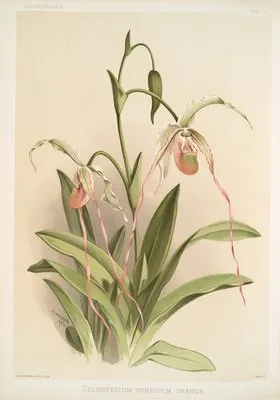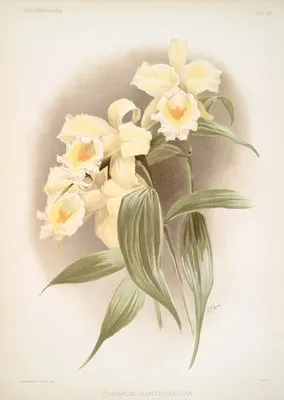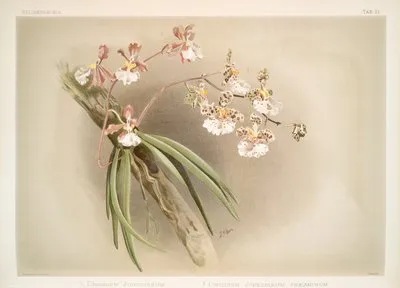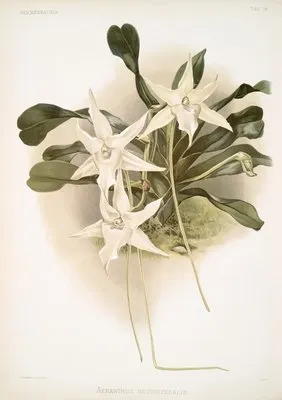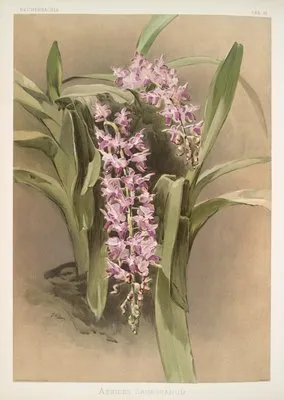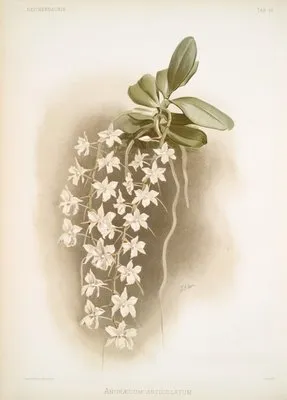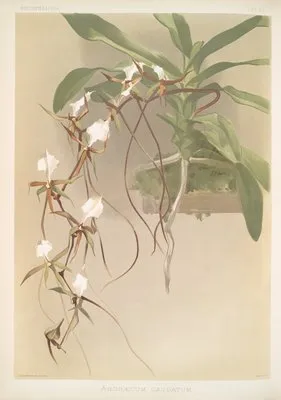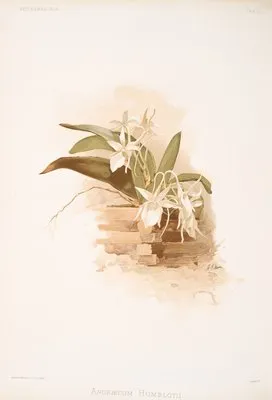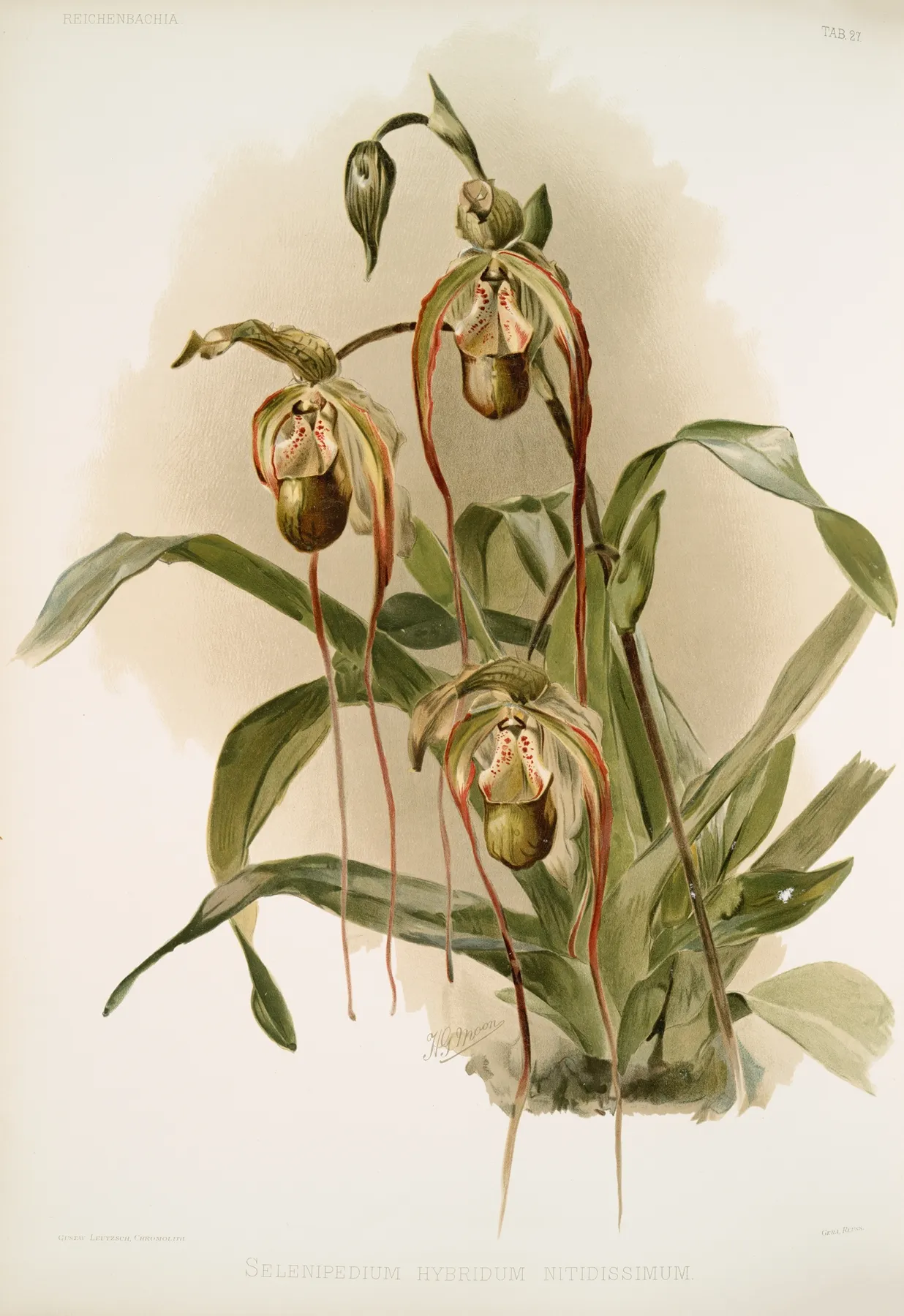
Selenipedium hybridum nitidissimum.
璧月杓兰属
Selenipedium hybridum nitidissimum.
Ten ways of seeing
- measured cast yellow-green
- upright 1.46 : 1
- published 1888
- Plate 176
First Look
江馆清秋,晨起看竹,烟光日影露气,皆浮动于疏枝密叶之间。
—— 清·郑板桥《题画竹》
On an autumn morning at the river lodge I looked at the bamboo: mist, sunlight, dew, all drifting among the sparse and dense leaves.
The sheet is vertical: the eye climbs and settles in the upper half. Let the plant stand before you look for detail. Then step in close: watch where colour meets line, and whether the line ever breaks. Third, find where the yellow is deepest: the whole tonal order is measured from that patch. The pose leans left: the upper half carries 9 points further left than the lower — a living thing, not a diagram.
Name and Thing
No reliable binomial survives, so the printed title must serve. The Chinese name 璧月杓兰属 is a modern rendering of the Latin, not an old garden name.
Form and Colour
Measured on this plate: flower colour covers 30.9% of the sheet, foliage 0.1%, the cast yellow-green with a second note of amber. No other plate shares exactly this measure. Orchids carry pseudobulbs or fleshy roots; six tepals, one modified into a lip that serves as a landing stage, and a column uniting stamens and pistil — a structure unique to the family. Filed under yellow — a honey-yellow, built in washes from a pale ground. Three things fix the habit: leaf arrangement, tepal count, and how the flower is borne.
Composition
Tall and narrow, the plant rising in one movement with generous margins — the upright format of most floras. (about 1.46 : 1) No details are appended: a plate for looking, not for keying out. The plant takes about 32% of the sheet, centred a little right of centre — the easy measure most florists kept to. Old plates set the plant slightly off centre, with unequal margins — that small imbalance is what keeps it alive.
Line and Colour
In the later nineteenth century chromolithography took over: colour printed rather than painted, line demoted. Decide first whether it was printed or painted; only then discuss whether it is beautiful. If you mean to copy it: block in the broad shapes and colours first, detail last; lithographic softness comes from thin washes — two or three pale layers will get you close.
Poetic Resonance
扈江离与辟芷兮,纫秋兰以为佩。
—— 战国·屈原《离骚》
I gird on river angelica and secluded angelica; I twist autumn orchids into a chaplet to wear.
The poem gives the mood first and the picture supplies the form; set the line beside the plate and the yellow the corolla becomes its resting point.
Symbolism
In China the orchid is the gentleman who blooms unseen; in Victorian Europe it was luxury and obsession, a single new species worth a fortune. This plate leans yellow, which in flower language adds one more degree of feeling. In a flora it is a species first and a symbol second; the order is worth keeping.
Season and Place
Varies by genus: temperate terrestrials flower in spring and summer, tropical epiphytes almost year-round. Worldwide, richest on tropical mountains. Chinese cymbidiums come from the hills of the south. The year 1888 on the plate is that of publication, not of flowering — the gathering came a year or two earlier. The bud and the ripe fruit on one branch tell the season; the name in the title often tells the journey.
The Book and the Hand
“Reichenbachia. Orchids” was drawn by Frederick Sander and published 1888-1894. This plate is Plate 176. The image is public domain; the hand-colouring is still one person's hand.
What to Take Away
Appreciation is not knowledge but habit — one more look each time. A flora exists to be consulted; look long enough and you forget to consult — someone in 1888 gave a whole day to a single flower.
About this plate
Selenipedium hybridum nitidissimum. is plate 176, from Reichenbachia. Orchids, drawn by Frederick Sander. This public-domain plate is reproduced at high resolution, free to view and download. Publication: St. Albans, F. Sander & Co., 1888-1894.