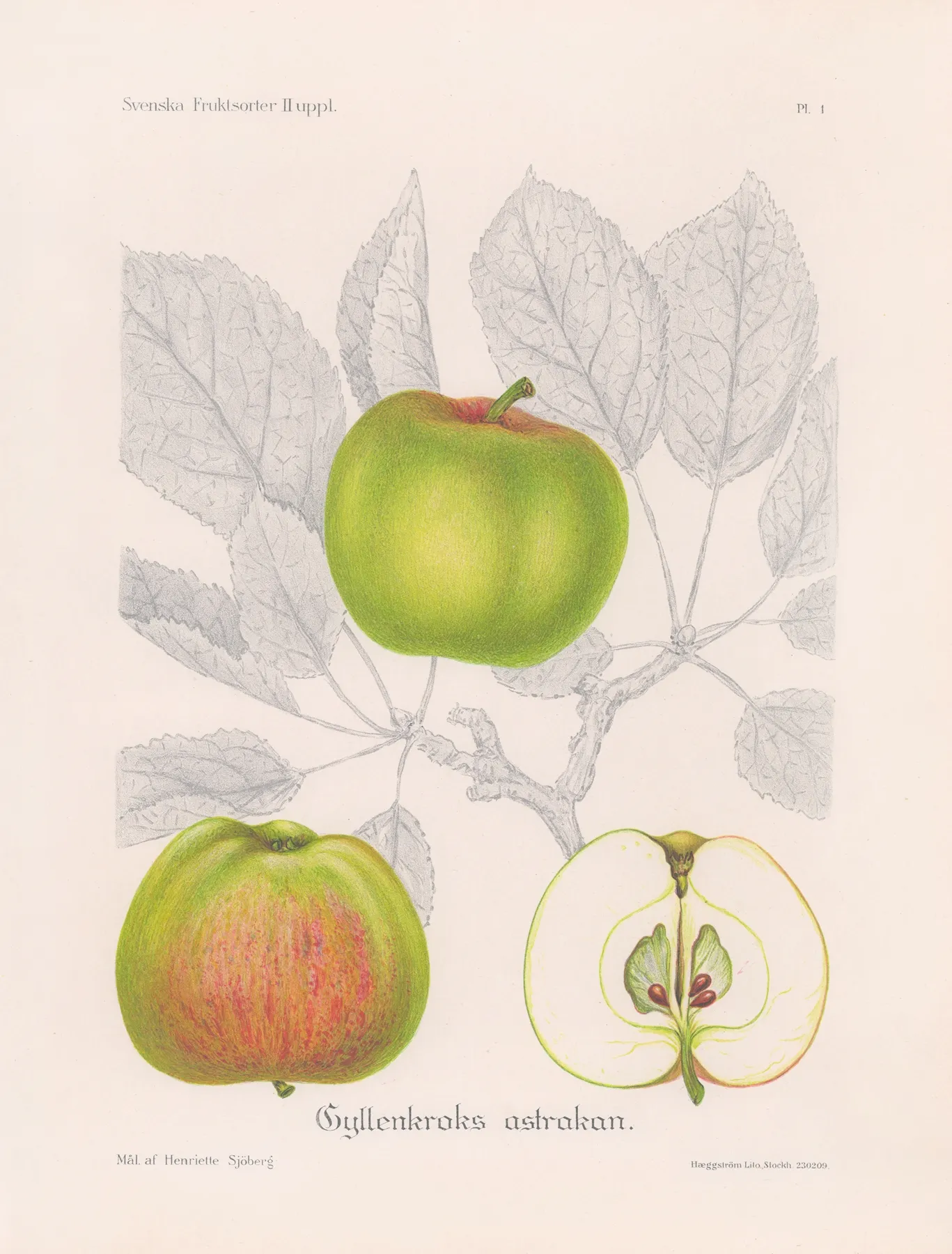
Gyllenkroks astrakan (1924)
Gyllenkraks astrakan|Svenska Fruktsorter II uppl. Gyllenkraks astrakan. Mäl. af Henriette Sjöberé Haæggströ
Gyllenkroks astrakan (1924)
Ten ways of seeing
- measured cast yellow-green
- upright 1.32 : 1
First Look
论画以形似,见与儿童邻。
—— 宋·苏轼《书鄢陵王主簿所画折枝》
To judge painting by likeness alone is the view of a child.
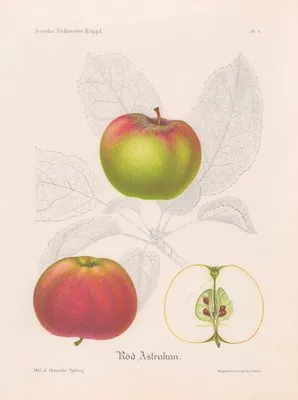
The sheet is vertical: the eye climbs and settles in the upper half. Let the plant stand before you look for detail. Then step in close: watch where colour meets line, and whether the line ever breaks. Third, find the darkest small patch: the whole tonal order is measured from there. The pose leans right: the upper half carries 10 points further right than the lower — a living thing, not a diagram.
Name and Thing
The binomial is Gyllenkroks astrakan: the first word is the genus it belongs among, the second the epithet that sets it apart. Two words carry a whole provenance. No established Chinese name exists, so it is cited by its binomial alone.
Form and Colour
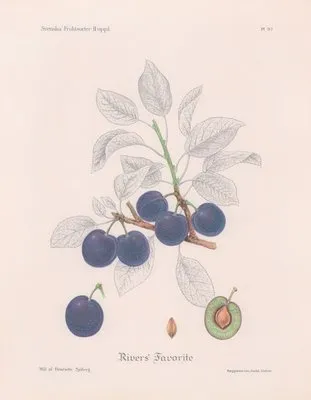
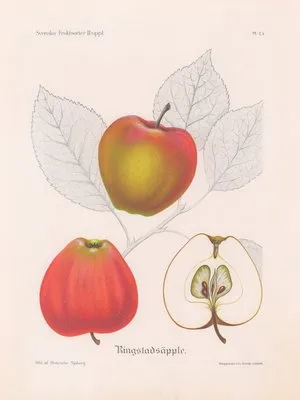
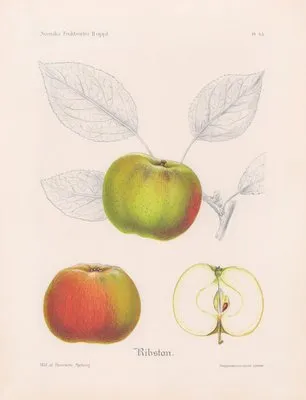
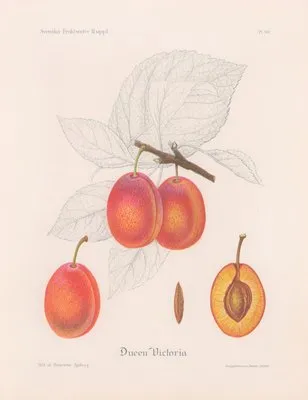
Measured on this plate: flower colour covers 10.4% of the sheet, foliage 2.5%, the cast yellow-green with a second note of amber. No other plate shares exactly this measure. Fruit plates pair the whole fruit with a section: the outline identifies the variety, the cut reveals skin thickness, core size and seed arrangement — the evidence of registration.No colour group is recorded. A single plant, laid out with nothing hidden.
Composition
The sheet is tall. No details are appended: a plate for looking, not for keying out. The plant covers only 19% of the sheet, centred a little left of centre; the emptiness is where the eye rests.
Line and Colour
After 1900 photography and colour reproduction ran alongside watercolour: accuracy rose, the cut of the burin disappeared. Take a loupe to three places: petal edge, leaf vein, caption. An unbroken line means engraving; colour crossing the outline means a hand. If you mean to copy it: this is a photomechanical record — match the colours directly, do not imitate the printing grain.
Poetic Resonance
一年好景君须记,最是橙黄橘绿时。
—— 宋·苏轼《赠刘景文》
Remember the best of the year: the time of yellow oranges and green tangerines.
The poem gives the mood first and the picture supplies the form; set the line beside the plate and the fruit becomes its resting point.
Symbolism
In China the pomegranate means many sons, the peach long life, the orange good fortune; in Europe the apple is temptation and knowledge, the grape abundance and sacrifice. Flower language was added later; the flower knows nothing of it, and that innocence is part of its power.
Season and Place
Late summer into autumn, variety by variety. Temperate fruits came mostly from Eurasia, later from the Americas. Nineteenth-century nurseries printed varietal albums for trade and exhibition: every fruit on the page was a saleable claim. The year 1924 on the plate is that of publication, not of flowering — the gathering came a year or two earlier. Read the locality and the flowering season both with a discount: one is hearsay, the other a ten-day peak.
The Book and the Hand
“Swedish fruit varieties (Svenska fruktsorter)” carries only Henriette Sjöberg's name. A plate is collective work: drawer, engraver and colourist were different hands, and the unnamed ones decided how good it looks.
What to Take Away
Appreciation is not knowledge but habit — one more look each time. A flora exists to be consulted; look long enough and you forget to consult — someone in 1924 gave a whole day to a single flower.
About this plate
Gyllenkroks astrakan (1924) is plate 83, from Swedish fruit varieties (Svenska fruktsorter), drawn by Henriette Sjöberg. This public-domain plate is reproduced at high resolution, free to view and download. Publication: Stockholm, P. A. Norstedt & Söners Förlag, 1924.