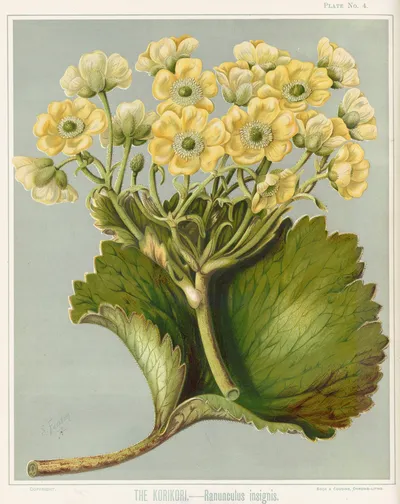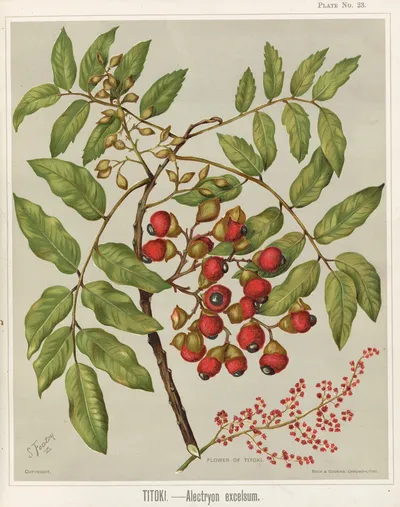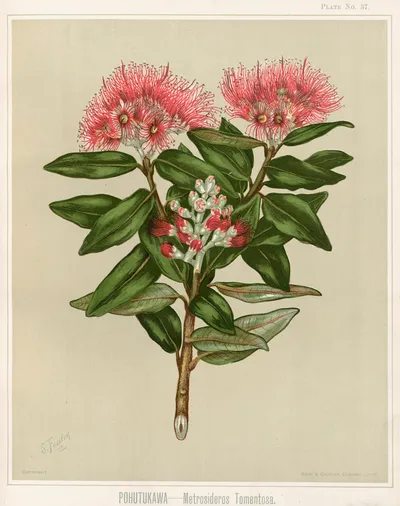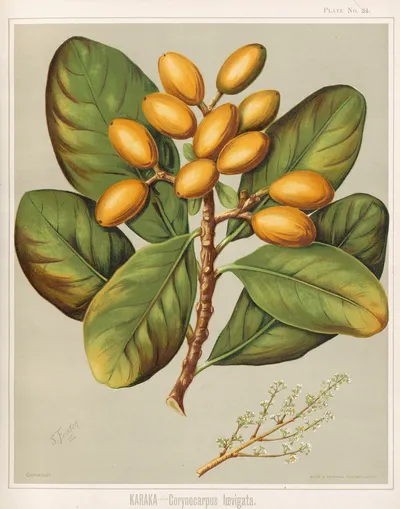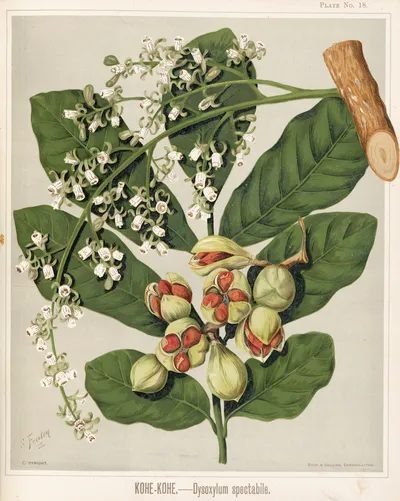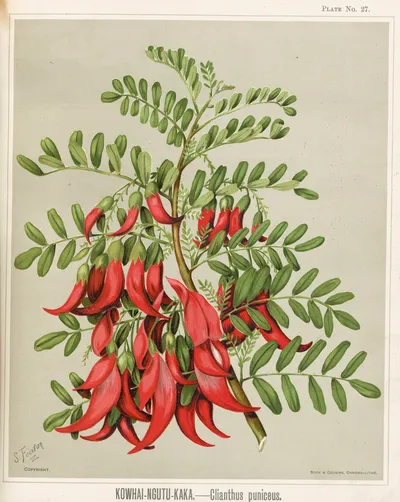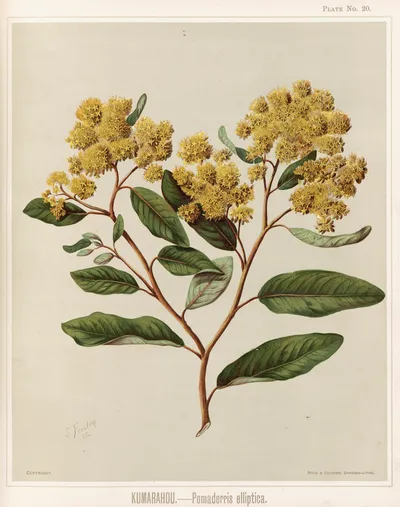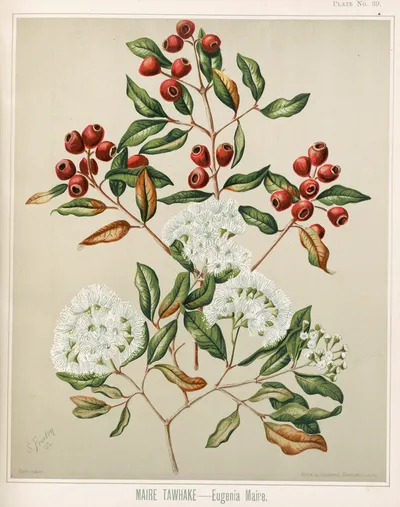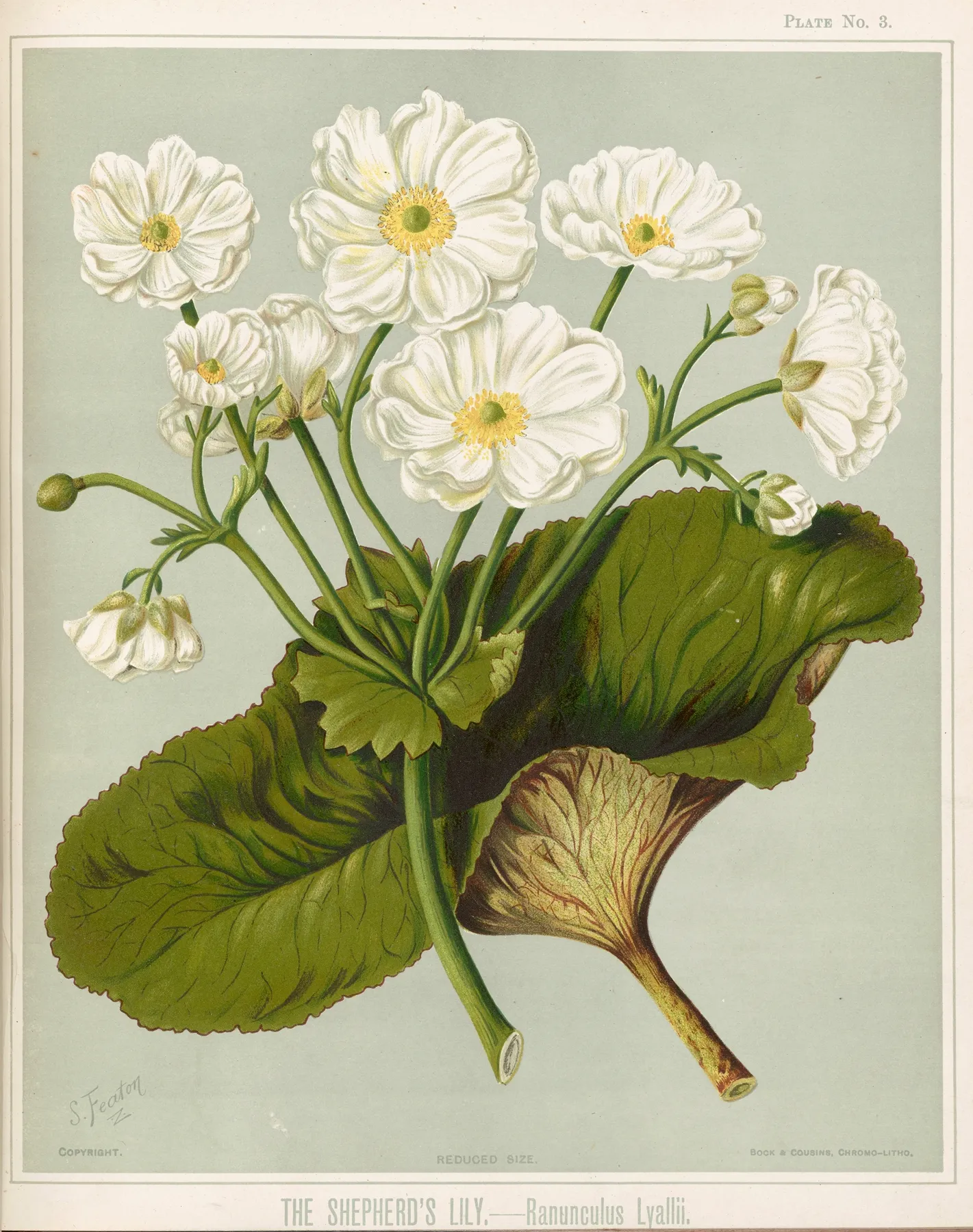
The Shepherd’s Lily. – Ranunculus lyallii. Plate 3
Ten ways of seeing
- slightly upright 1.27 : 1
First Look
搜尽奇峰打草稿。
—— 清·石涛《苦瓜和尚画语录》
Exhaust the strange peaks, and then make the sketch.
Slightly taller than wide; the eye lands above centre. Then step in close: watch where colour meets line, and whether the line ever breaks. Third, find the darkest small patch: the whole tonal order is measured from there.
Name and Thing
Only the genus Ranunculus is given; species-level names came later. No established Chinese name exists, so it is cited by its binomial alone.
Form and Colour
Bulbous plants store the year underground — bulb, corm or tuber — then send up a few thick leaves and a single scape, with six tepals in cup, funnel or star.No colour group is recorded. A single plant, laid out with nothing hidden.
Composition
Slightly taller than wide, the plant set a little above centre. No details are appended: a plate for looking, not for keying out. Blank paper is not unfinished work: it is where the eye rests.
Line and Colour
The exact date is lost. Woodcut before 1700, copper in the eighteenth century, steel and lithography from the 1820s, chromolithography by the century's end. Take a loupe to three places: petal edge, leaf vein, caption. An unbroken line means engraving; colour crossing the outline means a hand. If you mean to copy it: take its skeleton, its margins and the order of its colours; the burin's hatching is the language of copper — suggest it with pencil density, do not imitate it stroke for stroke.
Poetic Resonance
东风夜放花千树,更吹落、星如雨。
—— 宋·辛弃疾《青玉案·元夕》
East wind at night sets a thousand trees of flowers alight, then blows them down like rain of stars.
The poem gives the mood first and the picture supplies the form; set the line beside the plate and the corolla becomes its resting point.
Symbolism
The tulip was an imperial emblem in Istanbul and a speculative bubble in Amsterdam; the hyacinth sprang from a boy's blood in Greek myth. What bulbs share is concealment: next year kept underground. Flower language was added later; the flower knows nothing of it, and that innocence is part of its power.
Season and Place
Early spring to early summer, genus by genus: tulips and hyacinths first, gladiolus and amaryllis later. Three homelands: the Mediterranean, Central Asia and South Africa. The tulip came from Ottoman gardens and became a Dutch mania. No firm date survives, so the season is inferred from the subject. The bud and the ripe fruit on one branch tell the season; the name in the title often tells the journey.
The Book and the Hand
“The Art album of New Zealand flora” carries only Sarah Featon's name. A plate is collective work: drawer, engraver and colourist were different hands, and the unnamed ones decided how good it looks.
What to Take Away
Appreciation is not knowledge but habit — one more look each time. Look long enough at an old plate and you stop seeing the plant and start seeing the person who gave it a day.